What Is Skill Intelligence? A Guide for HR and L&D
Skill intelligence turns scattered talent data into a live map of what your workforce can actually do. A practical guide for HR and L&D leaders.

Everyone talks about becoming a skills-based organization. Skill intelligence is the layer that makes it real — and this is what HR and L&D leaders need to know.
Executive summary
Most organizations know who their people are. Far fewer know what their people can actually do. Job titles, org charts, and completed courses describe roles and activity — but they say almost nothing about verified capability. That gap is why so many workforce decisions still rely on assumptions rather than evidence.
Skill intelligence closes that gap. It is the discipline — and increasingly the technology — of continuously identifying, measuring, and mapping the skills present in your workforce, so that leaders can see what capability they have, what they are missing, and what to do next. Where a traditional HR system stores static data, a skills intelligence platform produces a living picture of capability that updates as people learn, work, and grow.
For HR and L&D leaders, skill intelligence is the foundation for everything a skills-based organization aspires to: better hiring, sharper internal mobility, targeted upskilling, and workforce planning grounded in evidence. This guide explains what skill intelligence is, why it matters now, and how to start building it.
What skill intelligence actually means
Skill intelligence is the ability to answer a deceptively simple question at scale: what can our people do? Not what their job description implies, not which courses they finished, but which capabilities they actually hold and to what level.
To answer that, a skills intelligence system does three things continuously. First, it identifies skills — extracting them from roles, work, learning history, and assessments rather than relying on employees to self-report a tidy list. Second, it measures proficiency, distinguishing awareness from working competence from genuine mastery. Third, it maps everything to a shared framework, so a skill means the same thing across teams, functions, and geographies.
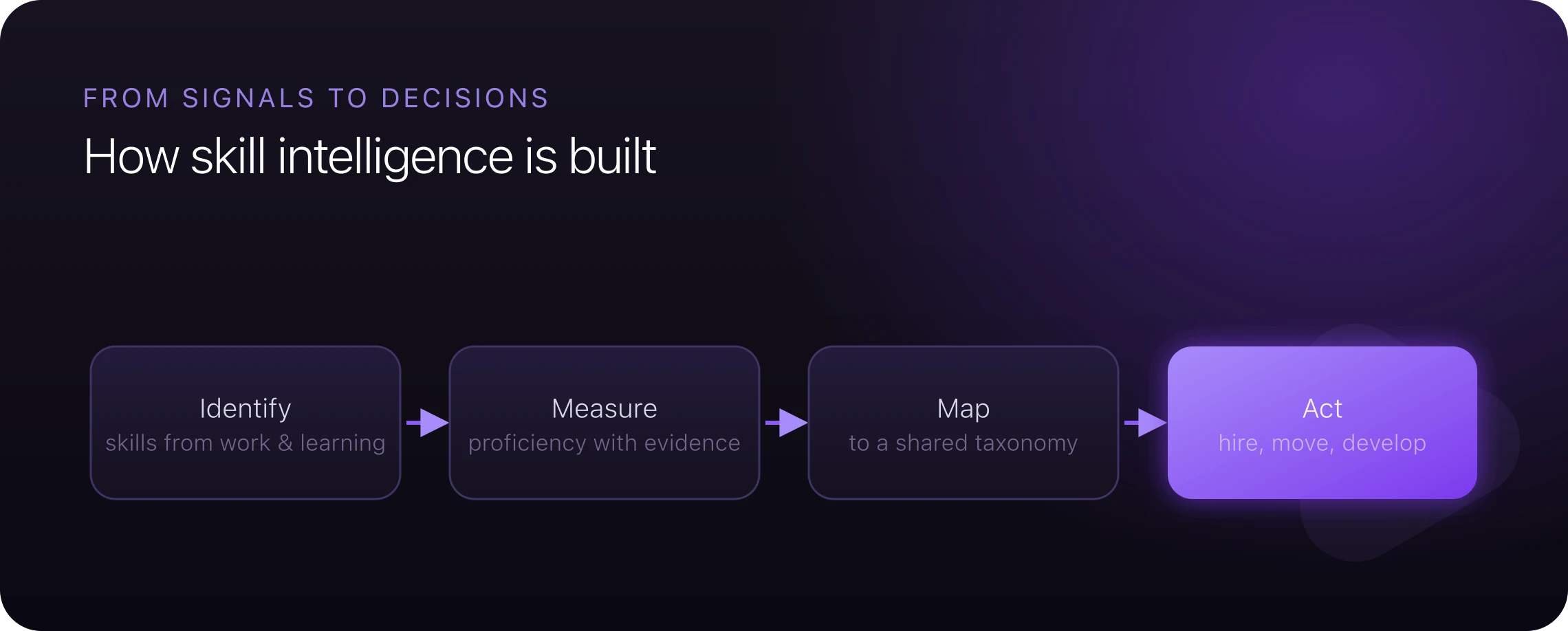
Identify, measure, map — then act. Skills data only earns its keep when a decision consumes it.
The result is a common language for capability. Once skills are named consistently and tied to verified evidence, they become data you can plan against — the raw material for a genuinely skills-based organization instead of a role-based one.
It helps to be precise about the term. Skills intelligence is not a survey you run once a year, and it is not a competency library sitting unused in a shared drive. It is a living system: skills flow in from many sources, proficiency is measured against a shared standard, and the picture stays current as the workforce changes. The word "intelligence" is doing real work here — the value is not in the raw data but in the ability to reason over it and act.
Why job titles and course completions fall short
For decades, workforce data has been organized around two proxies: the job someone holds and the training they completed. Both are convenient, and both are misleading.
Job titles compress enormous variation into a single label. Two people with the identical title can differ wildly in what they can do — one may be leading advanced work while the other is still ramping up. The title reveals none of that. Course completions have the opposite problem: they measure activity, not outcome. Finishing a course confirms that learning was delivered, not that a skill was acquired, retained, or can be applied under real conditions.
This is why an honest skills gap analysis so often surprises leadership. When you stop counting titles and completions and start measuring verified capability, the true shape of the workforce — its real strengths and its real risks — comes into focus, and it rarely matches the org chart.
The four building blocks of skill intelligence
A credible skills intelligence platform rests on four building blocks. Miss any one and the picture distorts.
A shared skills taxonomy
Everything starts with a common vocabulary. A skills taxonomy defines the skills that matter to your organization and how they relate to each other, so that "data analysis" or "stakeholder management" carries the same meaning everywhere. Without this shared reference, skills data fragments into thousands of inconsistent labels that cannot be compared or aggregated.
Verified proficiency, not self-assessment
Self-reported skills are a starting signal, but they are noisy — confidence and competence are not the same thing. Robust skill intelligence grounds proficiency in evidence: assessments, demonstrated work, and validated learning outcomes. Good skill assessment software is what turns a vague claim of "I know SQL" into a measured, comparable level of capability.
Continuous, dynamic data
Skills are not static. People learn, practice, and sometimes let capabilities lapse. A one-time skills audit is out of date the moment it is finished. Real skill intelligence refreshes as work and learning happen, so the map reflects the workforce as it is today, not as it was at the last review cycle.
Connection to business context
Skills data only creates value when tied to decisions — the roles you are hiring for, the projects you are staffing, the capabilities your strategy will demand in eighteen months. Skill intelligence links what your people can do to what the business needs, turning a capability inventory into a planning tool.
What skill intelligence makes possible
When these building blocks come together, a set of decisions that used to run on intuition can run on evidence instead.
Internal mobility improves because you can find the person who already has the capability — or is one step away from it — rather than defaulting to an external hire. Upskilling gets targeted because development is aimed at verified gaps that matter, not broadcast to everyone regardless of need. Workforce planning becomes proactive because leaders can compare the capabilities they have today against the capabilities strategy will require, and close the distance deliberately.
Hiring also sharpens. When you know precisely which skills a team is missing, you can define roles around genuine gaps instead of copying a stale job description. And AI readiness — the question every executive is now asking — becomes measurable rather than aspirational, because you can see which parts of the workforce actually hold the emerging skills the moment demands.
None of this is possible while capability remains invisible. Skill intelligence is what makes the workforce legible enough to act on.
How to start building skill intelligence
You do not need a multi-year transformation program to begin. The most effective path is incremental.
Start with a bounded, business-critical population — a function facing real change or a set of roles central to strategy — rather than boiling the ocean across the whole organization. Adopt or adapt an existing skills taxonomy instead of authoring one from scratch; the goal is a shared language, not a bespoke encyclopedia. Then establish a source of verified proficiency for the skills that matter most, so your first map rests on evidence rather than self-assessment.
From there, connect the picture to a real decision — a mobility program, a targeted upskilling initiative, a workforce plan — so skill intelligence proves its value early rather than becoming a data project with no owner. This shift is as much organizational as technical. Moving from managing headcount to developing capability is part of a broader evolution from human resources to human capability management, and skill intelligence is the operating layer that makes that evolution practical.
Common pitfalls to avoid
Two failure modes recur. The first is treating skill intelligence as a data-collection exercise: teams pour effort into building an exhaustive inventory that no decision ever consumes. Skills data that does not change a hiring, mobility, or development choice is overhead, not intelligence.
The second is over-reliance on self-assessment. It is fast and cheap, and it produces a map that feels complete while quietly encoding everyone's blind spots and biases. Verified proficiency costs more effort up front and is the difference between a picture you can trust and one that merely looks reassuring. Anchor the skills that matter most in real evidence, and let lighter signals fill in the periphery.
The Kampster Perspective
Skill intelligence is not a dashboard you buy and switch on. It is a continuous capability the organization builds — a shared language for skills, evidence-based proficiency, and a live connection between what people can do and what the business needs.
Kampster was built for that reality. Rather than storing static talent records, it treats capability as something to be surfaced, verified, and developed continuously — turning scattered signals from learning, assessment, and work into a picture leaders can actually plan against. In an era where the questions have shifted from "who did we train?" to "what are we capable of?", skill intelligence is the layer that lets HR and L&D answer with evidence instead of assumption. Organizations that build it will make better decisions about their people. Those that do not will keep managing titles while the real work of capability goes unseen.