Skills Gap Analysis: How to Find and Close Workforce Skill Gaps
A practical guide to skills gap analysis for L&D and executive leaders: how to map, measure, and close the skill gaps that hold your organization back.


A practical playbook for finding the workforce skill gaps that matter — and closing them before they cost you.
Executive summary
Every organization has skill gaps. The difference between resilient organizations and fragile ones is whether they can see those gaps clearly, prioritize the ones that matter, and close them faster than the business changes around them.
A skills gap analysis is the discipline that makes this possible. Done well, it moves L&D and workforce planning from anecdote and guesswork to evidence: this is the capability we have, this is the capability we need, and this is the distance between the two. Done poorly — or not at all — organizations invest in training that no one needed, discover critical shortages only when a project stalls, and watch strategic initiatives fail for reasons that had a name months earlier.
This guide walks through what a skills gap analysis actually is, why the traditional once-a-year approach no longer holds up, and a repeatable process for running one. The goal is not a report that sits in a shared drive. The goal is a live, decision-ready view of workforce capability that leaders can act on.
What a skills gap analysis actually measures
At its simplest, a skill gap analysis compares two things: the skills your workforce has today, and the skills your strategy requires — now and over the next 12 to 24 months. The gap is the difference.
That sounds obvious, but most organizations struggle because they only ever measure one side of the equation. They know what training they delivered and who attended. They rarely know what people can actually do as a result. Attendance is not capability. A completed course is an input; a verified, applied skill is the outcome that matters.
A credible workforce skills gap analysis therefore has to answer three separate questions:
- What capability do we have? Not what we hoped people learned, but what is verified and observable in the work.
- What capability do we need? Tied to specific business goals, roles, and the technologies reshaping them — AI adoption chief among them.
- How wide, and how urgent, is the gap? A small gap in a mission-critical skill is more dangerous than a large gap in something peripheral.
The answers only become useful when they are specific. "We need better data skills" is not actionable. "Forty percent of our operations team cannot interpret a model's confidence score before acting on its output" is something you can build a plan around.
Why the annual skills audit no longer works
For decades, the skills audit was an annual event: a spreadsheet, a round of manager assessments, a summary slide. In a world where roles changed slowly, that cadence was defensible.
It is no longer defensible. AI and automation are rewriting job descriptions faster than annual reviews can track. A skill that was a differentiator eighteen months ago may now be table stakes, and a skill that did not exist two years ago may now be critical. By the time an annual audit is compiled, reviewed, and presented, the picture it describes is already out of date.
There is a second problem. Manual, manager-led assessments are inconsistent by design. Two managers rating the same competency will apply different standards, and self-assessment adds another layer of noise — people routinely over- or under-rate themselves. The result is a dataset that looks precise but rests on shaky foundations.
Modern skills gap analysis treats capability as something to be measured continuously and objectively, not surveyed once a year. That shift — from periodic audit to ongoing skill intelligence — is what separates organizations that merely describe their gaps from those that can actually manage them.
A five-step process for running a skills gap analysis
A useful analysis is a loop, not a project with an end date. Here is a process that holds up in practice.
Step 1: Anchor to business outcomes, not job titles
Start with what the organization is trying to achieve. An AI transformation, an expansion into a new market, a regulatory shift, a productivity target — each implies specific capabilities. Work backward from those outcomes to the skills that underpin them. This keeps the analysis focused on gaps that affect results, rather than producing an exhaustive inventory of every skill in the building. If a gap does not connect to an outcome someone cares about, it does not belong at the top of the list.
Step 2: Define the target state in concrete terms
For each priority area, describe what "good" looks like at the level of observable behavior. Which roles need which skills, and to what proficiency? Vague target states produce vague gaps. Concrete ones — expressed as what a person should be able to do, not what they should know — give you something measurable and give employees a clear picture of where they stand.
Step 3: Measure current capability objectively
This is where most analyses succeed or fail. Rather than relying on self-ratings or manager impressions alone, measure capability directly. Modern skill assessment software can verify what people can actually do, apply a consistent standard across teams and locations, and surface the difference between confidence and competence. Objective measurement is what turns a skills gap analysis from an opinion into evidence leaders will act on.
Step 4: Map and prioritize the gaps
With both sides of the equation in hand, the gaps become visible. Now rank them. Weigh each gap by two factors: how critical the skill is to a business outcome, and how urgent the timeline is. A large gap in a low-impact skill can wait. A modest gap in a skill your most important initiative depends on cannot. Prioritization is where analysis becomes strategy — it decides where finite budget and attention go first.
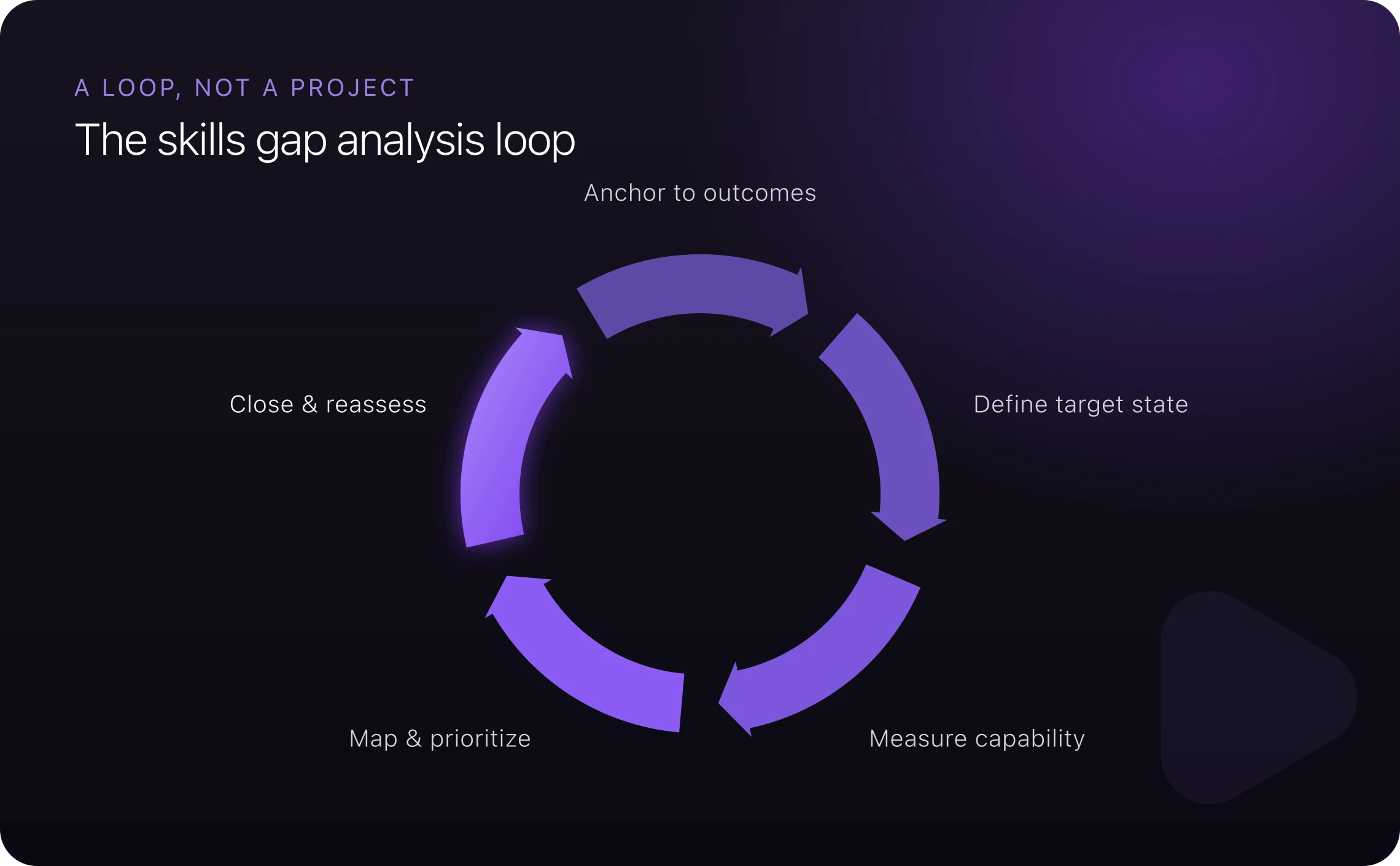
Step 5: Close the gaps, then measure again
Analysis without action is just an expensive way to feel informed. For each prioritized gap, choose the right closing mechanism: targeted upskilling & courses for gaps that development can address, internal mobility to move existing capability where it is needed, and hiring only for the gaps that cannot be closed fast enough from within. Then reassess. Because you measured objectively in step three, you can now show whether the gap actually narrowed — and that evidence is what earns L&D its next round of investment.
Common mistakes that undermine the analysis
A few failure patterns show up again and again:
- Measuring activity instead of capability. Completion rates and learning hours tell you what happened, not what changed. If your analysis is built on activity data, it is measuring the wrong thing.
- Boiling the ocean. Trying to assess every skill across every role produces a dataset too large to act on. Start with the gaps tied to your most important outcomes and expand from there.
- Treating it as a one-off. A single snapshot ages quickly. The organizations that benefit most treat gap analysis as a standing capability, refreshed as roles and strategy evolve.
- Stopping at the report. The analysis is a means, not an end. If it does not change what the organization does next — who gets developed, hired, or moved — it has failed regardless of how polished it looks.
What good looks like
When a skills gap analysis is working, the signs are unmistakable. Leaders can answer, in specific terms, what their workforce can and cannot do. Development budget flows toward the gaps that matter most rather than being spread evenly and thinly. When a new initiative is proposed, the capability question is answered with data before the project starts, not discovered mid-flight. And the organization can show, over time, that the gaps it set out to close are actually closing.
That state is achievable, but not with spreadsheets and annual surveys. It requires treating workforce capability as something you measure continuously and objectively — the same way you would never run finance on a once-a-year manual estimate.
The Kampster Perspective
We built Kampster on a simple conviction: organizations do not have a learning problem, they have a capability-visibility problem. Most already spend heavily on training. What they lack is a clear, current, evidence-based view of the gap between the capability they have and the capability their strategy demands.
A skills gap analysis is how that view gets built. But it only holds its value if it is continuous and objective rather than periodic and impressionistic. That is why Kampster combines verified assessment, skill intelligence, and targeted development in one place — so closing a gap and proving it closed are part of the same loop, not separate exercises. In the age of AI, the organizations that win will not be the ones that trained the most. They will be the ones that saw their gaps first and closed them fastest.