Why the Future of Human Resources Depends on Skill Intelligence, Not Job Titles
Most workforce decisions rest on job titles and self-assessments, not evidence. Skill Intelligence gives HR objective visibility into capability — and cuts the cost of getting it wrong.


The greatest workforce risk facing organizations today is not talent scarcity — it is talent invisibility.
Organizations invest enormous resources in hiring, promoting, relocating, and developing employees. Yet most workforce decisions are still based on incomplete information. Managers rely on CVs, interviews, years of experience, manager recommendations, and self-assessments. The assumption is simple: if someone says they possess a skill, they probably do.
Unfortunately, research and organizational practice suggest otherwise. Employees frequently overestimate or underestimate their abilities, managers often evaluate potential based on past performance rather than future capability, and organizations make critical talent decisions without a clear understanding of the skills they actually possess.
The result is costly. A poor hiring decision can cost tens of thousands of euros. A failed promotion can impact an entire team. A poorly planned relocation or project assignment can delay strategic initiatives and increase employee turnover. The problem is not a lack of talent — it is a lack of visibility into talent.
This paper explores why traditional Human Resources approaches are no longer sufficient and how Skill Intelligence is emerging as a critical capability for modern organizations.
The Talent Visibility Problem
Most organizations can answer basic workforce questions. They know how many employees they have, what positions they hold, what their compensation levels are, and how long they have worked for the company.
Far fewer organizations can answer questions such as:
- What skills do we actually possess?
- Where are our capability gaps?
- Who is ready for a leadership role?
- Which employees can transition into emerging positions?
- Which skills will become critical in the next three years?
This creates a dangerous blind spot. Human Resources teams are increasingly expected to support workforce planning, succession planning, AI readiness, internal mobility, organizational transformation, and talent development — yet many of these decisions are made without objective capability data.
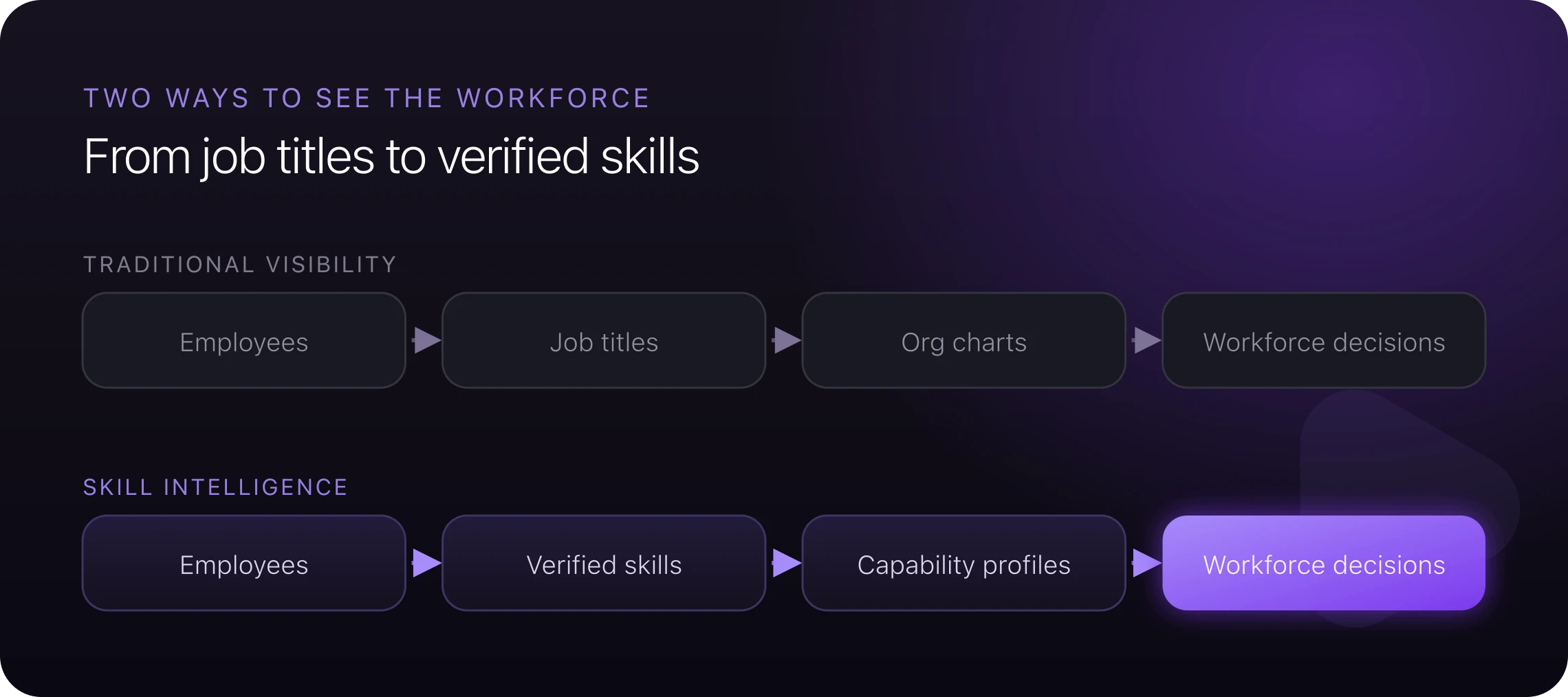
Same people, same decisions — but built on evidence instead of proxies.
The difference appears simple. Its impact is transformational.
The Cost of Poor Talent Decisions
Every workforce decision carries risk, and the larger the organization, the larger the consequences.
Hiring risk
Research consistently demonstrates that poor hiring decisions generate substantial costs: recruitment expenses, onboarding costs, management time, lost productivity, replacement costs, and team disruption. For professional and managerial roles, the cost of a poor hiring decision can easily exceed €30,000–€50,000 and in some cases reach multiples of annual salary.
The challenge is that hiring decisions are frequently based on proxies rather than evidence. A strong CV does not guarantee competence, and a successful interview does not guarantee performance. For Human Resources professionals, this creates one of the most expensive risks within the organization.
Promotion risk
Many organizations promote employees because they excel in their current role. However, success in one role does not automatically translate into success in another. A high-performing specialist may not become a successful manager, and a strong operational employee may struggle in a strategic role. When HR leaders promote based on assumptions rather than capability, they increase the likelihood of failure.
Mobility risk
Organizations increasingly rely on internal mobility and workforce redeployment. Employees move between projects, departments, functions, business units, and countries. The success of these transitions depends on understanding capability. Without visibility into actual skills, organizations risk placing the wrong people in the wrong roles.
The pattern is consistent: Poor visibility → poor decisions → poor performance → financial cost. Most organizations focus on the final outcome. Few address the root cause.
Why Self-Assessment Is Not Enough
Many organizations rely heavily on employee self-assessment, asking employees to rate themselves on competencies and skills. While useful, self-assessment has significant limitations.
Behavioral research has repeatedly shown that individuals often misjudge their own abilities. Some employees overestimate their competence; others underestimate their capabilities. Both outcomes create challenges for workforce planning. The famous Dunning-Kruger effect demonstrates that people with lower competence frequently overestimate their ability, while highly competent individuals often underestimate their relative performance.
For Human Resources departments, this creates a serious challenge. If employees cannot accurately assess themselves, organizations require more objective mechanisms for measuring capability. The greater the gap between perceived and actual capability, the greater the risk of poor workforce decisions.
From Human Resources to Human Capability Management
Historically, Human Resources departments focused on recruitment, payroll, compliance, administration, and performance management. These functions remain important. However, the competitive advantage of modern organizations increasingly depends on something else: capability.
As a result, Human Resources is evolving into Human Capability Management. The central question is no longer "How many employees do we have?" It is "What capabilities do we have, what capabilities are missing, and how quickly can we develop them?"
This shift is creating demand for entirely new tools, metrics, and workforce strategies. Skill Intelligence is becoming one of the foundations of this transformation.
The Rise of Skill Intelligence
Organizations are increasingly moving from job-based thinking toward skill-based thinking. Historically, work was organized around positions. Today, organizations increasingly recognize that competitive advantage depends on capabilities rather than titles. The critical question is no longer "What position does this employee hold?" but "What can this employee actually do?"
This shift is creating a new category of workforce management: Skill Intelligence. It provides organizations with visibility into existing skills, capability gaps, future readiness, development opportunities, and workforce potential. For HR leaders, this visibility creates the foundation for more accurate workforce decisions.
How Kampster Approaches Skill Intelligence
Kampster was designed around a simple principle: capability should be measured, not assumed. The platform combines several capabilities into one continuous model.
- Adaptive skill assessment — evaluating actual competence rather than perceived competence.
- Skill gap identification — identifying development priorities at both individual and organizational levels.
- Capability verification — providing objective evidence of skill acquisition and readiness.
- Workforce readiness analysis — helping organizations understand future capability requirements.
- Personalized development — creating targeted learning pathways based on actual needs.
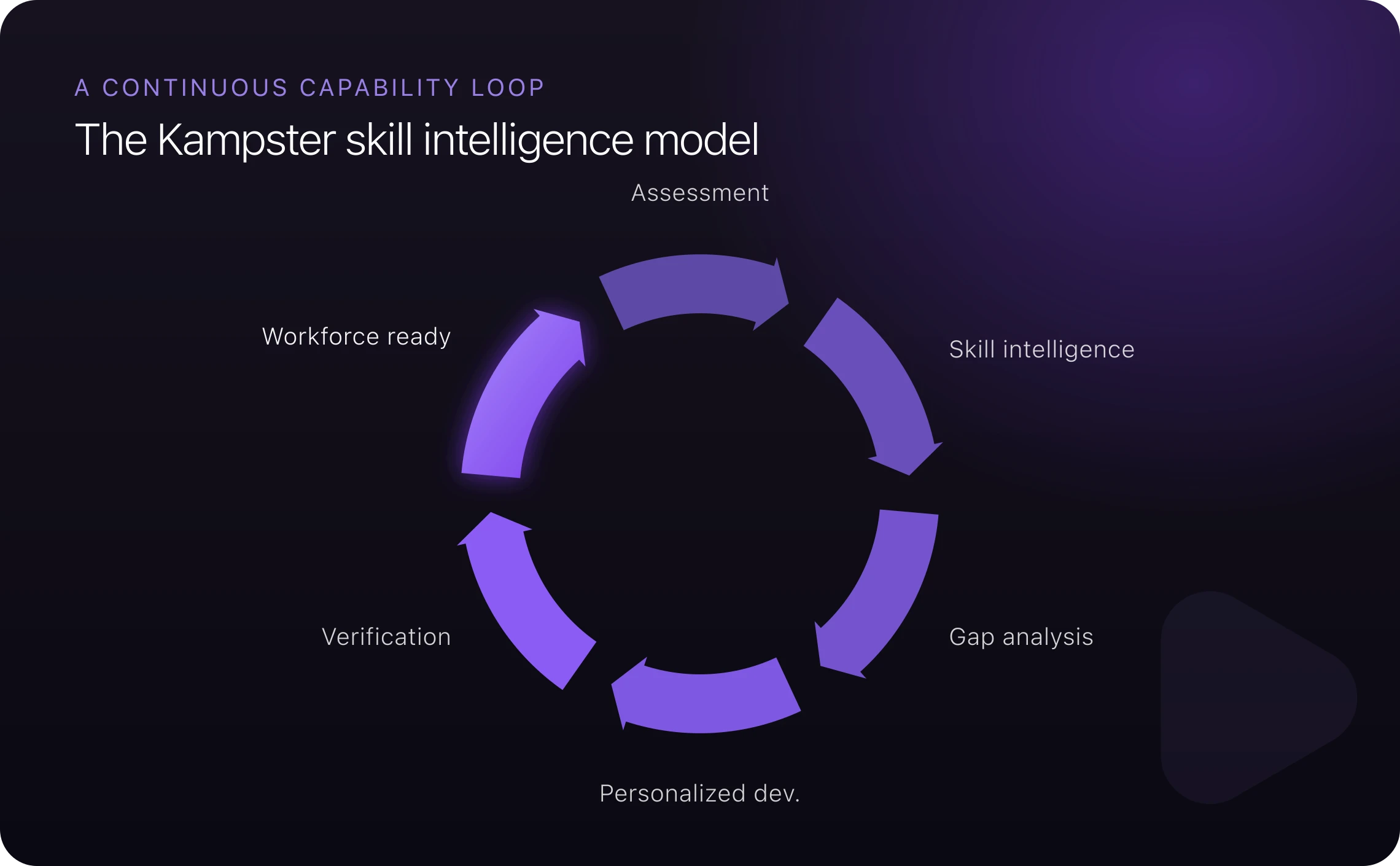
A continuous capability loop — from assessment to readiness, then back to the next assessment.
This creates a continuous capability development cycle rather than isolated training interventions.
Internal Mobility and Career Development
One of the most significant opportunities created by Skill Intelligence is internal mobility. Organizations frequently assume they need to hire externally to fill critical roles. In reality, the required talent often already exists within the organization — the challenge is identifying it.
Skill Intelligence enables Human Resources teams to:
- discover hidden talent
- identify high-potential employees
- support internal mobility
- accelerate succession planning
- reduce recruitment costs
This creates value for both employees and employers.
AI and Workforce Readiness
Artificial Intelligence is accelerating the need for capability visibility. Organizations are investing heavily in AI technologies, but technology adoption depends on people. The challenge facing HR leaders is increasingly clear: which employees are prepared for AI, which require development, and which capabilities will become critical in the future?
Without Skill Intelligence, these questions remain difficult to answer. With it, workforce readiness becomes measurable — moving from awareness to learning to skills to capability and, ultimately, business impact. This shift positions Human Resources as a strategic contributor to business transformation rather than a purely administrative function.
The Future of HR
The future of HR will not be defined by organizational charts. It will be defined by capability maps. The most successful Human Resources leaders will not simply manage employees — they will manage workforce capability.
They will understand what skills exist, what skills are missing, where potential resides, and how capability evolves over time. They will make workforce decisions based on evidence rather than assumptions, and they will increasingly rely on Skill Intelligence to do so.
The Kampster Perspective
The greatest workforce risk facing organizations today is not talent scarcity. It is talent invisibility. Organizations make critical decisions every day about hiring, promotion, mobility, succession, and workforce transformation — yet many of these decisions are made without a clear understanding of actual capability.
Skill Intelligence offers a new approach. By combining assessment, verification, capability analysis, workforce readiness measurement, and personalized development, organizations can improve the quality of workforce decisions while reducing risk and increasing organizational adaptability.
In a world increasingly defined by rapid change and AI-driven transformation, the organizations that succeed will not be those with the most employees. They will be those that best understand the capabilities of the people they already have. The future of Human Resources is not talent management — it is capability management, and Skill Intelligence is the foundation that makes it possible.
References
- World Economic Forum — Future of Jobs Report
- McKinsey & Company — Defining the Skills-Based Organization
- Deloitte — Human Capital Trends
- Harvard Business Review — The Skills-Based Organization
- Society for Human Resource Management (SHRM) — Cost of a Bad Hire
- Cappelli, P. — Skills-Based Hiring and Workforce Transformation
- Kahneman, D. — Thinking, Fast and Slow
- Kruger, J., & Dunning, D. — Unskilled and Unaware of It