From Human Resources to Human Capability Management
The next decade won't be about managing people, but about managing capability. Why HR is shifting from job titles to skill intelligence and capability visibility.


Why the next decade will not be about managing people, but about managing capability.
Executive Summary
For more than a century, Human Resources has played a critical role in organizational success. The function evolved from personnel administration to talent management, workforce planning, leadership development, and employee experience. Yet a fundamental assumption has remained largely unchanged: organizations manage people through jobs. Employees are hired into positions, developed through roles, promoted through organizational hierarchies, and evaluated through performance frameworks.
This model worked well in a world where jobs changed slowly and skills remained relevant for years. That world no longer exists. Artificial Intelligence, automation, digital transformation, and continuous technological disruption are reshaping work faster than organizations can redesign job descriptions.
As a result, a new management challenge is emerging. Organizations no longer need to understand only who their employees are. They need to understand what their employees are capable of becoming. This shift marks the transition from Human Resources to Human Capability Management — a transformation that may become as significant as the emergence of Human Resources itself.
The End of the Job-Centric Organization
For decades, organizations have been structured around jobs. Workforce planning begins with positions. Recruitment targets vacancies. Learning programs support roles. Career development follows organizational ladders.
The traditional HR model runs Job → Employee → Training → Performance → Promotion, and it assumes relative stability. But stability is disappearing. The average employee today will use technologies in five years that do not yet exist. Entire categories of work are being transformed by AI. New roles emerge faster than traditional HR processes can adapt.
The question is no longer "What role does this person have?" The question increasingly becomes "What capabilities does this person possess?"
The Capability Economy
For decades, organizations competed through assets. Then they competed through information. Then through technology. Today, a new competitive advantage is emerging: capability.
Technology can be purchased. AI can be licensed. Information is universally available. Human capability remains difficult to build. The evolution of competitive advantage runs Assets → Information → Technology → Capability.
Organizations are increasingly realizing that workforce capability is becoming as important as financial capital. The challenge is that most organizations have very limited visibility into capability.
The Capability Blind Spot
Most organizations know how many employees they have, what positions exist, how much they spend on salaries, and where employees are located. Far fewer organizations know what skills they possess, where critical expertise resides, which capabilities are missing, who is ready for future roles, and how prepared they are for change. This creates what can be described as a Capability Blind Spot.
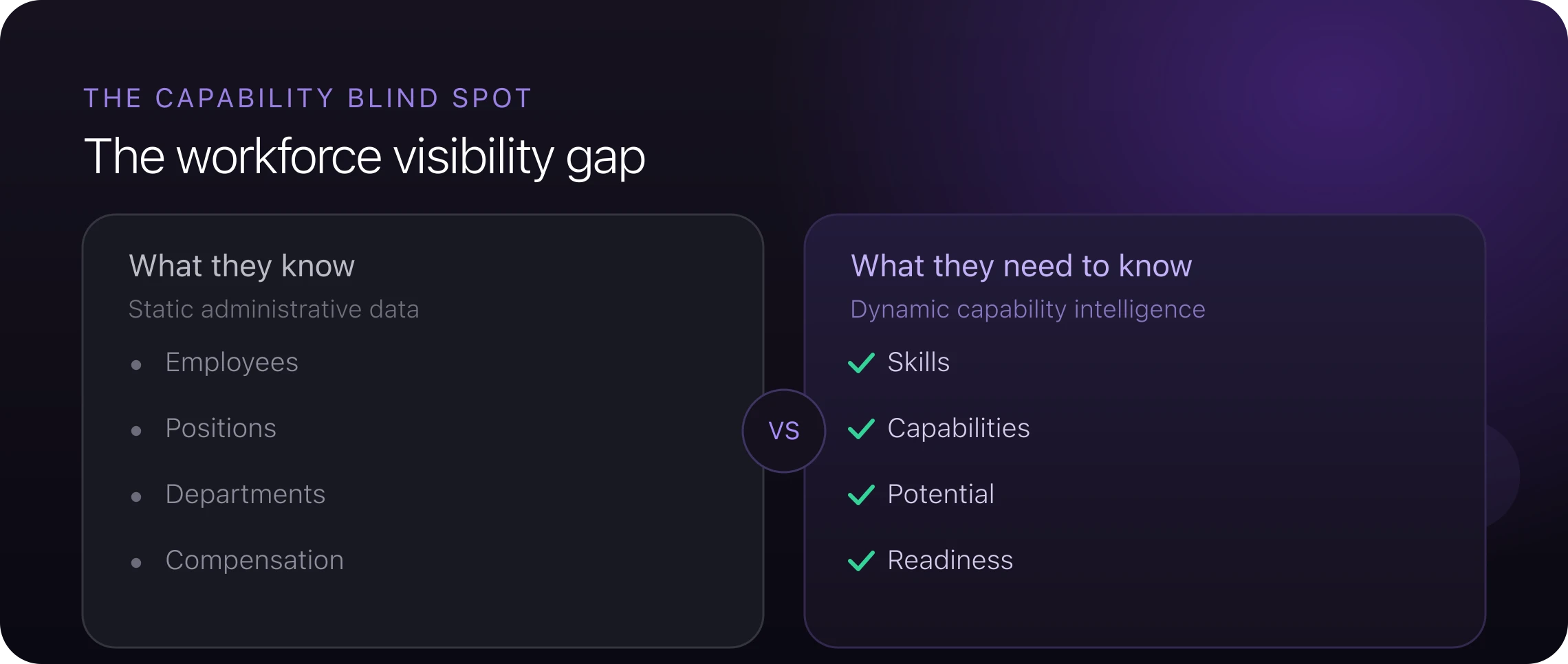
The larger this gap becomes, the greater the organizational risk.
Why Traditional Talent Management Is No Longer Enough
Traditional talent management focuses on managing people. The future requires managing capability. These are not the same thing.
People are relatively static data points. Capabilities are dynamic. Capabilities grow, decline, evolve, and become obsolete. The workforce challenge of the AI era is not simply having talent. It is understanding how capability changes over time.
The trajectory runs People management → Talent management → Capability management. Organizations that fail to make this transition risk making increasingly expensive decisions with increasingly limited visibility.
The Cost of Capability Blindness
The inability to understand workforce capability affects every major HR decision. Hiring is based on resumes, interviews, and assumptions. Promotion is based on past performance rather than future readiness. Internal mobility suffers because hidden talent remains undiscovered. Succession planning falters because future leaders are difficult to identify. AI transformation stalls because capability gaps remain invisible until implementation fails. And learning investments are deployed without understanding actual needs.
The cost chain is predictable: Poor capability visibility → Poor decisions → Capability gaps → Lower performance → Higher costs. Most organizations attempt to solve the symptoms. Very few solve the visibility problem itself.
The Rise of Skill Intelligence
To manage capability, organizations require a new layer of workforce visibility. This layer is Skill Intelligence, and it provides answers to questions traditional HR systems cannot answer.
Skill Intelligence builds from Assessment → Skill data → Capability intelligence → Strategic workforce decisions. Instead of focusing on job titles, organizations gain visibility into verified skills, capability gaps, readiness levels, development priorities, and workforce potential. This transforms workforce planning from assumption-based management into evidence-based management.
From Learning and Development to Capability Development
The same transformation is occurring within Learning and Development. Historically, L&D focused on training delivery, and success was measured through courses completed, learning hours, and certifications earned.
The future requires a different approach. The key question is no longer "How much learning occurred?" The key question is "What capabilities improved?" The progression runs Training → Learning → Skills → Capability → Business impact. Capability becomes the primary outcome. Learning becomes the mechanism.
Human Capability Management
Human Capability Management represents the next evolution of Human Resources. Its purpose is not simply to manage employees.
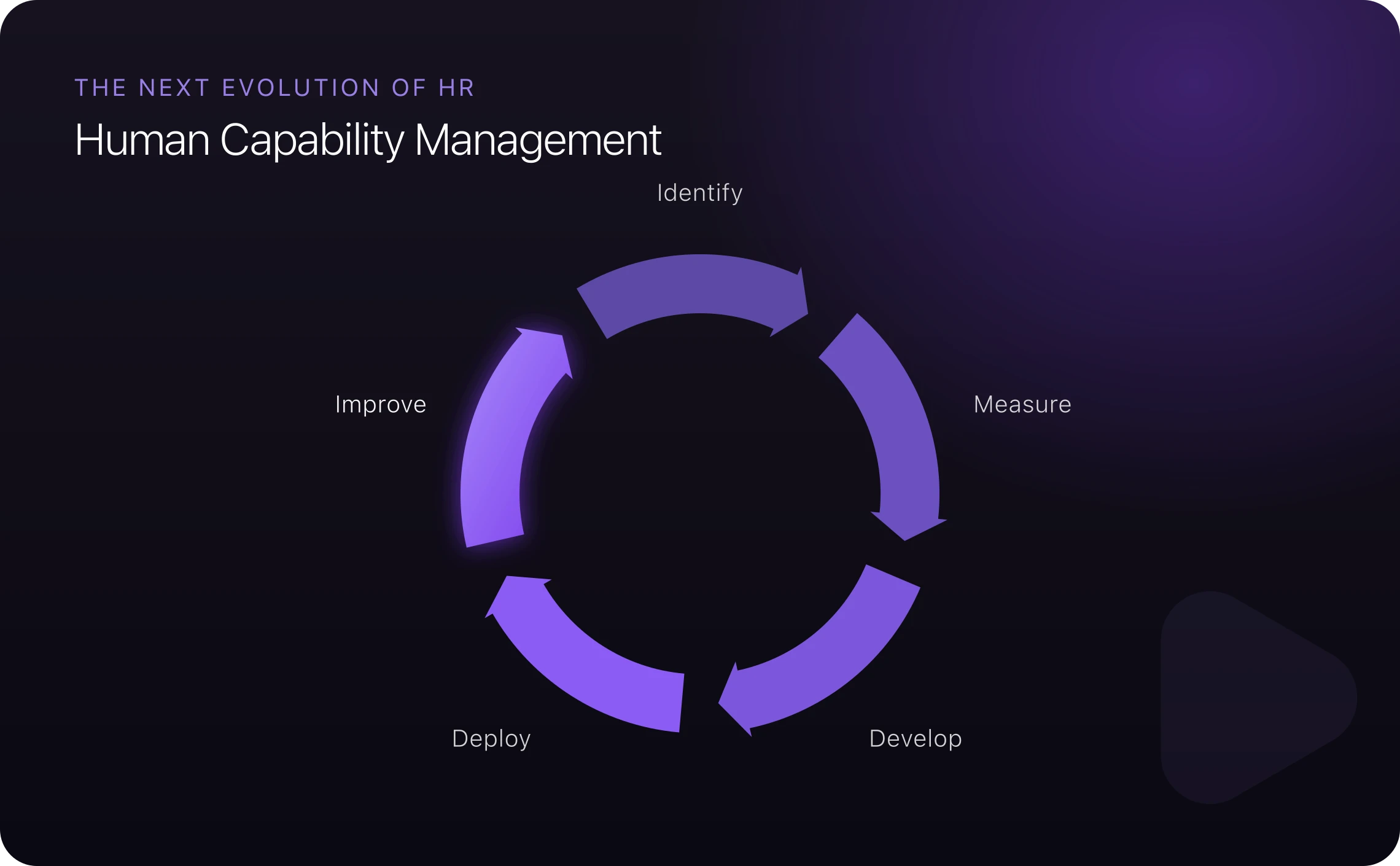
Not a one-off program but an ongoing cycle — capability is identified, measured, developed, deployed, and continuously improved.
This creates a continuous cycle of workforce development aligned with business needs.
Why AI Accelerates This Shift
Artificial Intelligence is increasing the importance of capability management. As routine work becomes automated, uniquely human capabilities become more valuable. Organizations increasingly need visibility into adaptability, critical thinking, problem solving, leadership, AI literacy, and digital fluency.
These capabilities cannot be managed effectively through job descriptions alone. They require continuous measurement and development. The chain runs AI adoption → Capability requirements → Capability visibility → Capability development → Business transformation. The organizations that master this process will gain a significant competitive advantage.
The Kampster Perspective
At Kampster, we believe the future of Human Resources lies beyond workforce administration and beyond traditional talent management. Organizations need systems capable of helping them understand and develop capability at scale.
This requires Skill Intelligence, Advanced Skill Assessment, Workforce Readiness Analysis, Personalized Development, Capability Verification, and Continuous Learning. The objective is not simply to manage employees. The objective is to create more capable organizations.
The Future of Human Resources
The next decade will fundamentally redefine the HR profession. The most successful HR leaders will not be those who manage headcount most efficiently. They will be those who understand capability most effectively. They will know what skills exist, what skills are missing, where potential resides, how capability evolves, and how quickly capability can be developed.
This shift represents a new operating model for workforce strategy — one built around capability rather than hierarchy.
Conclusion
Human Resources is entering its next chapter. The future will not be defined by organizational charts, job descriptions, or workforce administration. It will be defined by capability.
Organizations that continue managing people without understanding capability will struggle to adapt to accelerating change. Organizations that embrace Human Capability Management will gain a new level of workforce visibility, agility, and resilience.
The future of work is not about managing employees. The future of work is about understanding what people can become. And that future begins with capability.