How to Measure AI Literacy (and Why Self-Assessment Isn't Enough)
A practical guide to AI literacy assessment for L&D and HR: why self-ratings and completion metrics fail, and what a credible AI literacy test looks like.


Why self-ratings and course-completion dashboards can't tell you whether your workforce is actually AI-ready — and what a credible assessment measures instead.
Executive summary
Most organizations now agree that AI literacy matters. Far fewer can say, with evidence, how AI-literate their workforce actually is. The gap between the two is where risk lives.
The instinctive way to measure AI literacy — asking people to rate their own confidence, or counting who finished the training — feels efficient and produces clean dashboards. It also produces numbers that are largely disconnected from real capability. Self-assessment is distorted by the well-documented tendency of the least skilled to overrate themselves, and completion metrics confirm attendance, not competence.
For L&D and HR leaders, the practical question is not whether to measure AI literacy, but how to measure it credibly. This article covers why measurement can't be assumed, why the common proxies fail, what a defensible AI literacy assessment looks like, and how to turn results into targeted training and tracked progress over time.
Why AI literacy has to be measured, not assumed
AI capability is now a business input, not a nice-to-have. Employees use generative tools to draft, analyze, code, and decide — often without oversight, and often without knowing where the tools are unreliable. When you don't know your workforce's real level, you are exposed on several fronts at once: people over-trusting outputs they can't evaluate, sensitive data flowing into tools people don't understand, and productivity claims you can't substantiate.
Regulation is sharpening the point. The EU AI Act's Article 4 obligation on AI literacy expects organizations to ensure staff have a sufficient level of AI understanding relative to their roles. "We ran an awareness webinar" is not the same as "we can demonstrate role-appropriate competence." One is an activity; the other is evidence. Increasingly, only the second will hold up.
Measurement also changes how you spend. Without a baseline, AI training is a broad, undifferentiated cost — the same generic module pushed to everyone, whether they're a data scientist or a first-time prompt writer. With a baseline, training becomes an investment you can target and defend. If you haven't yet aligned on the underlying concept, it's worth being precise about what AI literacy is before you try to quantify it, because you can only measure what you've defined.
Why self-assessment and completion metrics fail
The two most common ways organizations "measure" AI literacy are the two least reliable.
Self-assessment measures confidence, not capability. When you ask people to rate their AI skills on a scale, you're measuring self-perception — and self-perception is a poor proxy for competence. Decades of research in behavioral psychology show that people are weak judges of their own ability, and the effect is worst exactly where it matters most: those with the least skill tend to overestimate the most, because the knowledge needed to do the task is the same knowledge needed to recognize doing it badly. In AI specifically, fluency with a chat interface feels like competence, which inflates self-ratings further. The result is workforce data that looks precise and points in the wrong direction.
Completion metrics measure attendance, not learning. A 95% course-completion rate tells you people clicked through the material. It says nothing about whether they can spot a hallucinated citation, write a prompt that produces a usable result, recognize when a task shouldn't be delegated to a model, or handle confidential data appropriately. Completion is trivially easy to achieve and trivially easy to game; it's a compliance artifact, not a capability signal.
Both approaches share the same flaw: they measure a proxy that's convenient to collect instead of the thing you actually care about. And both create a false sense of safety — the dashboard is green while the underlying risk is untouched.
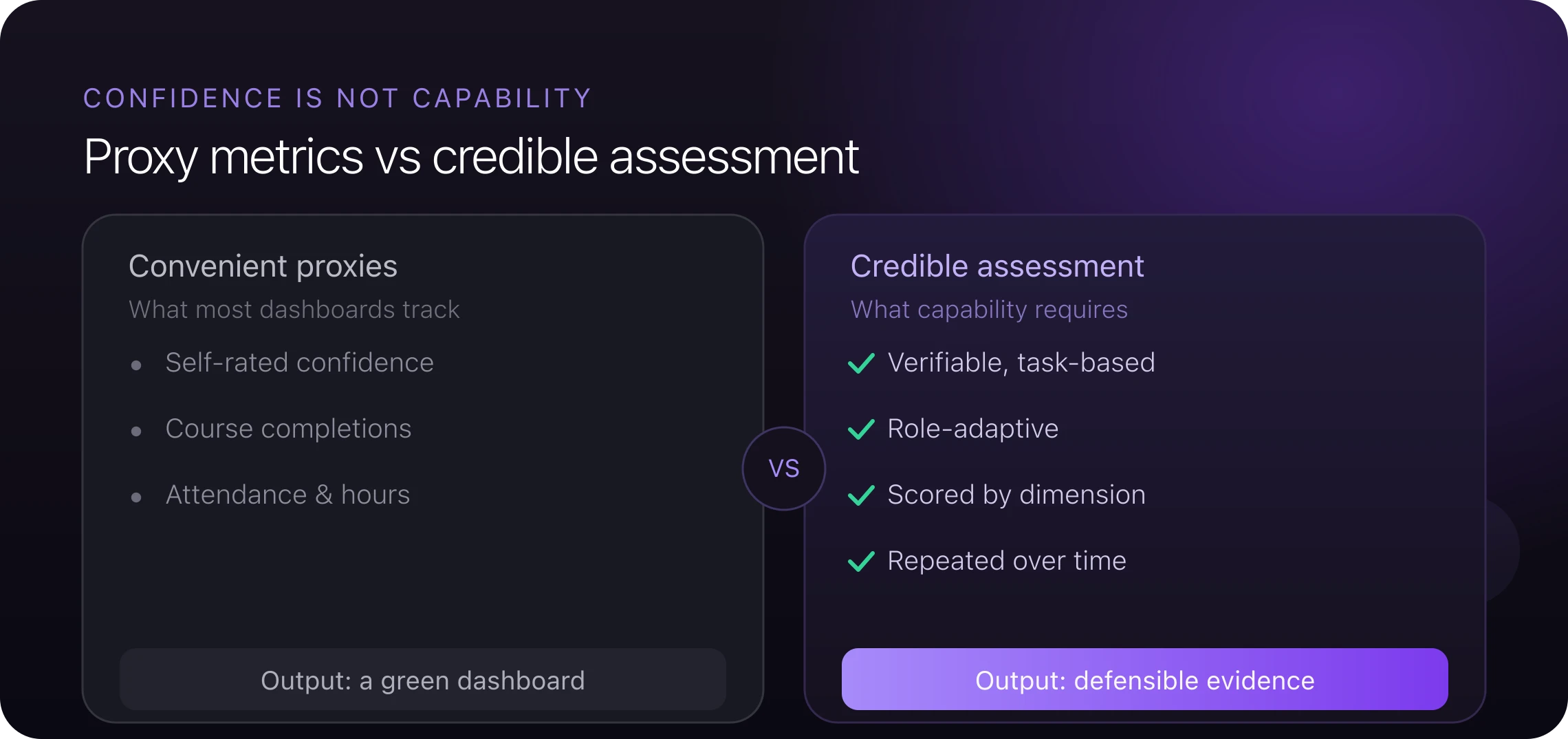
Proxies are convenient to collect; only assessment measures the thing you actually care about.
What a credible AI-literacy assessment looks like
If self-ratings and completion counts don't work, what does? A defensible AI literacy assessment has three properties.
It's verifiable, not self-reported
The assessment has to test what a person can do, not what they say they can do. That means task-based and scenario-based questions with objectively correct or clearly better answers — evaluate this AI output for reliability, choose the appropriate tool for this task, identify what's wrong with this prompt, decide whether this data can go into an external model. Because the results feed real decisions about training spend, compliance, and roles, identity matters too: an assessment someone can offload to a colleague or to a chatbot in another tab measures nothing. Proctoring and identity-verified skill assessments are what turn a score into evidence you can stand behind.
It's role-adaptive, not one-size-fits-all
AI literacy is not a single number. The competence a legal reviewer needs is different from what a marketer, a developer, or an executive needs. A credible assessment adapts to the person: it calibrates difficulty to their responses rather than handing a beginner and an expert the same fixed test, and it frames questions in the context of their role. Adaptive assessment also finds the true edge of someone's capability faster — the point where understanding stops — instead of just tallying correct answers on a static form.
It measures dimensions, not just a total
A single overall grade hides the information you most need. Useful assessment separates the components of AI literacy — foundational understanding of how these systems work and fail, practical prompting and tool use, critical evaluation of outputs, and safe, compliant, ethical handling of data and decisions. Someone can be strong at getting results from a model and weak at knowing when not to trust it. That profile is invisible in a total score and essential for deciding what to do next.
Turning results into targeted training
An assessment that ends in a score is a missed opportunity. The point of measuring is to act, and good measurement makes the action obvious.
When results are broken down by dimension and by role, gaps become specific and addressable. Instead of assigning the same generic AI course to the entire company, you can route people to the development they actually need: the team that scores well on prompting but poorly on output evaluation gets critical-appraisal training, not another prompting primer; the department handling sensitive data with weak safe-use scores gets governance-focused work first. Aggregate the same data upward and you can see which functions are ready to adopt AI at scale and which are a risk if they do — the difference between a targeted rollout and an expensive, undifferentiated one.
This is also where measurement pays for itself. Targeted training is cheaper and faster than blanket training, and it's more credible with the people taking it, because it's visibly matched to their real gaps rather than pushed at everyone regardless of level.
Tracking progress over time
AI literacy is not a state you reach once. The tools change monthly, the risks evolve, and a workforce that was current a year ago may not be now. Measuring once gives you a snapshot; measuring on a cadence gives you a trend — and trends are what let you manage.
A baseline assessment, targeted training, and a follow-up assessment close the loop: you can see whether capability actually moved, in which dimensions, and for which teams — not whether people liked the course. Over successive cycles this produces something most organizations lack entirely: a defensible record of AI capability over time, mapped to roles. That record is what satisfies a regulator asking for evidence of ongoing AI literacy, what tells the board whether the training budget is working, and what tells L&D where next quarter's effort should go. The reassessment isn't a fresh, disconnected test; it's the same measurement re-run, so the numbers are comparable and the progress is real.
The Kampster Perspective
The organizations that will use AI well are not the ones with the most enthusiasm or the highest completion rates — they're the ones who can see, in evidence, what their people can actually do with these tools. That visibility doesn't come from asking people how they feel about their skills or from counting who finished a module. It comes from verifiable, role-adaptive, multi-dimensional assessment, run as a repeated measurement rather than a one-off event.
Kampster was built around that conviction: identity-verified, adaptive assessment that measures real capability, feeds directly into targeted development, and tracks progress over time. If you want to move from assuming AI readiness to demonstrating it, our approach to AI literacy training and assessment is designed to give you the baseline, the gaps, and the evidence — not just another green dashboard.