AI Literacy Training for Employees: How to Build a Program That Works
A practical guide for L&D and HR: how to design AI literacy training for employees that changes behaviour, verifies capability, and survives real work.


A practical playbook for L&D and HR leaders who need AI literacy that shows up in the work, not just the LMS.
Executive summary
Every organization is now under pressure to make its workforce AI-capable. Most respond by buying a course, assigning it to everyone, and watching the completion rate climb. A few months later, adoption is patchy, risky prompting is everywhere, and leadership is asking why a fully trained workforce still can't use the tools.
The problem is rarely the content. It is the design. Generic, one-size-fits-all AI training treats literacy as a single event to be consumed rather than a capability to be built, verified, and maintained. An effective AI literacy program does three things a course cannot: it starts from a baseline of what people can actually do, it trains by role rather than by broadcast, and it verifies capability instead of assuming it.
This guide walks L&D and HR through building that program — the components, a phased rollout, how to measure impact, and the mistakes that quietly sink most efforts. If you first want to align on scope, it helps to be clear on what AI literacy is before you design training for it.
Why generic AI training fails
The default approach — one video course, pushed to the whole company — fails for structural reasons, not because the material is bad.
First, it ignores where people start. A data analyst who already prompts daily and a compliance officer who has never opened a chatbot sit through the same introduction. One is bored, the other is lost, and neither ends up more capable. Averages are the enemy of literacy.
Second, it teaches concepts, not behaviour. Employees can define "hallucination" on a quiz and still paste customer data into a public tool the next morning. Knowing about AI and being able to use it safely and effectively are different things, and only the second one moves the business.
Third, it measures the wrong thing. Completion tells you a video played to the end. It says nothing about whether a marketer can now draft a campaign brief with AI, or whether a manager can spot a fabricated citation. When the only metric is activity, the program optimizes for activity — and capability stays flat.
Fourth, it treats literacy as finished. The tools change monthly. A course recorded last quarter is already describing an older interface, and a workforce trained once drifts back to old habits within weeks. Literacy that isn't maintained decays.
The components of an effective program
An AI literacy program that actually changes how people work is built from a few interlocking parts. Miss one and the others weaken.
A shared baseline of AI fundamentals
Everyone needs a common floor: what generative AI is and isn't, where it's reliable and where it fabricates, how to write a clear prompt, how to verify an output, and what data must never go into a tool. This is the universal layer, and it should be genuinely universal — short, concrete, and free of hype.
Role-based application
On top of the shared floor, people need training in their own context. A recruiter learns to screen and draft without introducing bias; a finance analyst learns to summarize and model while checking every number; a customer-support agent learns to draft responses that stay on-policy. Generic literacy tells people AI exists. Role-based literacy tells them what to do with it on Monday morning.
Responsible use and governance
Data handling, privacy, bias, disclosure, and human oversight are not a separate compliance module bolted on at the end — they belong inside every role's training, framed as part of doing the job well. For many organizations this is also a legal requirement: EU AI Act Article 4 obliges providers and deployers to ensure a sufficient level of AI literacy among staff who operate these systems. Building governance into the program from the start turns an obligation into an advantage.
Verification, not just delivery
The component most programs skip is proof. If you cannot show that a person can perform a task with AI, you have delivered content, not capability. Verification — through applied assessment rather than recall quizzes — is what lets you tell leadership, and a regulator, that your workforce is genuinely prepared.
Reinforcement over time
Because the tools and the risks keep moving, literacy needs a maintenance layer: short, recurring nudges, updated examples, and periodic re-checks that keep capability from decaying and absorb new tools as they arrive.
A phased rollout: assess, train, verify
The sequence matters as much as the content. Running these three phases in order is what separates an AI upskilling effort that sticks from one that stalls.
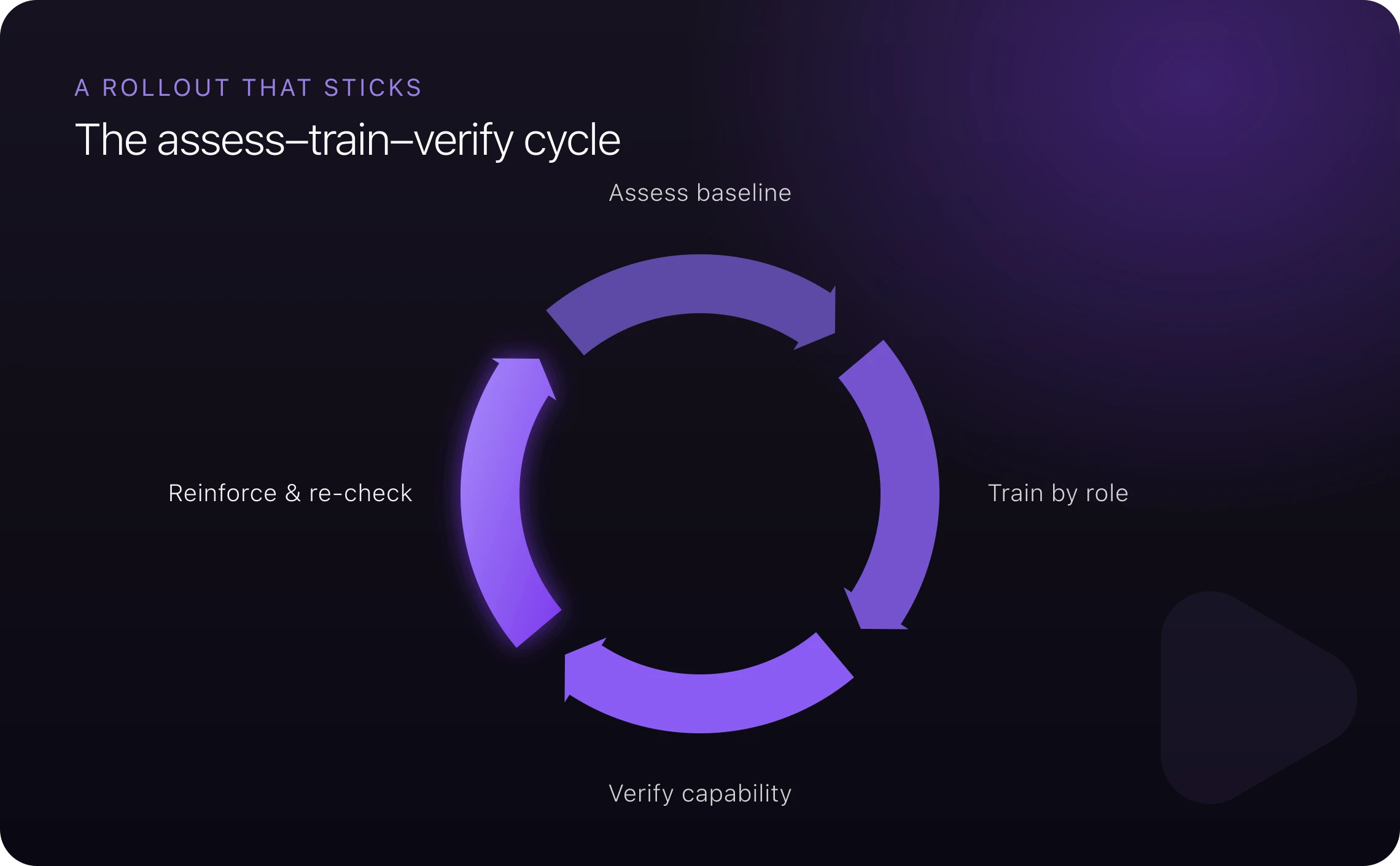
The rollout is a loop, not a campaign — each verification pass surfaces the gaps the next round of training closes.
Phase 1 — Assess the baseline
Start by measuring where the workforce actually is, before spending a cent on content. A short diagnostic across roles reveals the real distribution: who is already fluent, who is anxious, who is confidently wrong. This does two things. It stops you from training people on what they already know, and it gives you a before picture to measure impact against later. Segment the results by role and team so the training that follows can be targeted rather than broadcast.
Phase 2 — Deliver role-based training
Use the baseline to route people. The already-fluent get advanced, role-specific application and a governance refresher; the beginners get the shared fundamentals first, then their role layer. Keep sessions short, hands-on, and anchored in real tasks from each team's actual work — a support agent practises on real ticket types, not a toy example. Adaptive delivery matters here: the program should adjust to what each person demonstrated in the assessment rather than marching everyone through identical modules.
Phase 3 — Verify capability
Close the loop with proof. Re-assess against the baseline and, crucially, verify through applied tasks: can the person actually produce a safe, useful output in their domain? Verified capability is what you report upward and what satisfies regulators. It also surfaces the pockets that need another pass, turning the rollout into a cycle rather than a one-off. Platforms built for AI literacy training and assessment are designed to run this assess-train-verify loop as a continuous process instead of a single campaign.
Measuring impact
If your headline metric is completion rate, you will get a completed program and an uncapable workforce. Measure the things that matter to the business instead.
- Capability lift — the change from baseline to post-training assessment, segmented by role. This is the core number: it shows the program moved the needle, not just that people showed up.
- Applied performance — can people complete real, role-specific tasks with AI to a defined standard? Verified through applied assessment, this is the closest proxy to on-the-job value.
- Adoption and depth — are the tools actually being used, and for meaningful work rather than trivial queries? Rising, sustained usage is a signal that literacy translated into behaviour.
- Risk reduction — fewer policy violations, less sensitive data pasted into public tools, more outputs verified before use. This is where literacy pays for itself in avoided incidents.
- Coverage and currency — what share of relevant staff are verified as literate, and how recently? For a regulated workforce, this is the evidence you keep on file.
Tie these back to business outcomes where you can — time saved on drafting, faster onboarding, fewer errors. The goal is to report impact, not activity.
Common mistakes
A handful of predictable errors account for most failed programs.
- Buying content before assessing. Without a baseline you cannot target, personalize, or prove impact. Assessment first, always.
- Training everyone the same way. Broadcasting one course ignores the range of starting points and roles, and wastes the time of both the fluent and the anxious.
- Confusing awareness with capability. A course about AI is not training in using AI. If there is no applied practice, there is no capability.
- Skipping verification. Delivery without proof leaves you unable to answer the only questions leadership and regulators actually ask: can our people do this, and can you show it?
- Treating it as one and done. A single campaign decays. Without reinforcement and periodic re-checks, the workforce drifts back and new tools go untrained.
- Isolating governance. Bolting compliance on as a separate module signals it's optional. Responsible use belongs inside the day-to-day workflow.
The Kampster Perspective
AI literacy is not a course you assign; it is a capability you build, verify, and maintain. The organizations pulling ahead are not the ones with the highest completion rates — they are the ones that can say, with evidence, exactly what their people can do with AI and where the gaps still sit.
That is why we built Kampster around the assess-train-verify loop rather than around content delivery. Start from a real baseline, train each role in its own context with responsible use built in, verify capability through applied assessment, and keep the whole thing current as the tools evolve. Do that, and AI literacy stops being a box you tick and becomes a measurable advantage your competitors can't fake — and a compliance obligation you've already met.