EU AI Act Article 4: The AI Literacy Compliance Guide
A practical guide to EU AI Act Article 4: what the AI literacy obligation requires, who it applies to, the enforcement timeline, and how to document compliance.


A plain-English guide to the AI literacy obligation every EU organization now carries — and how to show you meet it.
Executive summary
Article 4 of the EU AI Act — Regulation (EU) 2024/1689 — introduces an obligation that applies to almost every organization using AI in the European Union: ensuring a sufficient level of AI literacy among the people who build, deploy, and operate AI systems on your behalf. It is short, broadly worded, and easy to overlook next to the Act's higher-profile rules on prohibited and high-risk systems. But it is one of the first obligations to bite.
The AI literacy requirement has applied since 2 February 2025, and the mechanisms for enforcing it come into force from 3 August 2026. Unlike some compliance regimes, Article 4 does not prescribe a fixed curriculum, a certification, or a mandatory exam. That flexibility is a gift and a trap: you get to design an approach that fits your organization, but you also have to decide what "sufficient" means and be able to show your reasoning. This guide walks through what the obligation says in plain English, who it covers, the timeline that matters, and a practical, defensible way to approach compliance.
This is practical guidance for compliance, L&D, and legal-adjacent teams — not legal advice. For a formal interpretation of your specific obligations, consult qualified counsel.
What Article 4 actually requires
Stripped of legal phrasing, Article 4 says: providers and deployers of AI systems must take measures to ensure, to their best extent, a sufficient level of AI literacy among their staff and other people who operate or use AI systems on their behalf.
Three phrases carry the weight. "Sufficient level" means the standard is proportionate, not absolute — the depth of literacy expected scales with the role and the risk involved. "Best extent" acknowledges that organizations have finite resources and must act reasonably, taking into account technical knowledge, experience, education, and the context in which the AI is used. "Staff and other persons" reaches beyond your payroll to contractors, temporary workers, and others operating AI systems on your behalf.
The Act defines AI literacy broadly: the skills, knowledge, and understanding that allow people to deploy AI systems knowledgeably, and to be aware of the opportunities, risks, and possible harms AI can cause. In practice that means people should understand enough to use AI responsibly in their role — not that everyone becomes a data scientist. If you want a fuller treatment of the underlying concept, see what AI literacy is.
Who it applies to
Article 4 applies to two roles defined by the Act, and most organizations are one or both.
- Providers develop an AI system (or have one developed) and place it on the market or put it into service under their own name or trademark. If you build or substantially customize AI, you are likely a provider.
- Deployers use an AI system under their own authority in a professional context. If your teams use AI tools to do their work — drafting, analysis, screening, support, decision support — you are almost certainly a deployer.
This is what makes Article 4 so far-reaching. The high-risk provisions of the AI Act only touch organizations working with specific categories of system, but the literacy obligation applies whenever AI systems are used in a professional setting inside the EU. A university using AI tools in admissions or research, a public body using AI for case triage, and a business using AI copilots across departments all fall within scope. The obligation also has extraterritorial reach: non-EU organizations whose AI systems are used in the EU can be caught too.
Importantly, the obligation is not limited to technical staff. It extends to anyone operating AI on the organization's behalf, which in a modern workplace can mean a large share of the workforce.
The enforcement timeline
The AI Act applies in phases, and the literacy obligation is near the front of the queue.
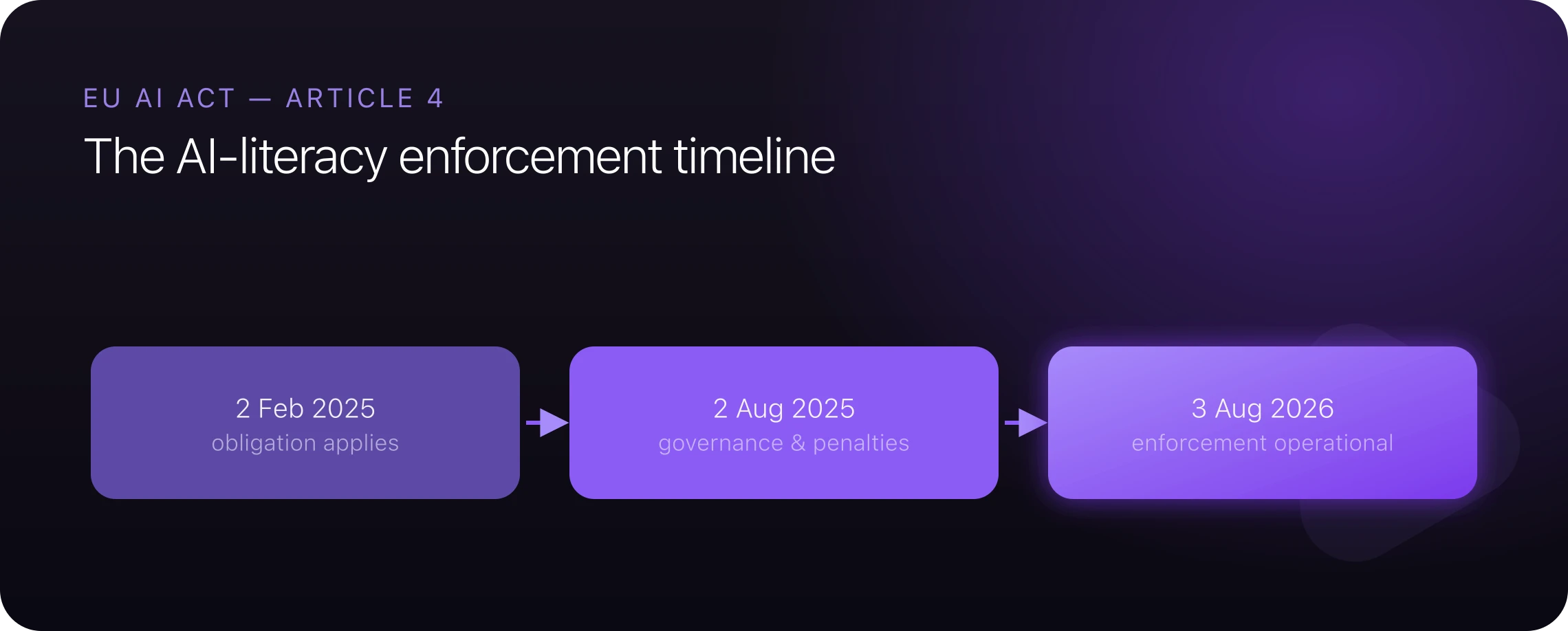
Article 4 became applicable on 2 February 2025, alongside the rules on prohibited AI practices; the governance and penalty framework followed on 2 August 2025; and from 3 August 2026 enforcement through national authorities is expected to be fully operational.
The practical reading is straightforward: the obligation is live now, and the window to have a defensible program in place is closing. Article 4 itself does not attach a specific standalone fine to non-compliance in the way some other provisions do, but it does not exist in isolation. AI literacy is foundational to meeting other obligations under the Act, and regulators and courts can consider whether an organization took reasonable measures. Treating February 2025 as the start line, not August 2026, is the safer posture.
What "sufficient AI literacy" means in practice
Because the Act sets a proportionate standard rather than a fixed one, "sufficient" is contextual. A useful way to think about it is that literacy should match what a person actually does with AI.
For a general workforce that uses everyday AI tools, sufficient literacy typically means understanding what the tools can and cannot reliably do, recognizing risks such as hallucinated output, bias, and confidentiality exposure, knowing when a human must stay in the loop, and understanding the organization's own policies on acceptable use. For people in higher-stakes roles — those configuring AI systems, making decisions informed by AI, or handling sensitive data — the bar rises to include a deeper grasp of limitations, oversight duties, and the specific risks of their domain.
Guidance emerging around the Act consistently points to a few themes: literacy should be role-based rather than one-size-fits-all, it should be tailored to the organization's actual AI use and risk profile, and it should be treated as ongoing rather than a single event, because both the technology and your use of it keep changing. The goal is capability that shows up in day-to-day work, not a certificate in a drawer.
A practical compliance checklist
There is no mandated template, but a defensible program tends to move through three stages: assess, train, and document. Each stage produces evidence you can point to later.
1. Assess
Start by mapping reality. Identify where AI systems are actually used across the organization and who operates them, including contractors and other third parties acting on your behalf. Group those people into roles by how they interact with AI and the risk each interaction carries. Then baseline current understanding, so you know where the real gaps are rather than guessing. A structured baseline also gives you a before-and-after story — for more on this, see how to measure AI literacy.
2. Deliver role-based training
Build learning that fits each group rather than a single generic course. General users need practical awareness of capabilities, risks, and your internal policies; specialized and decision-making roles need deeper, domain-specific content on oversight and limitations. Keep it grounded in the tools your people actually use, and make it repeatable so new joiners and new tools are covered as they arrive.
3. Document and verify
Because there is no mandated exam, documentation is how you demonstrate compliance. Keep records of what training was delivered, to whom, when, and what it covered. Capture completion, and where possible some evidence of understanding — a short assessment or knowledge check strengthens the record. Retain your policies, your role mapping, and the rationale behind what you judged "sufficient." Revisit the whole cycle periodically as your AI footprint evolves. If you would rather not assemble this from scratch, our EU AI Act AI-literacy training and assessment approach is built around exactly this assess-train-document loop.
Common misconceptions
A few misreadings of Article 4 come up repeatedly, and each one creates avoidable risk.
- "It only applies to tech companies." It applies to any organization deploying AI in a professional context in the EU — most businesses, public bodies, and institutions qualify as deployers.
- "We have until August 2026." The obligation has applied since February 2025. The later date concerns the maturing enforcement framework, not the start of the duty.
- "There's a required certification or exam." The Act mandates no specific curriculum, certificate, or test. It requires sufficient, proportionate literacy — and it is on you to define and evidence that.
- "One awareness email covers it." A single generic communication rarely amounts to a proportionate, role-based effort, and it produces thin evidence. Literacy is expected to be tailored and ongoing.
- "Only employees count." The obligation explicitly reaches other persons operating AI on your behalf, including contractors and temporary staff.
The Kampster Perspective
At Kampster, we see Article 4 less as a box to tick and more as a prompt every EU organization now has a reason to answer: do our people actually understand the AI they use? The obligation's deliberate flexibility rewards organizations that treat literacy as real capability-building — assessed against roles, tailored to actual use, and refreshed as things change — rather than a one-off formality.
That is the same principle we build around: understand where people stand, close the gaps that matter for their role, and keep a clear record of it along the way. Compliance becomes a by-product of doing the underlying work well. In the age of AI, the organizations that fare best under Article 4 will not be the ones with the thickest policy binder. They will be the ones whose people can genuinely use AI knowledgeably, responsibly, and with a clear view of the risks.
