What Is AI Literacy? A Practical Guide for the Workforce
AI literacy is the workforce capability to use AI safely and effectively. A practical guide to what it means, why it matters, and how organizations build it.


What AI literacy really means for the workforce — and why it has become a board-level priority.
Executive summary
Every organization now has access to artificial intelligence. Few can honestly say their people know how to use it well. That gap — between AI availability and AI capability — is what AI literacy is meant to close.
AI literacy is the practical ability of a workforce to understand, use, evaluate, and govern AI tools in the flow of everyday work. It is not a technical specialization reserved for data scientists, and it is not the same as knowing which buttons to press in a particular tool. It is a baseline capability, distributed across every role, that determines whether an organization's AI investment turns into real productivity or quiet risk.
This guide defines AI literacy for a business audience, explains why it has moved up the executive agenda, sets out a practical AI literacy framework of the underlying skills, and shows how organizations build and measure it. If you are responsible for L&D, transformation, risk, or workforce strategy, this is the foundation the rest of your AI program stands on.
What is AI literacy?
AI literacy is the set of knowledge, skills, and judgment that lets a person use AI systems effectively and responsibly in their work. A literate employee can recognize where AI helps and where it does not, frame a problem so a tool can assist with it, critically assess what the tool produces, and understand the limits, risks, and obligations that come with using it.
The word literacy is deliberate. Reading literacy was never about a single book — it was a transferable capability that let people engage with any text. AI literacy works the same way. It is not tied to one vendor's assistant or this year's model. It is the durable capability that lets someone pick up whatever AI tool lands on their desk next quarter and use it with confidence and care.
That distinction matters because AI literacy in the workplace is often confused with tool adoption. Rolling out an AI assistant and running a demo is adoption. Ensuring people can judge when to trust its output, protect confidential data, and stay accountable for the result is literacy. Adoption without literacy is how organizations end up with confident-sounding errors, leaked information, and compliance exposure.
Why AI literacy matters now
Three forces have turned AI literacy from a nice-to-have into an urgent priority.
The first is speed of diffusion. Generative AI reached hundreds of millions of workers faster than any previous workplace technology. Employees are already using these tools, often without guidance and sometimes without their employer's knowledge. The question is no longer whether AI enters the workflow — it is whether people use it competently when it does.
The second is the value gap. Organizations are investing heavily in AI platforms and licenses, but the return depends almost entirely on the people using them. A capable employee turns an AI tool into faster analysis, better drafts, and sharper decisions. An unprepared one produces plausible nonsense, reworks flawed output, or avoids the tool altogether. The same license produces radically different outcomes depending on the literacy behind it.
The third is regulation. AI literacy is becoming a legal obligation, not just good practice. Under EU AI Act Article 4 compliance, providers and deployers of AI systems must ensure a sufficient level of AI literacy among their staff and others operating AI on their behalf. That provision becomes enforceable on 3 August 2026, and it applies broadly — not only to technology companies, but to any organization putting AI to work. Regulators are effectively formalizing what leading organizations already understood: deploying AI without preparing your people is negligence, not innovation.
Together these forces mean AI literacy is now a board-level topic. It sits at the intersection of productivity, risk, and compliance — three concerns that rarely align so clearly around a single capability.
An AI literacy framework: the core components
Because AI literacy spans knowledge, skill, and judgment, it helps to break it into components. The following AI literacy framework describes the skills a workforce needs, from foundational awareness through responsible use. Not every role needs the same depth in each, but every role needs some grounding in all of them.
Foundational understanding
People need a working mental model of what AI is and how modern systems behave. This does not require mathematics. It requires understanding that large language models predict plausible text rather than retrieve verified facts, that they can be confidently wrong, that their knowledge has boundaries, and that their output reflects the data they were trained on. This foundation is what lets employees form realistic expectations instead of either over-trusting or dismissing the technology.
Practical application
This is the hands-on skill of getting useful results: framing a task clearly, giving a tool the right context, iterating on a response, and integrating AI into a real workflow rather than treating it as a novelty. Practical application is where productivity gains are actually realized, and it is the most visible AI literacy skill — but on its own it is not enough.
Critical evaluation
The ability to judge AI output is what separates a productive user from a liability. Literate employees verify claims, notice when an answer is fabricated or subtly wrong, recognize bias, and know which decisions require a human check. As AI produces more of the first draft of everyday work, critical evaluation becomes the single most important protective skill in the workforce.
Responsible and safe use
Employees need to understand the rules of engagement: what data can and cannot be entered into a tool, how to protect confidentiality and personal information, when AI use must be disclosed, and where accountability sits when a tool is involved. This component is where AI literacy meets governance and, increasingly, legal obligation.
Ethical and organizational awareness
Beyond individual tasks, a literate workforce understands the broader implications of AI: fairness, transparency, the impact on people affected by AI-assisted decisions, and the organization's own policies and values. This is what allows AI to be adopted in a way that builds trust rather than erodes it.
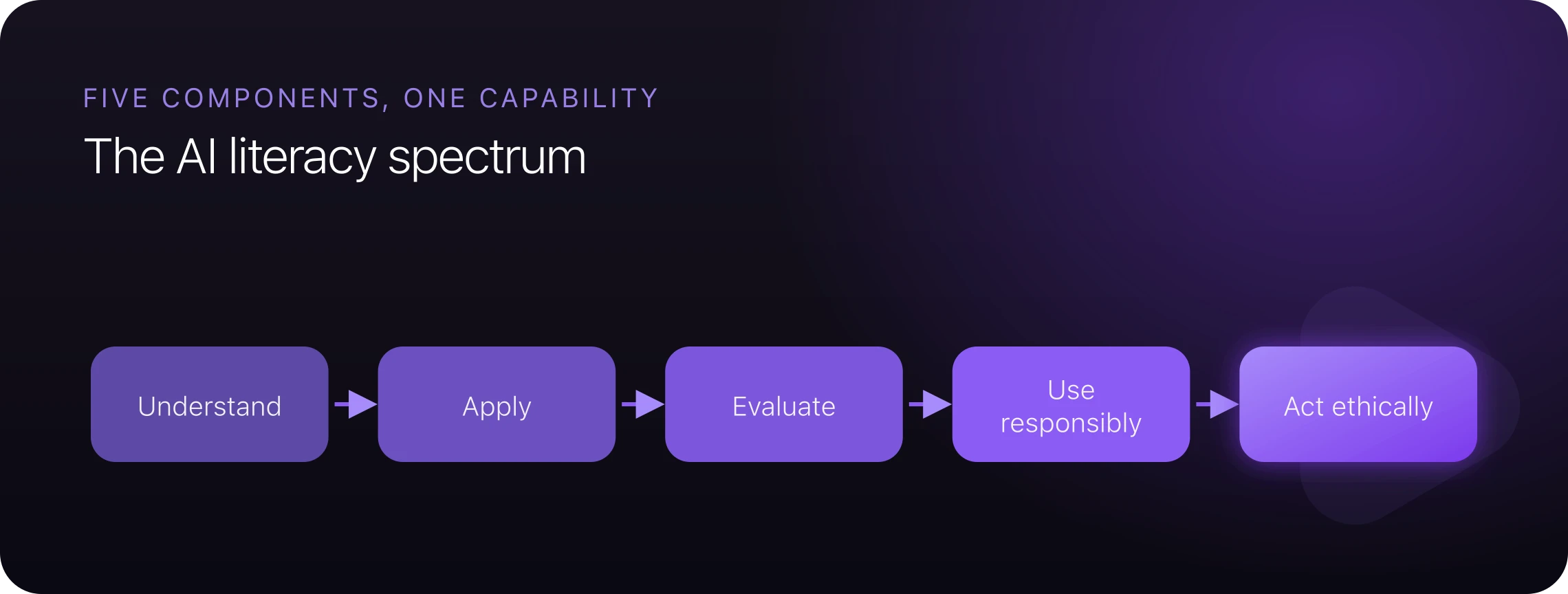
These five components form a spectrum — and a credible AI literacy program develops all of them, not just the middle one.
How AI literacy differs from general AI training
Many organizations already run AI training, so it is worth being precise about the difference.
General AI training is usually tool-specific and task-specific. It teaches people how to use a particular assistant, often through a demonstration and a set of prompts. It is useful, but it ages quickly, transfers poorly to the next tool, and rarely touches judgment, risk, or governance. When the tool changes — which it does constantly — much of the training is obsolete.
AI literacy is tool-agnostic and capability-based. It builds the underlying understanding and judgment that survive tool changes and apply across every AI system an employee will encounter. Training teaches someone to use today's tool. Literacy prepares them to use whatever comes next, safely.
There is also a measurement difference. Training is typically tracked by completion: how many people attended, how many finished the module. Literacy has to be assessed by capability: can people actually recognize a flawed AI output, handle sensitive data correctly, and apply the tool to a real problem? Completion tells you people were present. Assessment tells you whether they are capable — and only the second satisfies both business goals and regulatory expectations.
This is not an argument against tool training. It is an argument for putting tool training on top of a literacy foundation, rather than mistaking one for the other.
How organizations build and measure AI literacy
Building AI literacy across a workforce is a program, not an event. A practical approach moves through a few clear stages.
Establish a baseline
Start by measuring where people actually are, not where you assume they are. A baseline assessment across the five components reveals the real distribution of capability — which is almost always wider than leaders expect, with pockets of sophistication next to significant blind spots. Without a baseline, every later claim of progress is guesswork. This is also where the difference between perceived and actual literacy first shows up: people routinely overestimate their own ability to spot flawed AI output.
Segment by role and risk
AI literacy is not uniform. A customer-service agent, a lawyer, a software engineer, and an executive need different depths and emphases. Roles that use AI on sensitive data or in regulated decisions need deeper grounding in responsible use and evaluation. Segmenting by role and risk lets you set proportionate expectations rather than pushing everyone through identical content.
Deliver capability, not just content
Effective programs are practical and role-relevant. People build literacy by working through realistic scenarios from their own domain — evaluating a flawed output, handling a data-sensitivity decision, applying a tool to a genuine task — not by watching generic videos. The goal is changed behavior in the flow of work, which means practice, feedback, and reinforcement over time.
Measure capability and close gaps
Because literacy is a capability, it has to be measured as one. Re-assessment shows movement against the baseline, identifies who is ready and who still needs development, and provides the evidence organizations increasingly need to demonstrate. For a deeper treatment of the metrics and methods involved, see our guide on how to measure AI literacy. The essential point is that assessment is not the end of the program — it is the loop that keeps it honest, surfacing gaps so they can be closed rather than assumed away.
Run as a cycle — baseline, develop, re-assess, close gaps — this turns AI literacy from a one-off campaign into a durable capability the organization can see, prove, and improve.
The Kampster perspective
At Kampster, we see AI literacy as the foundation beneath every AI ambition an organization holds. Tools, licenses, and platforms are the easy part of AI transformation. The hard part — and the part that actually determines the return — is whether people across the organization can use them with skill and judgment.
We also believe literacy has to be verified, not assumed. The organizations that will navigate both the productivity opportunity and the compliance obligation are the ones that can point to real capability data: who is ready, where the gaps are, and how quickly they are closing. That is why our approach pairs practical, role-relevant learning with assessment, so AI literacy becomes something an organization can measure and prove rather than hope for. If you are building this into your workforce, our AI literacy training and assessment brings the learning and the evidence together in one place.
AI literacy is no longer optional. Diffusion has made it universal, economics have made it valuable, and regulation is about to make it mandatory. The organizations that treat it as a genuine workforce capability — defined, developed, and measured — will turn AI from a source of risk into a durable advantage. The rest will keep paying for tools their people were never prepared to use.