What Is an AI LMS? A Guide to AI Learning Platforms
An AI LMS uses machine intelligence to author, personalize, and verify learning at scale. Here is what an AI learning platform does and how to evaluate one.


What an AI LMS actually is, how it differs from the software you already run, and how to evaluate one without buying hype.
Executive summary
An AI LMS is a learning management system in which artificial intelligence is not a bolt-on feature but the core operating layer. Where a traditional LMS stores courses that people manually build, an AI learning platform generates learning from your existing knowledge, adapts each pathway to the individual, verifies what people can actually do, and surfaces where capability gaps sit across the organization.
The distinction matters because the questions executives ask have changed. Leaders are no longer satisfied knowing that a course was completed. They want to know whether the workforce is ready — for AI, for new regulation, for the next reorganization. A conventional LMS was never designed to answer that. An AI-powered LMS is.
This guide explains what an AI LMS is, the capabilities that define the category, where it fits alongside broader talent systems, and the questions to ask before you commit budget. It is written for L&D leaders, HR executives, and the operators who ultimately own workforce readiness.
From LMS to AI LMS
The Learning Management System has anchored corporate learning for two decades. Its job was straightforward: distribute content at scale, track completions, manage compliance, and produce reports. That model assumed knowledge was relatively stable and that building a course — a slow, expensive, manual effort — was a one-time cost you amortized over years.
That assumption has collapsed. Skills now expire faster than course libraries can be refreshed, AI is reshaping roles quarterly, and the half-life of a technical competency is measured in months. The bottleneck is no longer distribution. It is the cost and speed of producing relevant, verified learning — and knowing whether any of it moved the needle.
An AI LMS attacks exactly that bottleneck. Instead of treating AI as a chatbot pinned to the side of a course catalog, it uses machine intelligence across the full lifecycle: authoring, personalization, assessment, and analytics. The result is not a faster LMS. It is a different category of system with a different job.
What makes an LMS an AI LMS
Marketing has diluted the term, so it helps to be precise. A genuine AI-powered LMS demonstrates intelligence in four places, not one.
AI-generated content
In a traditional LMS, someone has to build every course by hand. In an AI LMS, the platform turns knowledge you already own — documents, procedures, policies, presentations, recorded expertise — into structured courses, lessons, and assessments. This is the single biggest shift. The goal is not content creation for its own sake but knowledge activation: unlocking the institutional know-how that currently sits trapped in files and in people's heads.
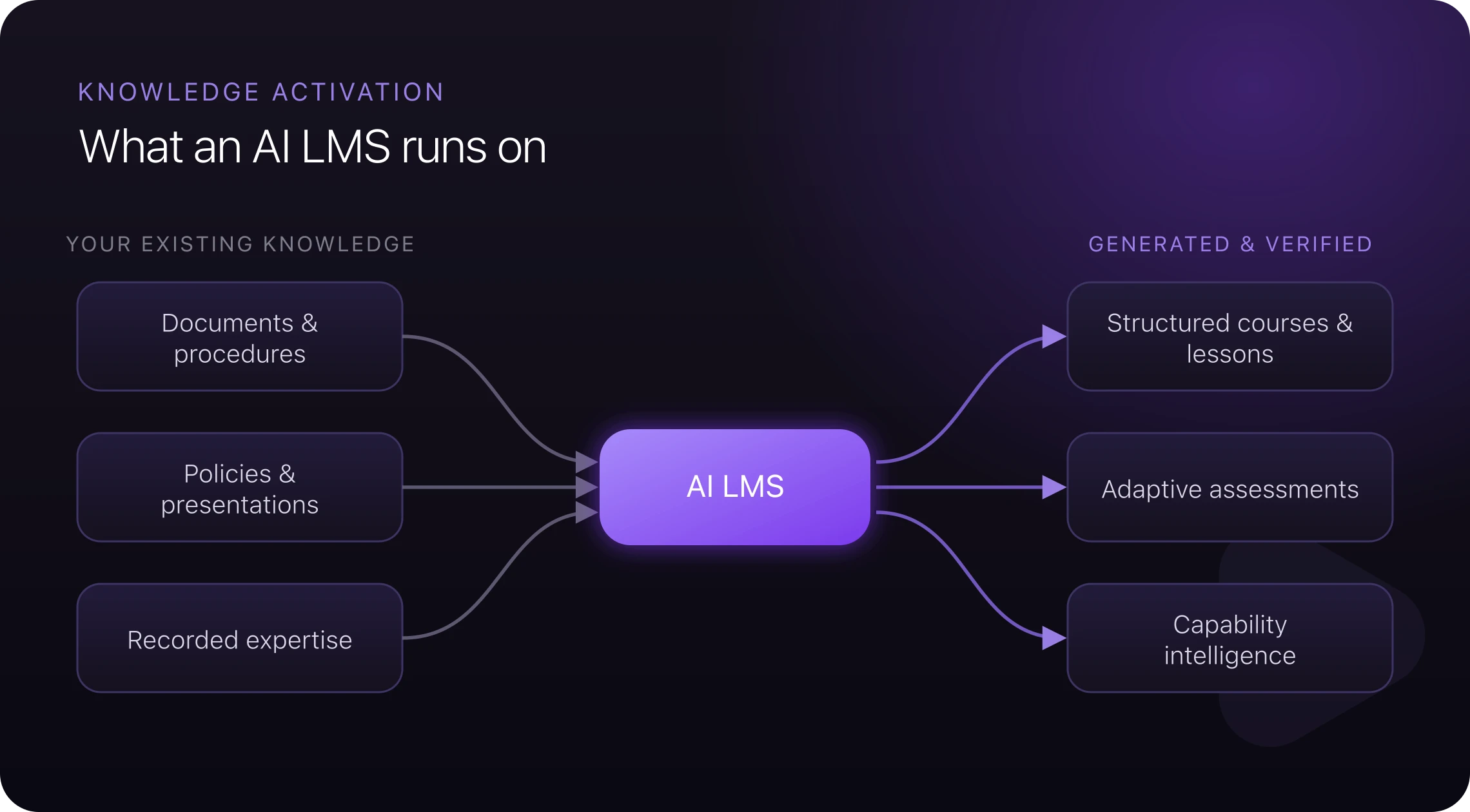
Knowledge activation — the institutional know-how you already own becomes structured, verified learning.
This is what makes continuous upskilling & courses economically viable. When a course costs days of specialist time to build, you ration learning. When it can be generated and refreshed from source material in minutes, you can keep an entire catalog current with how the business actually operates.
Adaptive personalization
A static LMS serves the same content to everyone. An AI learning platform adapts. It reads where a learner already is, routes around what they have proven they know, reinforces what they have not, and adjusts pace, difficulty, and examples to the individual. Two people enrolled in the same subject can travel very different paths to the same verified outcome. Personalization is what turns learning from a compliance event into something that respects an expert's time and closes a novice's gaps.
Verification, not just completion
Completion tells you someone reached the end of a course. It says nothing about whether they can do the work. AI-driven skill assessments change the unit of measurement from activity to demonstrated capability. Instead of a checkbox, you get evidence: what a person can actually do, at what level, with what confidence. This is the difference between a training record and a capability signal — and it is the data executives have been missing.
Capability intelligence
The fourth layer is organizational. Once learning is generated, personalized, and verified, the platform can aggregate the signal into a live picture of workforce capability: verified competencies, gaps against strategic priorities, concentration risk where critical skills sit with too few people, and readiness for specific changes ahead. A conventional LMS produces reports about learning activity. An AI LMS produces intelligence about capability.
AI LMS vs. traditional LMS
The cleanest way to see the difference is by the question each system is built to answer. A traditional LMS answers did learning happen? An AI LMS answers is the workforce capable and ready?
That reframing cascades through every design decision. Content moves from manually authored to AI-generated. Pathways move from one-size-fits-all to adaptive. Measurement moves from completion to verified capability. Reporting moves from activity dashboards to capability intelligence. Cost structure moves from expensive, slow course production to fast, continuous refresh.
None of this means the LMS fundamentals disappear. You still need to deliver courses, run compliance, track progress, and issue certificates — and a serious AI LMS does all of that. The point is that those functions become one layer of a larger system rather than the whole product.
AI LMS for corporate training
For a corporate L&D function, the practical case for an AI LMS comes down to three pressures that a legacy system handles badly.
The first is speed of change. When a product, policy, or system changes, the training built around it is immediately stale. An AI LMS regenerates the relevant learning from updated source material instead of queuing a content project that lands a quarter too late.
The second is scale without headcount. Personalized, verified learning has historically required either large instructional-design teams or a compromise to lowest-common-denominator content. AI-powered generation and assessment let a small team deliver personalized, verified learning to thousands of people.
The third is the AI transition itself. Every organization now needs its workforce to build fluency with AI tools and judgment about their limits. Structured AI literacy is fast becoming a baseline capability rather than a specialist one, and it is precisely the kind of fast-moving, role-specific subject that manual course production cannot keep up with. An AI LMS is well suited to delivering it — and to verifying that it landed.
For regulated environments — public sector, universities, financial services — verification carries extra weight. Being able to demonstrate not just that training was assigned but that capability was verified is increasingly what auditors, regulators, and boards expect to see.
Where an AI LMS fits in your stack
An AI LMS rarely stands alone. It sits alongside an HRIS, a talent or skills framework, and sometimes a separate performance system. The important architectural question is whether learning, assessment, and capability data live in one connected system or are stitched together across tools that do not share a model of the person.
When authoring, personalization, verification, and analytics share one spine, the capability signal is coherent: what someone learned, what they can now do, and where they still have gaps all reference the same profile. When they are split across vendors, you get the familiar problem of a learning system that knows about courses and a talent system that knows about roles, with no reliable bridge between them.
This is also where the AI LMS conversation blurs into a larger one. Once a platform is generating learning, verifying skills, and reporting readiness, it is doing more than managing learning — it is managing capability. Some organizations frame this broader ambition as what a human capability platform is, a category that treats the LMS functions as one layer beneath skill intelligence and workforce readiness rather than as the whole product.
How to evaluate an AI LMS
Because almost every vendor now claims to be AI-powered, evaluation should test the substance behind the label. A short set of questions separates a real AI LMS from a traditional system with a chatbot attached.
Ask where the AI actually operates. If it only helps you search or summarize existing courses, that is a feature, not a category. Look for AI across authoring, personalization, assessment, and analytics.
Ask how content gets made. Can the platform generate structured, assessable learning from your own documents and expertise, or does someone still have to build every course by hand?
Ask what it measures. Does it stop at completion, or does it verify capability and give you a defensible signal of what people can do?
Ask what it tells leadership. Can it move beyond activity reports to a live view of capability, gaps, and readiness that an executive would actually use to make a decision?
Ask about the model of the person. Is there one connected profile that follows the individual across learning, assessment, and readiness, or is the data fragmented across disconnected modules?
And ask about trust in regulated settings: how the system handles verification, evidence, and the AI's own limits, so that what it produces stands up to scrutiny.
The answers will tell you quickly whether you are looking at an AI learning platform or a familiar LMS wearing a new label.
The Kampster Perspective
An AI LMS is not a faster version of the software you already own. It is a shift in what the system is for — from managing the delivery of learning to developing and verifying capability. The organizations that benefit most are the ones that treat that shift as the point, not the marketing.
We built Kampster around that conviction. It does everything you expect from an LMS — courses, delivery, progress, certificates — but those functions sit on top of AI-driven authoring, personalization, verified assessment, and capability intelligence. Because in an era where skills expire faster than course libraries can be rebuilt, managing learning is no longer enough. The task is to understand, develop, and verify capability — and that is what an AI learning platform is actually for.