Why the Future of Workforce Development Requires More Than Learning Management Systems
LMS platforms track whether learning happened. The AI era demands capability — visibility, verification, and readiness. Enter the Human Capability Platform.


Beyond the LMS: why managing learning is no longer enough, and what comes next.
Executive summary
For more than two decades, Learning Management Systems (LMS) have been the foundation of corporate learning. Organizations used LMS platforms to distribute courses, manage compliance training, track completion rates, issue certificates, and report learning activity. For years, this approach was sufficient: knowledge was relatively stable, training programs changed slowly, and business transformation occurred over years rather than months.
That world no longer exists. Artificial Intelligence, automation, digital transformation, and rapidly changing workforce requirements are exposing the limitations of traditional LMS platforms. Organizations no longer struggle to deliver learning — they struggle to develop capability.
The challenge facing modern organizations is not managing courses. It is understanding, developing, verifying, and continuously improving workforce capability. This shift is creating a new category beyond the traditional LMS — one we describe as the Human Capability Platform.
The LMS era
Learning Management Systems emerged to solve an important problem: organizations needed a way to distribute learning content at scale. The LMS became the central infrastructure for course delivery, compliance training, certification tracking, and learning administration, following a familiar path of Content → Course → Employee → Completion → Reporting.
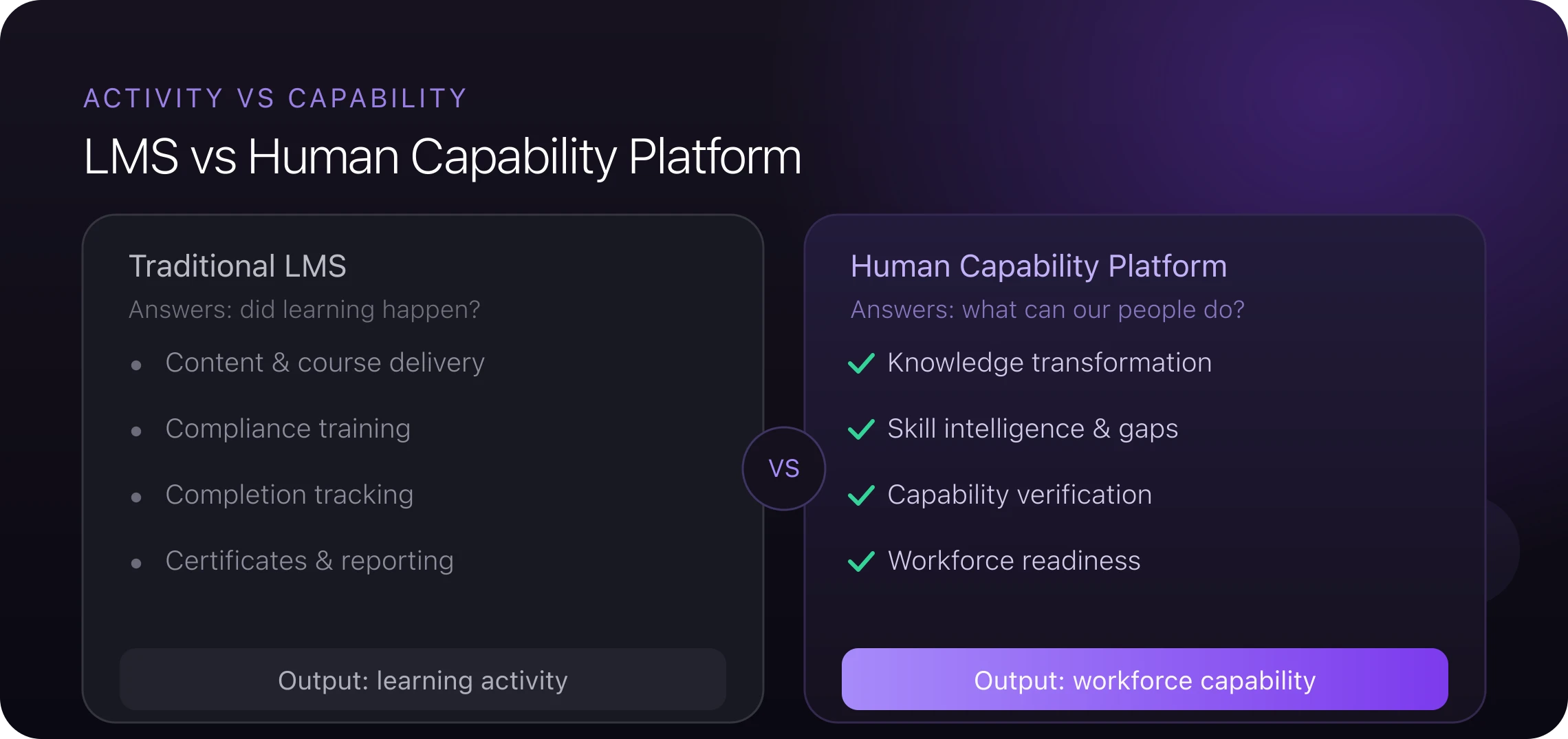
The LMS was designed to answer a simple question: did learning happen? For many years, that was enough. Today it is not.
The new workforce challenge
Organizations now operate in an environment defined by continuous change. Artificial Intelligence is changing jobs, new technologies emerge every year, skills become obsolete faster than ever before, and employees must continuously adapt.
The problem facing executives has changed. They are no longer asking how many courses were completed or how many learning hours were consumed. Instead, they ask: what capabilities do we have? What capabilities are missing? Who is prepared for AI? Which skills will be critical next year? How quickly can we develop them?
These questions cannot be answered by a traditional LMS. The old model tracks learning activity and course completion; the new model demands capability visibility and workforce readiness. Organizations increasingly care less about activity and more about capability.
Why learning is no longer the goal
One of the biggest misconceptions in corporate education is that learning itself is the objective. It is not. Organizations do not invest in learning because they want employees to complete courses. They invest because they want employees to perform better, adapt faster, solve problems, use new technologies, and drive business results.
Learning is not the outcome. Capability is the outcome — and that distinction changes everything.
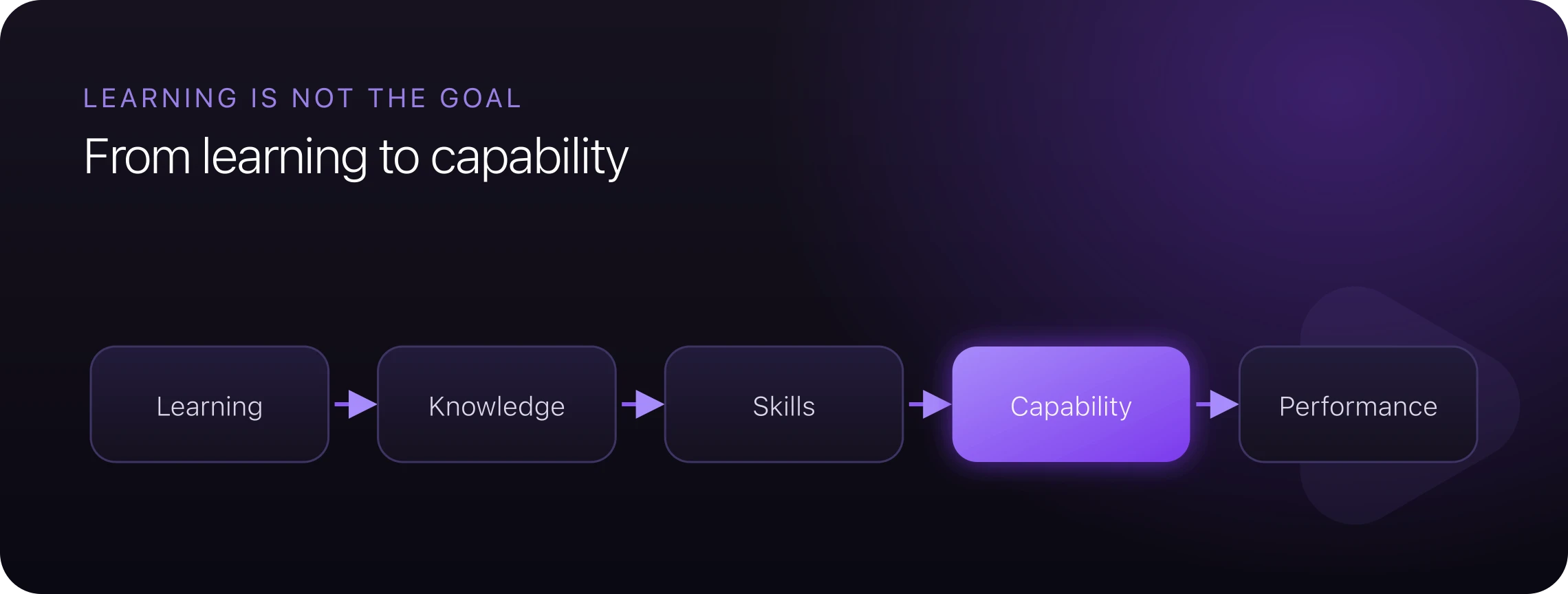
Most LMS platforms stop at the first link. Modern organizations need the whole chain — because capability, not learning, is the real outcome.
The rise of Human Capability Platforms
A new category is emerging. Instead of focusing on content management, Human Capability Platforms focus on capability development. These systems answer questions such as: what does an employee actually know? What skills are verified? What capability gaps exist? What learning should happen next? How ready is the workforce for change? Answering them requires capabilities well beyond traditional LMS functionality.
What makes Kampster different
Kampster includes many LMS capabilities — organizations can create courses, deliver learning, track progress, and issue certificates. However, these features represent only one layer of the platform, which evolves from a Learning Management System through Personalized learning, Skill intelligence, Capability verification, and Workforce readiness toward a full Human Capability Platform. Kampster was built around the belief that workforce capability matters more than course completion.
Capability 1: Knowledge transformation
Most organizations already possess enormous amounts of knowledge, but it remains trapped inside documents, presentations, procedures, policies, and expert know-how. Traditional LMS platforms require content to be manually created. Kampster instead transforms existing knowledge — documents, procedures, presentations, and knowledge bases — into learning experiences, assessments, and development paths using AI. The objective is not content creation; it is knowledge activation.
Capability 2: Skill intelligence
Most organizations know who their employees are. Far fewer know what their employees can actually do. Kampster introduces Skill Intelligence: the ability to identify verified competencies, capability gaps, development priorities, workforce strengths, and workforce risks. This shifts the conversation from jobs to skills.
Capability 3: Workforce readiness
The biggest challenge of the AI era is not technology adoption. It is human adoption. Organizations need visibility into readiness across the chain of Awareness → Learning → Skills → Capability → Readiness → Business impact. Kampster helps organizations understand where employees stand today and what must happen next.
Capability 4: Personalized development
Traditional LMS platforms treat learning as content distribution. Kampster treats learning as capability development. Different employees require different learning paths, different levels of support, different priorities, and different contexts. The future of learning is not standardized — it is personalized.
Capability 5: Continuous growth
Most learning systems focus on events: a course, a workshop, a certification. Kampster focuses on continuous development. Through micro-habits, adaptive learning, and personalized development pathways — Learning → Habit → Skill → Capability → Growth — learning becomes part of everyday work rather than a separate activity. This creates sustainable development rather than temporary engagement.
The Kampster perspective
The next generation of workforce technology will not be defined by Learning Management Systems. It will be defined by Human Capability Platforms. Organizations increasingly need answers to questions traditional LMS platforms were never designed to solve: workforce capability, future readiness, skill intelligence, and organizational adaptability. The systems that provide these answers will become strategic infrastructure for the modern enterprise.
Conclusion
Is Kampster an LMS? Technically, yes — it includes many of the functions traditionally associated with Learning Management Systems. But describing Kampster as an LMS is like describing a smartphone as a telephone: technically correct, yet it fails to capture what the platform actually does.
Kampster represents a broader category: a Human Capability Platform designed to help organizations understand, develop, verify, and continuously improve workforce capability. Because in the age of AI, managing learning is no longer enough. Organizations must manage capability — and that requires something far more powerful than an LMS.