AI LMS vs Traditional LMS: What Actually Changes
AI LMS vs traditional LMS, decoded for L&D and execs: what actually changes in authoring, personalization, skill visibility, and measurable workforce readiness.


A practical comparison for L&D leaders deciding whether an AI LMS is a genuine shift or just a new label on the same platform.
Executive summary
Every learning vendor now claims to be "AI-powered," which makes it harder, not easier, to tell what has genuinely changed. For most L&D and HR leaders, the question is not whether artificial intelligence is fashionable. It is whether an AI LMS solves problems the traditional LMS never could — and whether that difference justifies the switch.
The honest answer is that the two systems are built to do different jobs. A traditional Learning Management System is content infrastructure: it distributes courses, tracks completions, and reports activity. An AI LMS is capability infrastructure: it generates and adapts learning, measures what people can actually do, and connects development to workforce outcomes. Both matter. But only one is designed for an environment where roles, tools, and required skills change every few months.
This post breaks down the ai lms vs lms comparison across the dimensions that decide real value: content creation, personalization, skill visibility, measurement, and total cost of ownership. If you want the underlying definition first, we cover what an AI LMS is separately. Here, the focus is the difference between the two — and where an ai powered lms vs traditional platform pays off.
What a traditional LMS was built to do
The traditional LMS earned its place. When organizations needed to move classroom training online, distribute compliance modules to thousands of people, and prove that learning happened, the LMS delivered. Its core loop is well understood: upload content, assign it, track completion, issue certificates, and report activity to auditors or leadership.
That model assumes something important — that the content already exists, changes slowly, and stays relevant long enough to justify the effort of building it. For stable, regulated topics like workplace safety or data protection, that assumption still holds. A traditional LMS remains a reasonable system of record for mandatory training.
The limitation is that the LMS was never designed to answer harder questions. It can tell you that 940 people completed a course. It cannot tell you whether any of them can now do the job better, where your real capability gaps are, or what those specific people should learn next. Completion is a proxy for learning, and learning is a proxy for capability — and in a fast-moving environment, both proxies leak.
What changes with an AI LMS
An AI LMS keeps the useful parts of the LMS — course delivery, tracking, certification — and rebuilds the parts that no longer fit. Four shifts do most of the work.
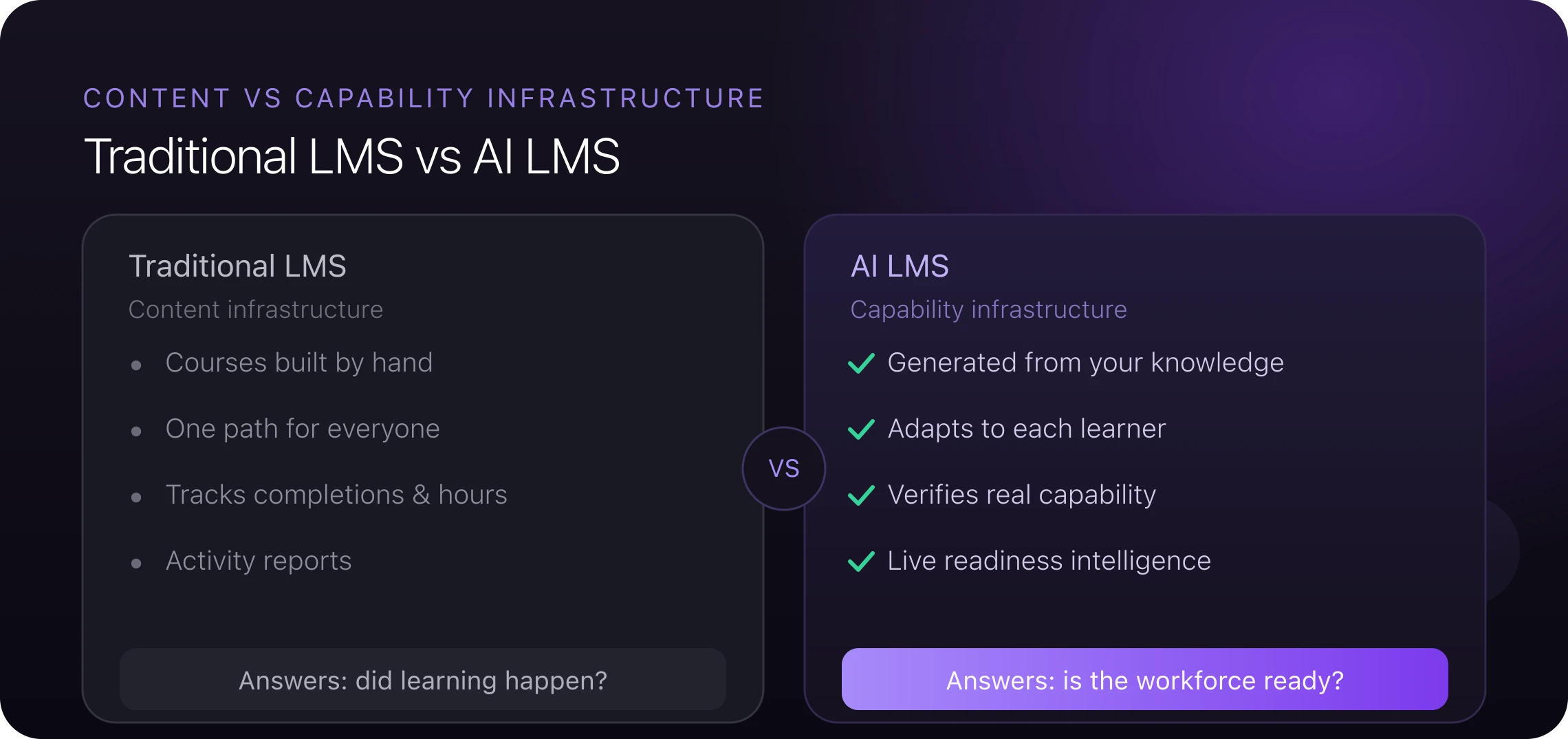
Two different jobs: one system records learning activity, the other builds and verifies workforce capability.
Content: from manual authoring to knowledge activation
In a traditional LMS, every course is a project. Someone scopes it, writes it, designs it, and maintains it — a cycle that often takes weeks and starts aging the day it ships. This is why so many catalogs are full of modules that were current three reorganizations ago.
The clearest of the ai lms benefits is that authoring collapses. An AI LMS turns the knowledge an organization already owns — policies, procedures, decks, product documentation, expert know-how — into structured courses, assessments, and learning paths in a fraction of the time. The bottleneck moves from production capacity to editorial judgment. Instead of asking "can we afford to build this course," L&D asks "is this the right thing to teach," which is a far better question to be spending time on. Practically, it means catalogs like upskilling & courses can stay current with the business rather than trailing it.
Personalization: from one path to many
A traditional LMS assigns the same course to everyone in a group. A senior engineer and a new hire receive identical content at identical pace, and both sit through material they either already know or are not yet ready for. Personalization, where it exists, usually means little more than branching by job title.
An AI LMS adapts to the individual. It adjusts difficulty, sequences topics based on what someone already demonstrates, and reroutes when a learner struggles or races ahead. The unit of design shifts from the course to the learner. For large, mixed-ability workforces — common across both enterprise and public-sector organizations — this is the difference between training that people tolerate and development they actually use.
Measurement: from activity to capability
This is the shift that matters most to executives, and the sharpest line in any ai powered lms vs traditional comparison. A traditional LMS measures activity: enrollments, completions, hours, pass rates. Useful for compliance, thin for strategy. None of it tells you what your workforce can do.
An AI LMS is built around capability. It uses ongoing skill assessments to establish what people can actually demonstrate, maps that against the skills the organization needs, and surfaces the gaps in between. The reporting question changes from "how much training did we deliver" to "how ready are we" — and that is a question boards and workforce-planning teams are increasingly asking directly.
Support: from static courses to always-on guidance
A traditional LMS goes quiet once a course ends. An AI LMS can stay present in the flow of work — answering questions grounded in the organization's own knowledge, recommending the next relevant module, and reinforcing skills through short, spaced practice instead of one-off events. Learning becomes continuous rather than episodic, which is closer to how capability is actually built.
Where the traditional LMS still wins
An AI LMS is not automatically the right choice, and pretending otherwise sets up disappointment. If an organization's needs are genuinely limited to distributing a fixed set of mandatory courses, tracking completion, and producing an audit trail, a traditional LMS does that job at lower cost and lower complexity. Adding AI to a purely compliance-driven program is over-engineering — you would be paying for adaptivity and skill intelligence you never use.
The traditional LMS also carries less change-management overhead. It is a known quantity; administrators understand it, and expectations are modest. An AI LMS asks more of an organization: cleaner source knowledge, a willingness to act on skill data, and comfort with a system that recommends rather than simply records. Where that appetite is missing, the technology underdelivers regardless of how capable it is.
Reading the total cost honestly
Headline license fees rarely tell the real story. A traditional LMS often looks cheaper per seat, but the true cost sits in content: the authoring hours, the instructional-design contracts, the perpetual maintenance to keep modules current. Those costs are easy to underestimate because they are spread across teams and budgets.
An AI LMS typically carries a higher platform cost and a much lower content cost, because generation and maintenance are largely automated. The comparison that matters is not license against license — it is total cost of capability: what it takes to get a workforce genuinely ready, kept current, and measurable. For organizations facing constant change, the automated-content model usually wins on that basis. For those with a small, stable catalog, it may not. The discipline is to compare the whole system, not the sticker price.
A short decision guide
The choice comes down to the problem you are actually solving. Choose a traditional LMS when your requirements are stable compliance training, completion tracking, and audit reporting, and when your catalog changes rarely. Choose an AI LMS when roles and required skills shift often, when you need visibility into what people can do rather than just what they finished, and when the cost and lag of manual authoring have become a real constraint.
Most organizations sit somewhere in between, which is why the strongest AI LMS platforms still include the compliance-grade tracking a traditional LMS offers. The goal is not to abandon what worked but to stop asking a content-distribution system to answer capability questions it was never designed for.
The Kampster Perspective
We think the ai lms vs lms debate is really a question about what you are trying to manage. If the job is to distribute and record training, a traditional LMS is enough. If the job is to understand, build, and verify what your workforce can do — while the ground keeps moving — that is a different system, and calling it an LMS undersells it.
Kampster includes the LMS essentials organizations still need, then goes further: turning existing knowledge into learning, personalizing development to the individual, and grounding everything in verified skills rather than completion counts. The measure of success is not how much training was delivered. It is whether the organization is more capable and more ready than it was — and whether it can prove it.