The End of Training
Organizations spend billions on training, yet capability rarely follows. Why learning is no longer the goal — and how to build capability that drives real outcomes.


Why learning is no longer the goal — and why capability is.
Executive Summary
Organizations spend billions of dollars every year on training. Employees attend workshops, complete courses, watch videos, earn certificates, and pass assessments. Yet despite unprecedented investment in learning, a fundamental question remains: why do so many organizations still struggle with performance, transformation, innovation, and capability development?
The answer is uncomfortable. Because training was never the goal. Training is an activity. Capability is an outcome.
For decades, organizations measured learning through inputs — courses completed, hours consumed, certificates earned, participation rates. But executives do not invest in learning because they want employees to complete courses. They invest because they want employees to perform differently. The problem is that most learning systems were designed to manage training rather than create capability.
Artificial Intelligence is exposing this limitation. As access to knowledge becomes universal, organizations are increasingly realizing that learning itself is not the competitive advantage. The ability to transform learning into action is. This paper explores why the future of workforce development extends beyond training, and why organizations must shift their focus from learning activity to capability outcomes.
The Training Illusion
For decades, organizations have measured success through training metrics. Questions such as how many people completed the course, how many learning hours were consumed, and how many certifications were issued have dominated Learning and Development reporting. These metrics create the appearance of progress. But they often fail to answer a more important question: did anything actually change?
The traditional training model runs Training → Completion → Reporting — and the problem is obvious. Completion is not capability. Attendance is not competence. Certification is not performance.
The Learning-Performance Gap
Consider a familiar scenario. An organization launches a leadership program. Employees complete the training, assessments show strong results, and certificates are awarded. Six months later, leadership behaviors remain unchanged, team performance is flat, and employee engagement is unchanged.
What happened? Learning occurred. Capability did not.
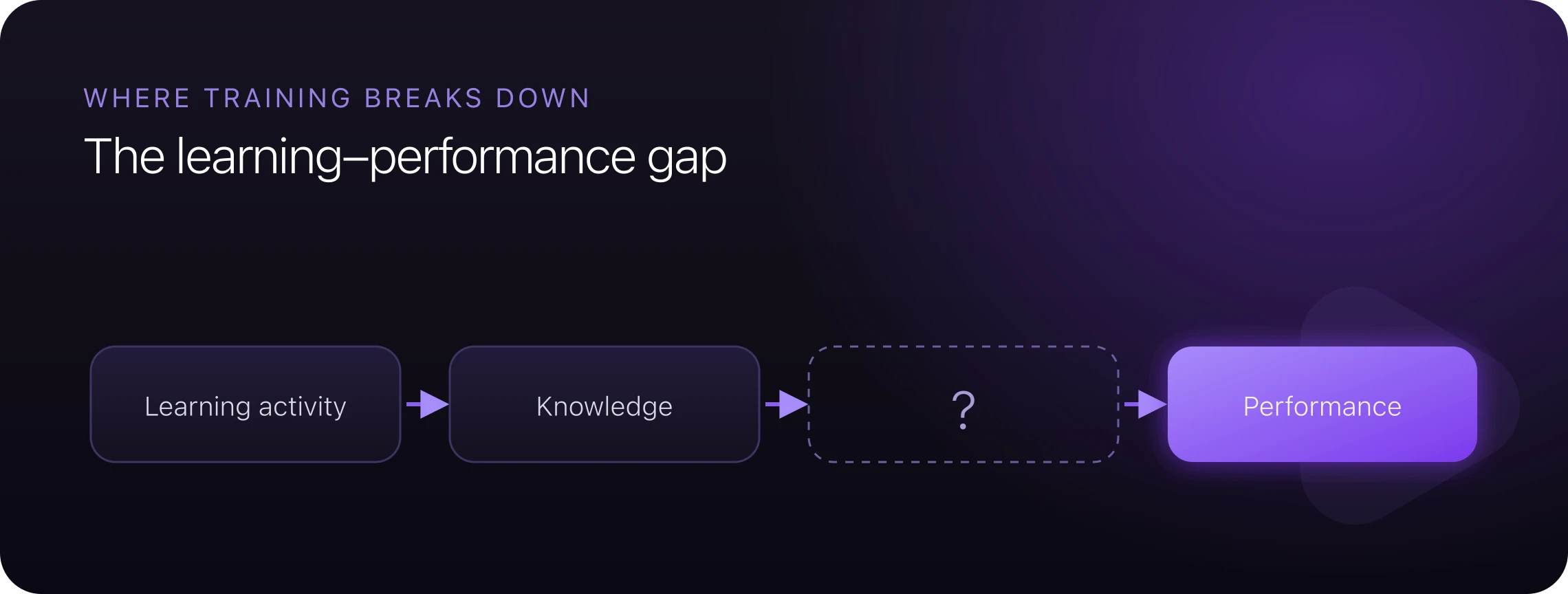
Most organizations invest in the first steps. Very few understand the middle — the transfer from knowing to doing, where capability is actually built.
Most organizations focus heavily on the first step. Very few understand what happens in the middle.
Why Knowledge Is No Longer Scarce
Historically, training existed because knowledge was difficult to access. Employees attended courses because information was not readily available. Experts were limited, books were expensive, and education was centralized.
Artificial Intelligence has changed this reality. Today, anyone can instantly access explanations, tutorials, examples, frameworks, simulations, and best practices. Knowledge has become abundant.
The arc is unmistakable: Knowledge scarcity → Training → Knowledge access → Knowledge abundance → Capability development. The challenge is no longer finding information. The challenge is applying it.
Why Organizations Don't Buy Training
This may sound provocative, but organizations do not buy training — at least not for its own sake. Organizations buy outcomes.
They do not purchase sales training because they love learning; they purchase it because they want more revenue. They do not invest in AI education because they enjoy educational content; they invest because they want successful AI adoption. They do not launch leadership programs because they want employees to watch videos; they do it because they want stronger leaders.
What organizations actually buy follows a chain — Training → Capability → Performance → Business outcome. Learning is merely the mechanism. The outcome is what matters.
The Capability Economy
As AI accelerates change, organizations increasingly compete on capability rather than knowledge. Technology can be purchased. Software can be licensed. Information can be generated instantly.
The true differentiator becomes the ability of people to adapt, solve problems, make decisions, learn continuously, and apply knowledge effectively. This creates what can be described as a Capability Economy. In this environment, workforce development becomes less about training and more about capability creation.
The Problem With Event-Based Learning
Traditional training is built around events — a workshop, a webinar, a course, a certification. The assumption is that learning happens during the event. Reality is different. Most development occurs after the event, when employees attempt to apply knowledge in real-world situations.
The real path of development is Training event → Application → Practice → Habit → Capability. Organizations often invest heavily in the first step while neglecting everything that follows.
From Learning Events to Capability Systems
The future of workforce development requires a different approach. Instead of asking "What training should we provide?", organizations increasingly need to ask "What capability do we need to build?" This shift changes everything.
The traditional path runs Need → Course → Completion. The capability-based path runs Need → Capability gap → Development → Application → Outcome. The second model begins with business objectives rather than content.
Why Context Matters
One reason training often fails is because it ignores context. Employees rarely learn because they enjoy consuming content; they learn because they need to solve problems. When learning is disconnected from real-world challenges, engagement declines. When learning is connected to immediate needs, motivation increases naturally.
The future of workforce development therefore depends on understanding what people are trying to achieve, what challenges they face, what capability gaps exist, and what outcomes matter most. Context becomes more important than content.
The Rise of Continuous Development
The organizations that succeed in the AI era will not be those that train employees most frequently. They will be those that develop employees most continuously. Capability is not created in a single workshop.
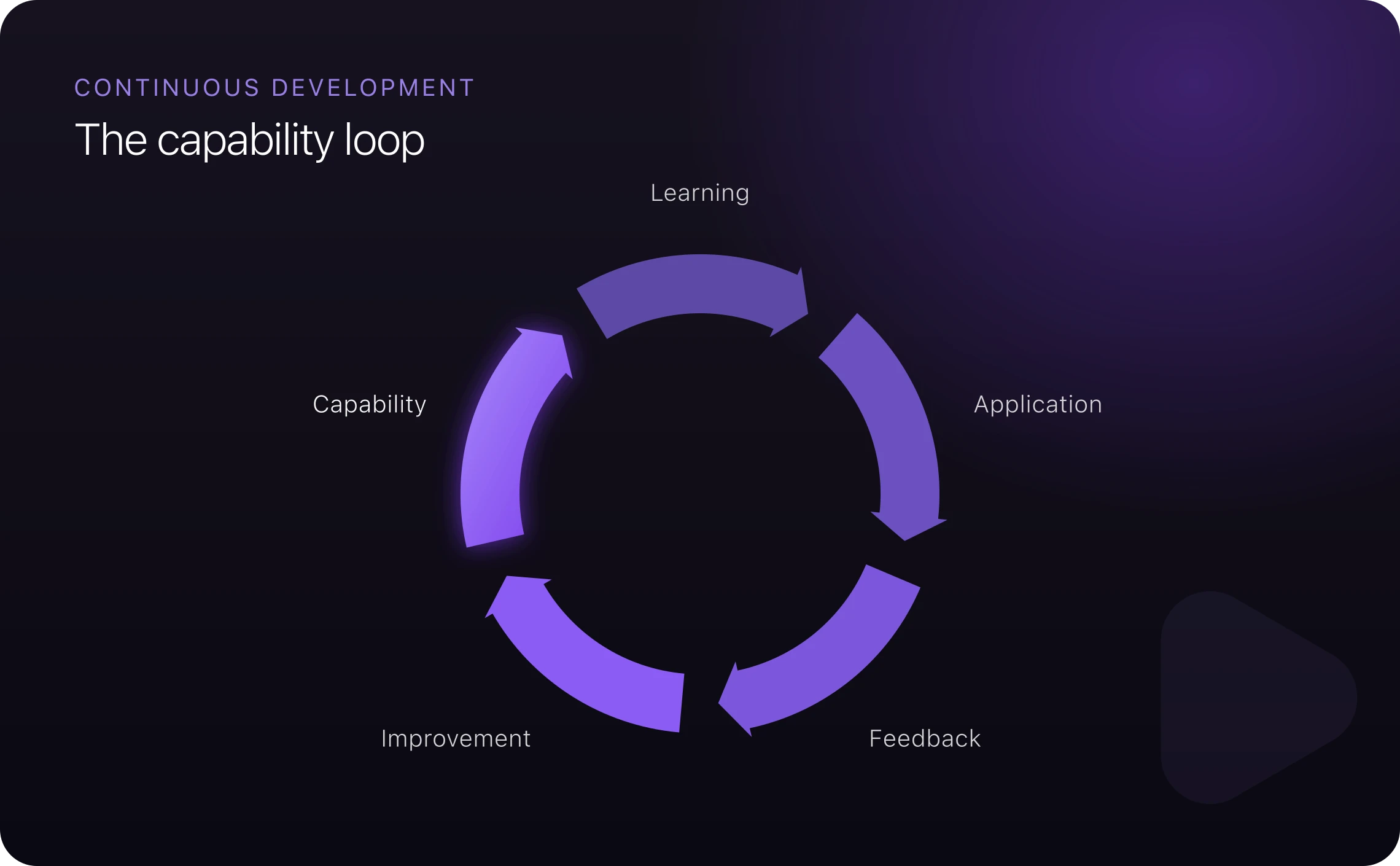
Each pass compounds — learning, application, feedback, and improvement build capability that keeps growing.
This process never truly ends.
The Kampster Perspective
At Kampster, we believe organizations are entering a new era — one where training alone is no longer enough. Learning remains important. But learning is only valuable when it creates capability.
This is why Kampster focuses on skill intelligence, capability assessment, contextual learning, personalized development, AI capability coaching, and workforce readiness. The objective is not simply to deliver courses. The objective is to help organizations create measurable capability growth.
The Future of Learning and Development
Learning and Development is undergoing a profound transformation. For decades, the discipline focused on managing training. The next decade will focus on managing capability. This shift changes the role of L&D entirely.
The most successful Learning and Development leaders will no longer be measured by courses delivered, learning hours, or completion rates. They will be measured by capability growth, workforce readiness, business outcomes, and organizational adaptability.
Conclusion
Training is not disappearing. But its role is changing. The future does not belong to organizations that deliver the most courses. It belongs to organizations that create the most capable people.
As Artificial Intelligence makes knowledge universally accessible, learning itself becomes less differentiating. Capability becomes the new competitive advantage. The question organizations must ask is no longer "How much training are we delivering?" The question is "What capabilities are we building?"
Because in the age of AI, training is not the destination. It is merely the beginning. Capability is what matters.