Beyond the AI Tutor: Why the Future of Learning Requires AI Capability Coaches, Not Chatbots
AI tutors answer questions. The next generation of learning AI pursues goals — turning knowledge into skills, skills into capability, and capability into real-world outcomes.


The challenge is no longer access to information. It is transforming information into capability.
The emergence of Generative AI has transformed access to knowledge. Today, anyone can ask an AI system a question and receive an answer within seconds. As a result, the role of educational technology is changing.
Most AI learning systems focus on answering questions. Few focus on helping people achieve goals — and this distinction is becoming increasingly important. Organizations do not invest in learning because they want employees to consume content. They invest because they want employees to perform better, develop new skills, solve problems, and adapt to change.
The future of AI in education therefore lies beyond tutoring. It lies in capability development. This paper explores why traditional AI tutors are insufficient for the future of learning and introduces the concept of the AI Capability Coach.
The AI Tutor Revolution
The first generation of AI-powered learning tools focused primarily on knowledge access. Users could ask questions and receive explanations instantly. This represented a major breakthrough: for the first time, learners had an always-available digital assistant.
The model was simple — Question → AI Tutor → Answer. It dramatically improved access to information, but it introduced a new limitation. Knowing is not the same as being capable.
The Knowledge-Capability Gap
Most learning systems assume that knowledge automatically creates competence. Reality suggests otherwise. Employees attend training programs but struggle to apply what they learned. Students pass exams but fail to transfer knowledge into real-world situations. Organizations invest in education but often see limited business impact.
The reason is simple: knowledge is only one stage in capability development. It flows through Knowledge → Understanding → Skill → Capability → Performance. Most AI tutors focus exclusively on the first step. Modern organizations need support across the entire chain.
Why Context Matters More Than Information
Consider two people asking the same question: "Teach me English." At first glance, both appear to have the same learning need. In reality, their contexts may be completely different.
One person wants to prepare for a job interview. Another wants to communicate with a partner from another country. The language is the same, but the objective is different — so the examples should be different, the learning path should be different, and the desired outcome should be different.
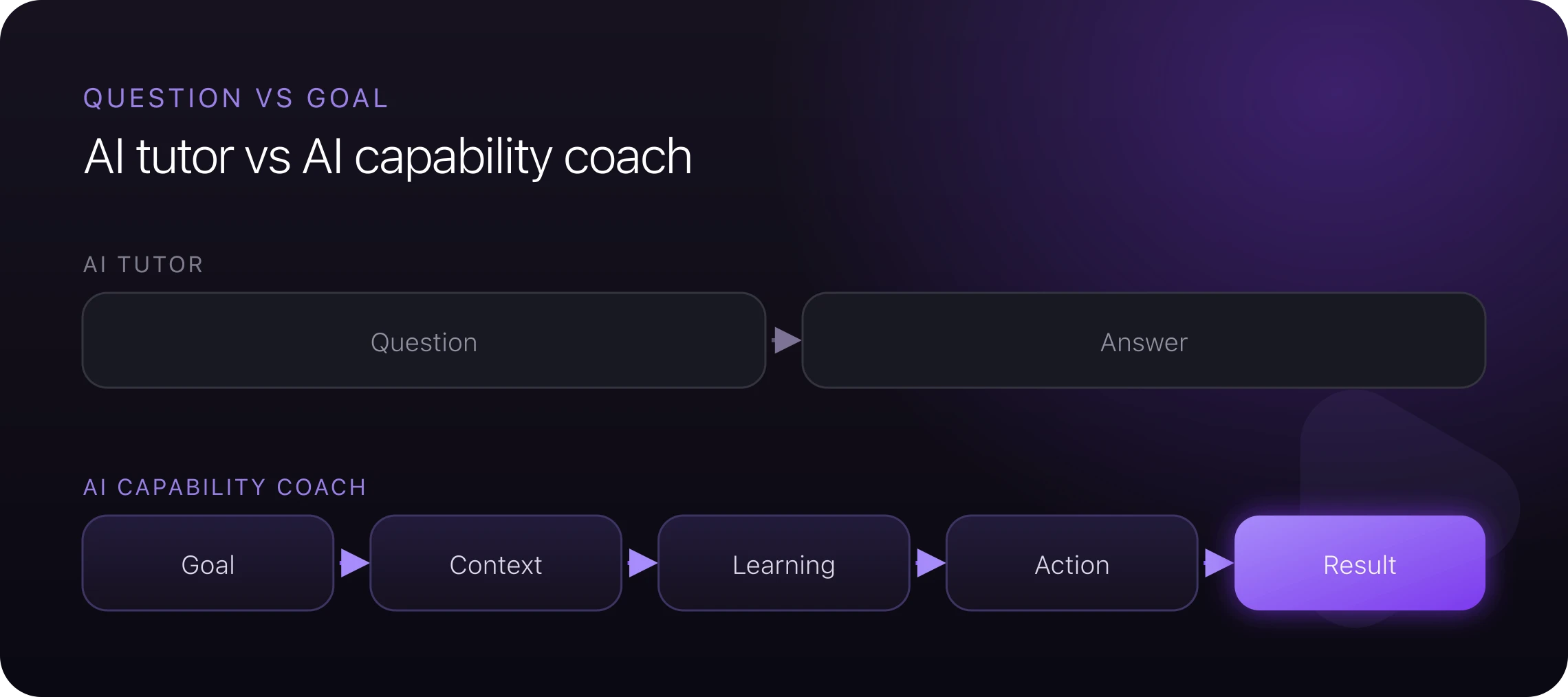
The tutor answers the question. The coach pursues the goal.
The second model reflects how people actually learn.
Introducing the AI Capability Coach
An AI Capability Coach is fundamentally different from a traditional AI tutor. Its purpose is not merely to answer questions — it is to help individuals develop capabilities.
A Capability Coach understands:
- what the learner wants to achieve
- what the learner already knows
- where capability gaps exist
- what context the learner operates in
- which skills need to be developed
- how progress should be measured
The focus shifts from information delivery to capability development.
The Kampster Approach
Kai was built around this principle. Rather than functioning solely as a conversational assistant, Kai is designed to become a context-aware capability development companion.
Kai understands the course being studied, the document from which the course was created, the learner's progress, assessment results, capability gaps, and development goals. This allows Kai to provide support that extends far beyond answering questions — moving from content to learning to guidance, and ultimately to capability growth.
The objective is not merely to help learners understand information. The objective is to help them apply it.
From Tutor to Learning Companion
The next stage of AI evolution is moving from tutoring toward guidance. A traditional tutor waits for questions. A Capability Coach actively supports development.
For example, Kai can explain concepts, identify misunderstandings, recommend next learning steps, highlight skill gaps, encourage reflection, and personalize learning experiences. The interaction becomes developmental rather than transactional.
From Learning Companion to Capability Coach
The most advanced learning systems will eventually move beyond content entirely. The central question will no longer be "What does the learner want to know?" Instead, it will become "What does the learner want to achieve?"
This shift fundamentally changes the role of AI. Development becomes goal-driven: a goal exposes a capability gap, Kai guides the learning, learning drives action, and action produces a result. Learning becomes a means rather than an end. Capability becomes the objective.
The Role of AI in Workforce Development
Organizations increasingly face challenges that traditional learning systems were never designed to solve, including AI readiness, leadership development, digital transformation, workforce reskilling, and capability mapping.
These challenges require more than content. They require continuous guidance and personalized development. Capability Coaches provide a mechanism for scaling this support across entire organizations.
Beyond Learning: Toward Lifelong Development
The long-term future of AI-powered learning extends beyond education. Individuals do not simply learn — they evolve. They change careers, develop new skills, adapt to new technologies, and pursue new goals.
The most valuable AI systems will not be those that provide the most answers. They will be those that provide the most effective guidance.
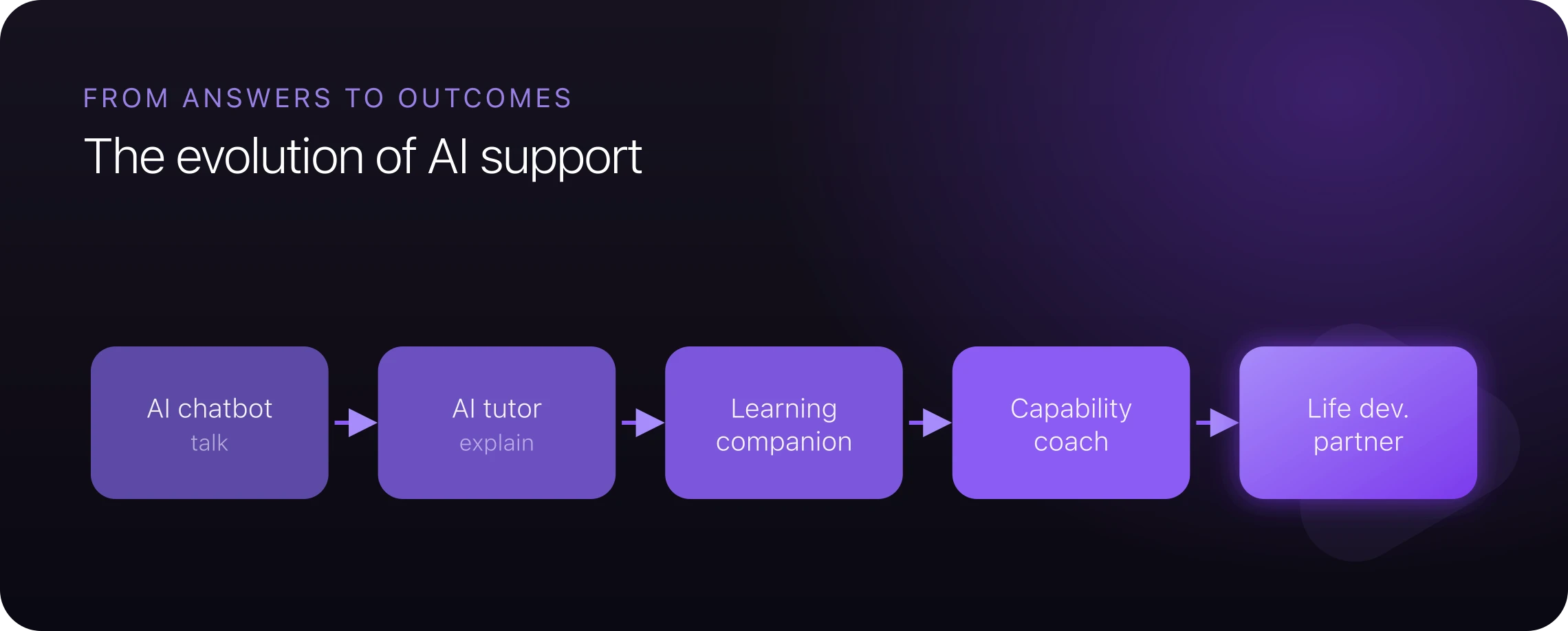
Each stage does more than the last — moving from delivering answers toward driving outcomes.
This progression reflects a broader shift in the role of artificial intelligence.
The Kampster LifOS Vision
Within the Kampster ecosystem, Kai represents more than a learning feature. It represents the foundation of a broader vision: a future where AI helps individuals continuously develop their knowledge, skills, capabilities, and potential — from knowledge to skills to capability to career to life goals.
The ultimate objective is not better learning. The ultimate objective is better outcomes.
The Kampster Perspective
The first generation of AI learning systems focused on information. The next generation will focus on capability. Traditional AI tutors answer questions; AI Capability Coaches help people achieve goals. This distinction will become increasingly important as organizations and individuals seek measurable outcomes rather than content consumption.
Kai was designed with this future in mind. Not as an AI chatbot. Not simply as an AI tutor. But as a context-aware Capability Coach that helps transform knowledge into skills, skills into capability, and capability into real-world outcomes. Because in the age of AI, the most valuable system is not the one that knows the most. It is the one that helps people become the most capable.