Context Is the New Curriculum
AI made content infinite, so content lost its value. The future of learning belongs to systems that understand why a person needs to learn — not just what.


Why AI is making traditional learning obsolete.
Executive summary
For centuries, education has been built around a simple assumption: if we provide the right content, learning will happen. Schools organize subjects, universities organize curricula, corporate learning platforms organize courses, and learning management systems organize content libraries. The underlying belief has remained largely unchanged — content is the foundation of learning.
Artificial intelligence is challenging this assumption. For the first time in history, content is no longer scarce. AI can generate explanations, examples, summaries, quizzes, learning materials, and entire courses in seconds. As content becomes abundant, its value begins to decline.
A new differentiator is emerging: context. The organizations that continue to focus primarily on content creation will increasingly struggle to engage learners. The organizations that understand context will create learning experiences that are more relevant, more effective, and more aligned with real-world outcomes.
This paper explores why context is becoming the most important variable in learning, and why the future of education, workforce development, and capability building will be defined not by content, but by relevance.
The end of the content era
Historically, access to content represented a competitive advantage. Educational institutions invested heavily in creating learning materials, organizations built extensive training libraries, and learning platforms competed based on the amount of content they offered. More content was assumed to create more value.
Artificial intelligence changes this equation. Today, almost anyone can generate courses, presentations, study guides, quizzes, summaries, simulations, and explanations. In the past, content was scarce and therefore valuable; in the present, content is abundant and value has shifted to context.
The challenge is no longer producing content. The challenge is delivering the right content to the right person at the right moment for the right reason.
The problem with traditional learning
Most learning systems still operate according to an industrial-era model. The assumption is that people with similar roles need similar learning experiences. As a result, everyone receives the same curriculum, follows the same sequence, gets the same examples, and is measured the same way.
This model was necessary when personalization was impossible. It is no longer necessary. The traditional path runs Content → Course → Learner → Completion.
The problem is that real life rarely follows a curriculum. People learn because they are trying to solve problems, because they are pursuing goals, because something in their life creates urgency. Traditional learning systems often ignore this reality.
A simple example
Consider two individuals learning the same language. A traditional learning platform sees them as identical learners. Both receive the same lessons, the same vocabulary, the same exercises, and the same progression.
Reality tells a different story. One learner is preparing for a business role in another country. The other wants to communicate with a partner from another culture before the birth of their child. The language is the same, but the purpose is entirely different — and so are the emotional drivers, the priorities, the desired outcomes, and the context. And context changes everything.
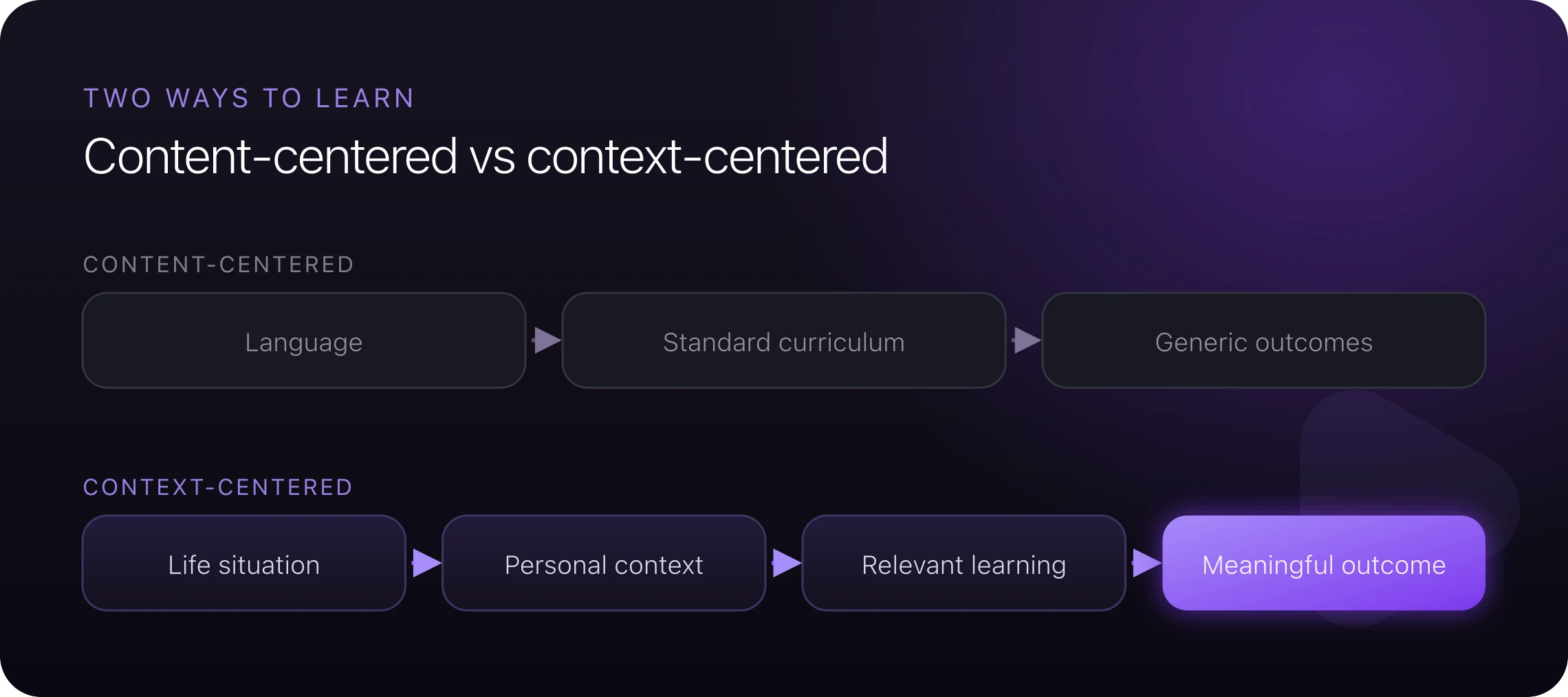
Same language, different purpose. Context — not content — decides what learning is worth.
The second approach reflects how people actually learn.
Why context drives motivation
One of the biggest challenges in education and workforce development is engagement. Organizations spend billions on learning platforms, yet employees still fail to complete courses and students still struggle to remain engaged.
The common response is to add motivation mechanisms — points, badges, leaderboards, rewards, gamification. These tools can help, but they address symptoms rather than causes. The deeper issue is often relevance. People rarely struggle to learn things that clearly improve their lives. They struggle to learn things that feel disconnected from their reality.
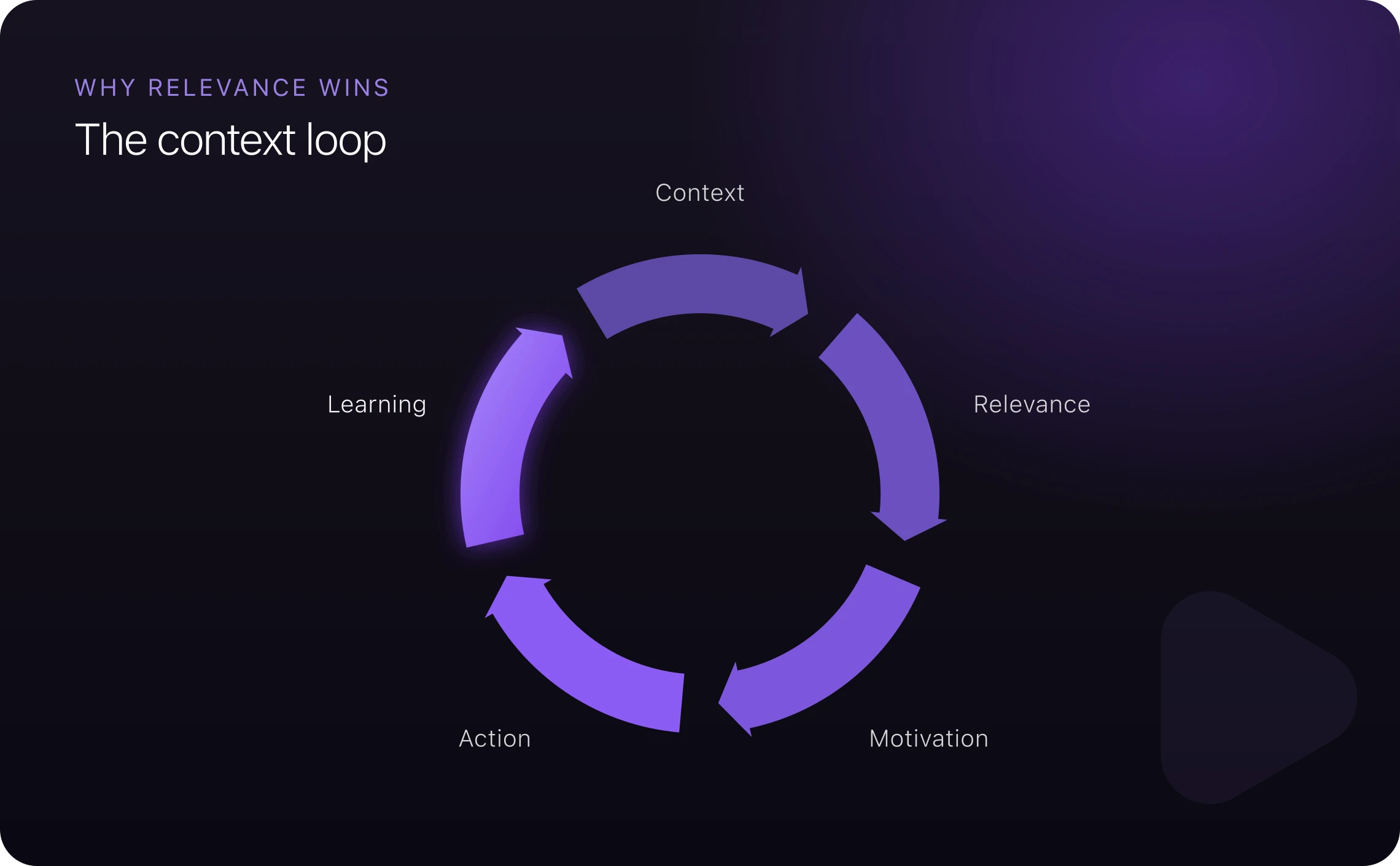
Context creates relevance, relevance creates motivation, motivation drives action — and action deepens context.
The stronger the context, the stronger the learning experience.
Why AI changes everything
Before artificial intelligence, contextual learning was difficult to scale. Teachers could personalize learning for a small number of students, managers could coach individual employees, and mentors could adapt guidance to specific circumstances. Mass personalization was impossible.
AI changes this equation. For the first time, learning systems can understand who the learner is, what they know, what goals they have, what skills they lack, what problems they are trying to solve, and what context they operate in.
The new path runs Learner context → AI understanding → Personalized learning → Capability development. The focus shifts from content delivery to outcome achievement.
From curriculum to capability
Traditional education asks: what should people learn? Context-driven learning asks: what are people trying to achieve? This distinction may appear subtle, but it is transformational.
When organizations focus on curriculum, learning becomes content-centered. When organizations focus on capability, learning becomes outcome-centered. The full arc runs Content → Curriculum → Learning → Capability → Outcome. The future belongs to systems that start with outcomes and work backward.
What this means for organizations
Organizations increasingly face challenges that cannot be solved through generic training — AI adoption, digital transformation, leadership development, workforce reskilling, and innovation capability. These challenges require learning experiences that adapt to individual roles, business goals, organizational priorities, and existing competencies.
The future of learning and development is therefore not more content. It is more context.
The Kampster perspective
At Kampster, we believe the future of learning will not be defined by content libraries. It will be defined by contextual intelligence. The most valuable learning systems will not simply answer questions — they will understand why the learner is asking them.
This requires combining personalized learning, skill intelligence, capability assessment, AI guidance, contextual understanding, and continuous development. The objective is not to create more learning content. The objective is to create more capable people.
The next generation of learning
The history of education can be viewed as a progression.
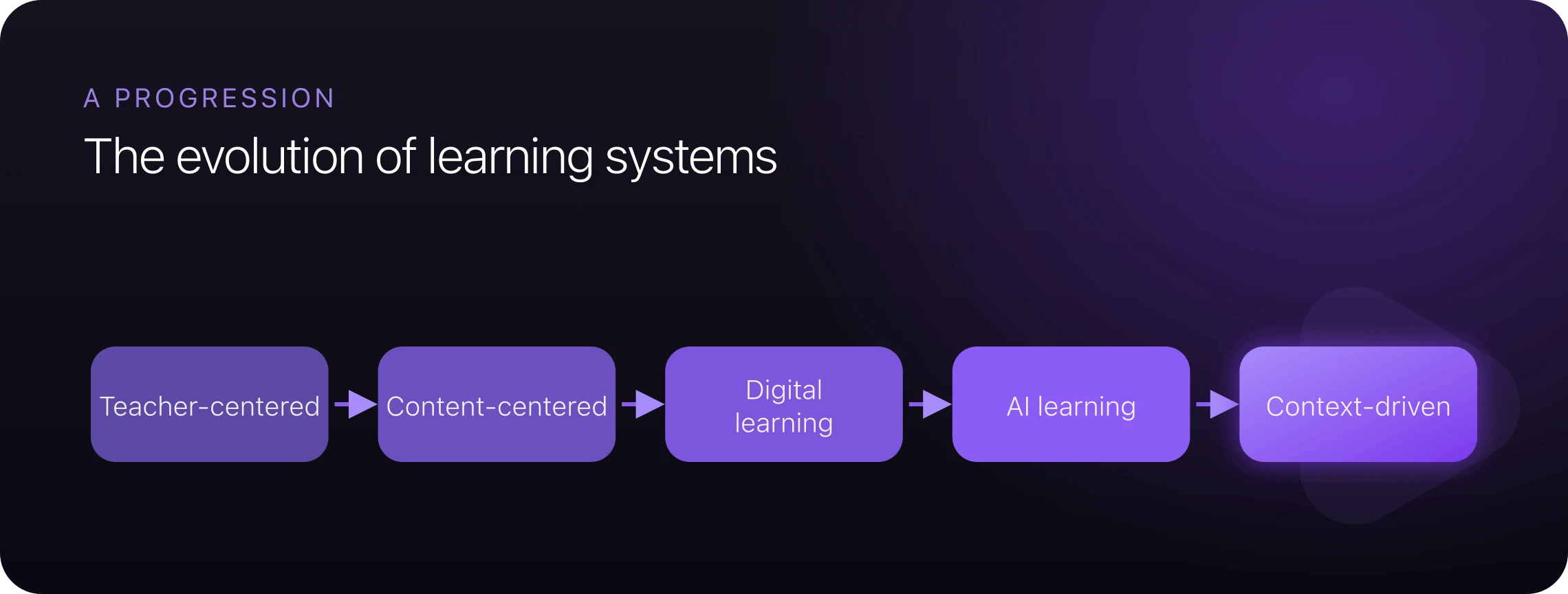
AI has already solved content generation. The next stage is understanding human context.
The next stage is not about generating more content — artificial intelligence has already solved that problem. The next stage is understanding human context.
Conclusion
The most important educational question of the AI era is no longer "What should people learn?" The most important question is: why do they need to learn it?
As content becomes abundant, context becomes valuable. As information becomes universal, relevance becomes differentiating. As AI tutors become common, understanding human goals becomes the new frontier.
The future of learning will not belong to the organizations with the largest content libraries. It will belong to the organizations that best understand the people they serve. Because in the age of AI, content is everywhere. Context is what makes learning matter.