The Capability Crisis
Organizations know where their servers, budgets, and customers are — but not where critical skills reside. Why capability is the least understood asset.


Why organizations know more about their technology than their people.
Executive summary
Organizations have never had more data. They can measure revenue in real time, customer behavior, operational efficiency, financial performance, software usage, and technology adoption. Yet many organizations struggle to answer a surprisingly simple question: what are our people actually capable of doing?
This gap between workforce visibility and workforce capability represents one of the most significant challenges facing organizations today. Companies know where their servers are. They know where their budgets are. They know where their customers are. But they often do not know where critical skills reside.
As artificial intelligence, automation, and digital transformation accelerate, this problem is becoming increasingly costly. Organizations are entering what can be described as a Capability Crisis — a situation in which workforce capability has become the most important competitive asset while simultaneously becoming the least understood.
The new competitive advantage
For decades, competitive advantage was built on assets. Companies competed through capital, infrastructure, distribution, technology, and information. Today, those advantages are becoming increasingly accessible: technology can be purchased, software can be licensed, information is available instantly, and AI is reducing barriers to knowledge.
As these advantages become commoditized, a new differentiator is emerging — capability: the ability of people to adapt, learn, solve problems, and create value.
The evolution is clear: Assets → Information → Technology → Capability. The organizations that succeed over the next decade will not necessarily have the best technology. They will have the workforce most capable of using it.
The visibility problem
Most organizations possess detailed information about their workforce. Human Resources departments know employee names, positions, salaries, tenure, departments, and certifications. Yet these metrics provide very limited insight into capability.
Knowing that an employee completed a course does not reveal whether they can apply the knowledge. Knowing someone's job title does not reveal their actual skill level. Knowing years of experience does not guarantee competence.
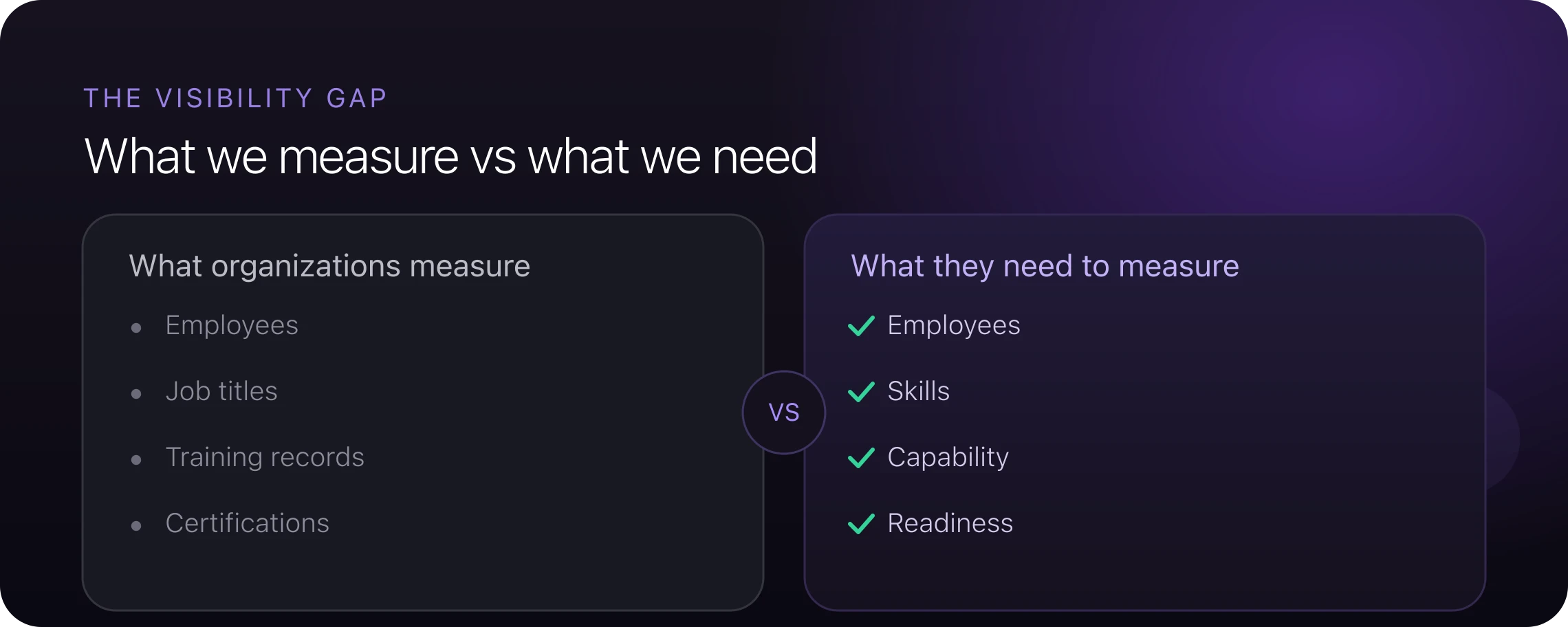
Job titles and certificates describe people. Only skills and readiness describe capability.
This gap creates a dangerous blind spot.
Why traditional talent systems are no longer enough
Most workforce systems were built for stability. Jobs were relatively predictable, career paths were linear, and skills changed slowly. That world no longer exists.
Artificial intelligence is reshaping roles faster than organizations can redesign job descriptions. New capabilities emerge every year, and entire professions are evolving. The challenge facing leaders is no longer managing jobs — it is managing capabilities. This requires a fundamentally different approach.
The hidden cost of capability blindness
Organizations often assume they understand their workforce. In reality, they frequently make critical decisions without objective capability data. This affects:
- Hiring — organizations hire based on CVs, interviews, and assumptions.
- Promotion — employees are promoted based on past performance rather than future capability.
- Workforce planning — strategic decisions are made without understanding existing skills.
- Transformation — new technologies are implemented without understanding workforce readiness.
- Learning and development — training programs are deployed without knowing actual skill gaps.
The cost chain is predictable: Poor visibility → Poor decisions → Capability gaps → Lower performance → Higher costs. Most organizations address the symptoms. Few address the root cause.
The AI readiness challenge
Artificial intelligence has intensified the Capability Crisis. Organizations worldwide are investing heavily in AI, but technology adoption depends on people. The key question is no longer "Do we have access to AI?" — it is "Do our people have the capability to use it effectively?"
Many organizations cannot answer who is AI-ready, which teams need development, what skills are missing, or how quickly capability gaps can be closed. Without these answers, AI transformation becomes a gamble.
The sequence that actually creates value runs Technology investment → Workforce capability → Adoption → Business impact. Technology alone does not create transformation. Capability does.
The rise of skill intelligence
To solve the Capability Crisis, organizations need a new layer of visibility. This layer is Skill Intelligence.
Skill Intelligence moves beyond job titles, resumes, certifications, and course completion rates. Instead, it focuses on actual capability, verified skills, capability gaps, workforce readiness, and future development needs.
The framework is straightforward: Assessment → Capability analysis → Skill intelligence → Strategic decisions. This transforms workforce management from assumption-based decision-making to evidence-based decision-making.
From human resources to human capability management
Historically, Human Resources focused on managing people. The next generation of organizations will focus on managing capability.
This transition is already underway. Leading organizations increasingly recognize that workforce capability is becoming as important as financial capital.
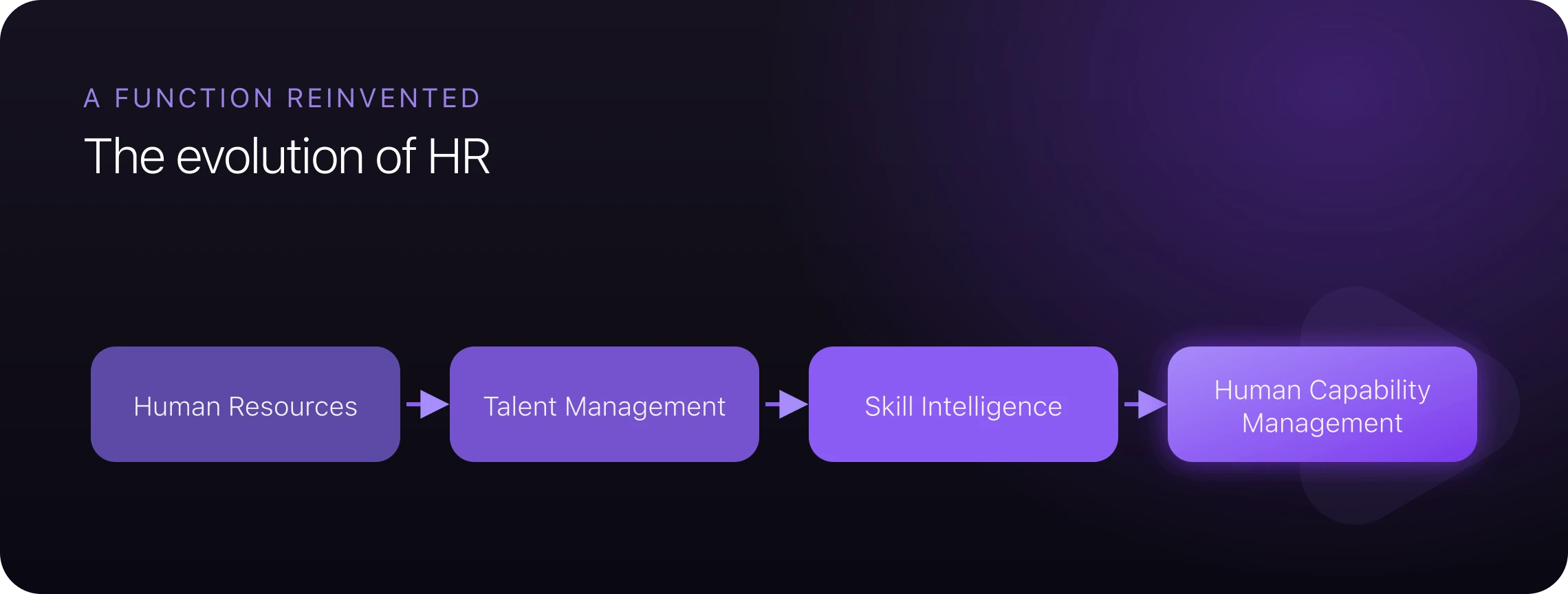
The central question shifts from “How many employees do we have?” to “What capabilities do we have?”
The organizations that make this transition successfully will gain a significant competitive advantage.
The Kampster perspective
At Kampster, we believe the Capability Crisis represents one of the defining challenges of the AI era. Organizations do not suffer from a lack of learning platforms. They suffer from a lack of capability visibility.
They need systems that can help them identify skills, measure capability, verify competence, detect gaps, support development, and monitor readiness. This is why Kampster combines advanced skill assessment, skill intelligence, personalized learning, workforce readiness analysis, and AI capability development. The objective is not simply to deliver training — it is to help organizations understand and develop capability.
Conclusion
The next decade will not be defined by who has the most information. Artificial intelligence is making information universally accessible. The next decade will be defined by who develops capability the fastest.
Organizations that understand their workforce capabilities will adapt faster. They will hire better, develop talent more effectively, implement technology more successfully, and respond to change more confidently.
The greatest risk facing organizations is not a shortage of talent. It is the inability to see, understand, and develop the talent they already have. That is the Capability Crisis — and solving it may become one of the most important priorities of the AI era.