The Capability Revolution: Why the New Kampster AI Doesn't Teach People, It Makes Them More Capable
The biggest shift in the new Kampster AI isn't technological — it's methodological. Why we stopped trying to boost motivation and started building capability through daily micro-habits.

A note from the founders on the launch of the new Kampster AI — and why we stopped trying to motivate people and started making them capable.
We spent decades solving the wrong problem
We are at the beginning of the biggest transformation in human potential development since the birth of the internet. Over the past twenty years, organizations have invested billions in LMS platforms, online courses, and digital academies with one goal — helping people acquire knowledge and skills faster. The result is paradoxical: knowledge has never been more accessible, yet it has never been harder to turn that knowledge into real capability. The number of completed courses keeps growing, the number of certificates keeps growing, but the development of real competencies isn't keeping pace.
The reason isn't a lack of content or technology. The reason is that the online learning industry spent decades trying to solve the wrong problem — motivation. Gamification, badges, points, and push notifications got people to open apps more often and finish more lessons, but rarely made them more capable. Motivation can spark behavior, but it rarely sustains it over time. This isn't a problem unique to digital learning — it's a universal problem of human behavior. A lack of information is almost never the obstacle; the obstacle is sustaining behavior over time.
What the first Kampster taught us
We arrived at this insight through the experience of the first Kampster. We saw the same pattern again and again: people start with enthusiasm, watch a few lessons, earn a certificate — and quickly slide back into old habits. The knowledge they gained never becomes part of their daily life. People don't develop capability; they develop temporary knowledge. That led us to the question that changed the direction of the entire company: what if motivation was never the real problem?
Reduce dependence on motivation, don't boost it
The biggest shift in the philosophy of the new Kampster AI isn't technological, it's methodological. Instead of trying to boost motivation, we're trying to reduce dependence on it. If a person has to find new motivation every single day just to learn, they'll give up quickly. If learning becomes part of their routine, the need for motivation shrinks.
That's why the platform is built around micro-habits — small, simple activities that take five to ten minutes and, through repetition, turn into automatic behavior. Over time these small activities stop requiring effort. They become routine, and routine is the foundation of long-term capability development.
This isn't just intuition. As far back as the late 19th century, the German psychologist Hermann Ebbinghaus showed that people quickly forget new information unless they repeat and apply it. The brain doesn't reward reading — it rewards use. That's why so many traditional trainings have limited long-term impact: they transfer information but don't build behavior.
Knowledge, skill, capability
Kampster AI doesn't measure how much content a user has watched, but how much more capable they are than yesterday. Knowledge answers the question of what you know. Skill answers the question of what you can do. Capability answers a different question — can you do it consistently, across different circumstances, over time? That's a much higher level of development, and it's exactly what we're building toward.
That development moves through clearly defined levels, and most platforms today stop at the second or third. Our goal is to take the user all the way to the fifth.
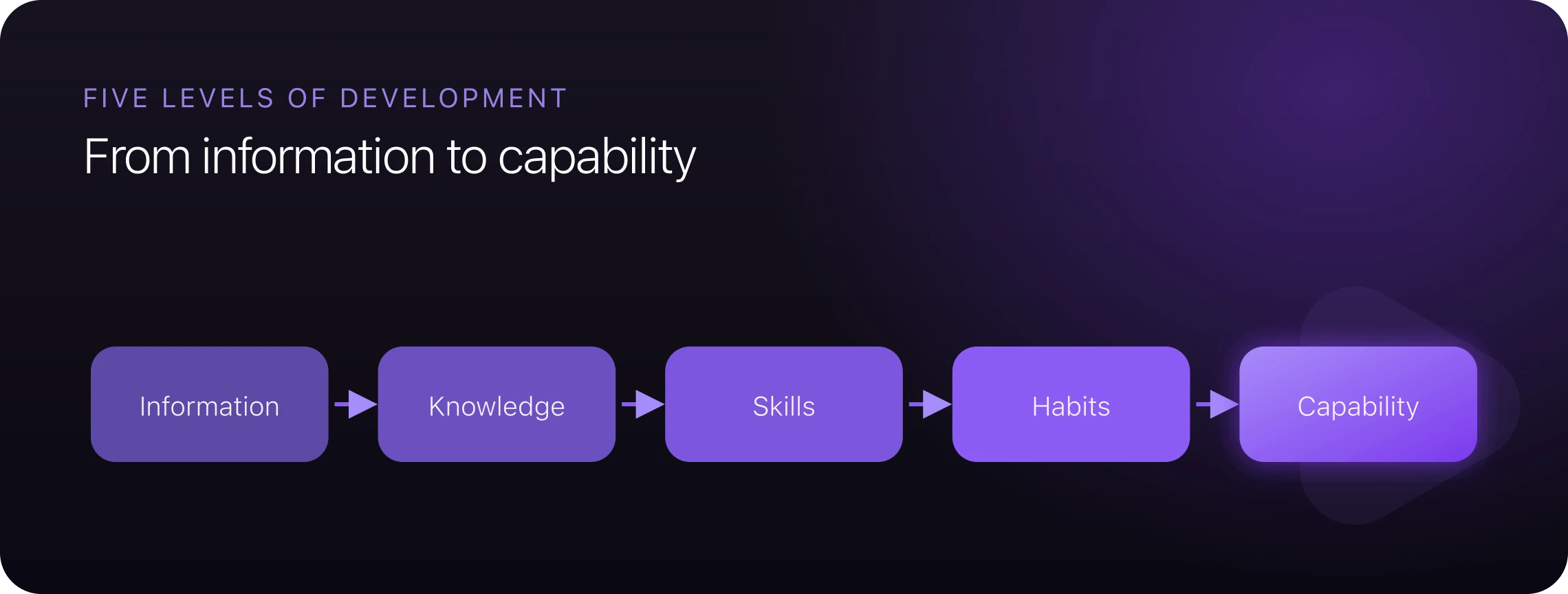
Most platforms stop at knowledge or skills. Kampster AI takes the user all the way to capability — consistent results regardless of context.
An AI coach, not a chatbot
That journey is driven by an AI that doesn't function like a chatbot handing out answers, but like a coach that knows when a user needs new information, when they need to practice, when they need to review, and when they're ready to be challenged with something harder. Through continuous assessment, a personalized plan, daily practice, and verification, every pass through that cycle makes the user more capable — not because they finished another course, but because they genuinely developed a new capability.
The new methodology and the new Kampster AI platform were first soft-launched at the Future & AI conference in June 2025, and shortly after presented at an international scientific conference in Linz at Johannes Kepler University in Austria.
The rise of Human Capability Management
The same logic is changing how companies should think about developing their people. Until recently, the biggest cost was producing content — manuals, video lessons, courses. Today, generative AI can do most of that work in minutes, which means content stops being scarce and becomes a commodity. What becomes valuable is the ability to turn that content into measurable behavioral change.
That's why we believe the next decade will give rise to a new software category — Human Capability Management — the same way CRM or Marketing Automation emerged before it, when old tools stopped answering the right questions. This shift already has concrete applications: in AI literacy, onboarding, compliance training, leadership development, and sales teams, where consistent behavior — not the number of completed trainings — makes the difference.
Most companies today know how many employees they have, how many training hours were delivered, and how many certificates were issued. Very few can answer a simpler question — what capabilities do we actually have, and which ones will we be missing in two years? That is exactly why we believe HR will transform into Human Capability Management over the next decade, where what matters most isn't how many people a company has, but which capabilities it holds.
The end of the access era
We're at the end of an era whose goal was to give people access to knowledge — a mission that, thanks to AI, has largely been accomplished. But if everyone has access to the same knowledge, it no longer makes the difference. What makes the difference is human capability — the ability to understand, apply, adapt, and continuously develop knowledge.
That's why Kampster AI wasn't built as just another online learning platform, but as infrastructure for human potential development in the age of artificial intelligence. Not so people learn more. So they become more capable.