How a National Child Protection Initiative Achieved More Than 280,000 Completed Learning Programs Using Kampster Technology
A national child protection initiative used Kampster to deliver large-scale digital education — 280,000+ completed programs and a completion rate above 87%.


A case study in large-scale digital education and social impact.
Executive summary
Around the world, governments, NGOs, educational institutions, and international organizations face a common challenge: how do you educate large populations about critical social issues in a way that is scalable, measurable, and effective?
Traditional approaches rely heavily on in-person workshops, classroom training, seminars, and printed materials. While valuable, these methods often struggle to reach large audiences consistently and efficiently.
This case study explores how a national child protection initiative successfully used Kampster technology to deliver large-scale digital education across an entire country. The initiative focused on educating key stakeholders involved in child protection, including teachers, school staff, professionals, parents, and institutional representatives. The results demonstrate the potential of modern digital learning systems to support public policy goals, social impact programs, and large-scale behavioral change initiatives.
The project demonstrates how digital learning can move beyond corporate training and become a strategic tool for addressing complex societal challenges.
The global challenge
Every country faces situations where large groups of people must quickly develop new knowledge and competencies. Examples include child protection, public health, digital literacy, cybersecurity awareness, AI readiness, environmental sustainability, workplace safety, and regulatory compliance.
The challenge is rarely the lack of educational content. The challenge is distribution, engagement, consistency, and measurable outcomes. Organizations often ask: how can we ensure that thousands — or even hundreds of thousands — of people actually complete training and absorb the knowledge? This challenge becomes even more difficult when participants come from different professions, institutions, locations, and levels of expertise.
The context
The project examined in this paper focused on strengthening knowledge and awareness related to child protection and violence prevention. The initiative brought together stakeholders from multiple sectors, including:
- education
- social services
- healthcare
- public administration
- family support systems
Rather than relying exclusively on physical seminars and workshops, the program adopted a digital-first approach powered by Kampster technology. The objective was simple: provide high-quality educational content at scale while maintaining accessibility, consistency, and measurable participation.
The solution
Kampster provided the learning infrastructure that enabled the initiative to operate on a national scale. The platform supported:
- online learning delivery
- self-paced education
- learner progress tracking
- knowledge assessment
- certification
- reporting and analytics
This allowed thousands of users to access learning materials regardless of their location or schedule. Instead of organizing hundreds of physical events, educational content became available on demand. Participants could learn at their own pace while institutions maintained visibility into participation and completion rates.
Results at scale
The most significant outcome of the initiative was its ability to achieve both scale and engagement simultaneously. Many digital learning programs succeed at attracting registrations but struggle to achieve meaningful completion rates. This initiative demonstrated a different pattern.
Adoption
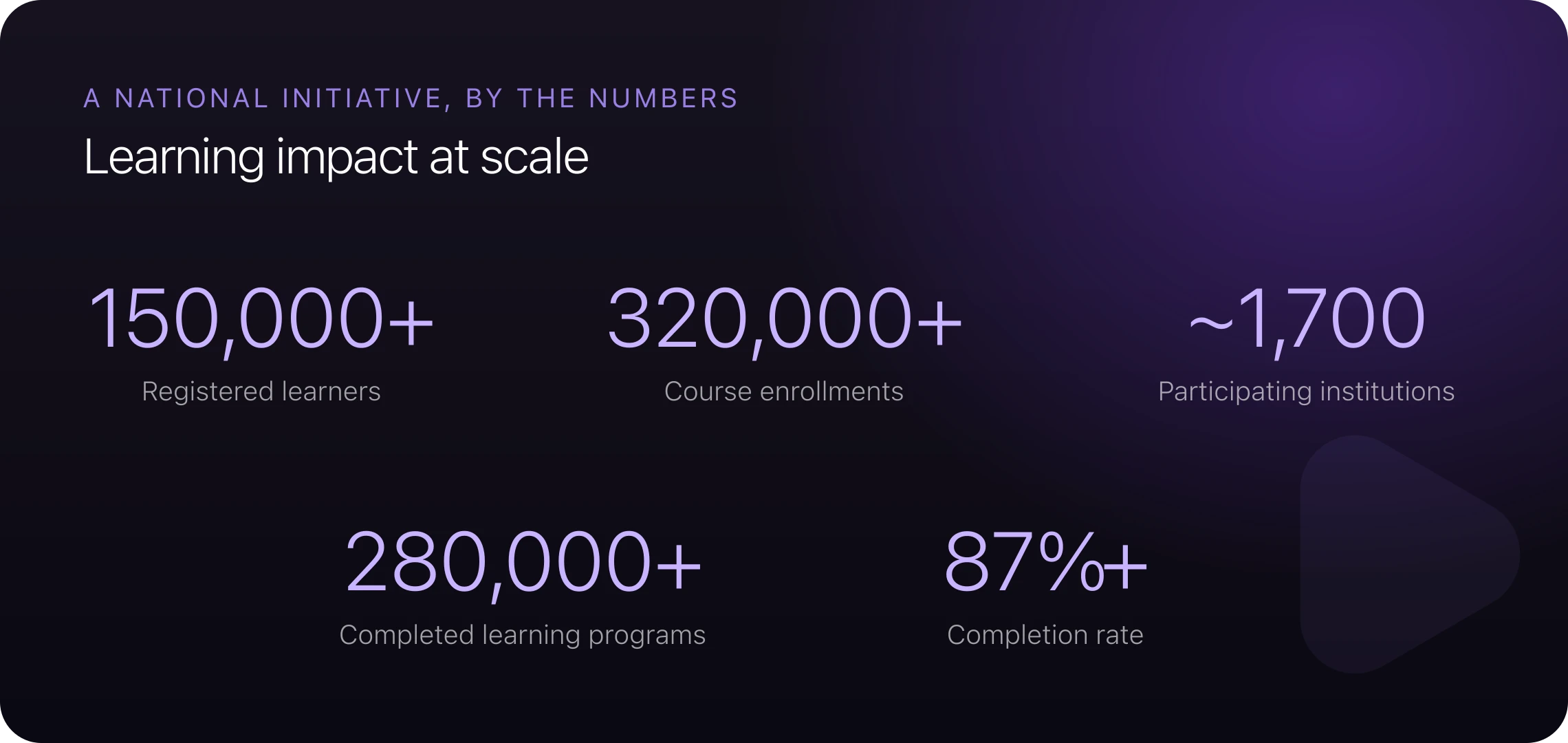
More than 150,000 individuals registered on the platform. For many organizations, reaching this level of participation would already be considered a major success.
Engagement
Users enrolled in more than 320,000 learning programs. This indicates that participants did not simply register and leave — they actively engaged with educational content.
Completion
More than 280,000 learning programs were successfully completed, representing a completion rate exceeding 87%. In the world of online learning, where many programs struggle with completion rates below 20%, this result is particularly significant.
Institutional reach
Approximately 1,700 institutions participated in the initiative. This demonstrates that the project successfully moved beyond individual learners and became embedded within organizational structures.
Why these results matter
The value of this project extends beyond the numbers. Each completed learning program represents an individual who gained knowledge and awareness about issues directly affecting the safety and well-being of children.
More importantly, the initiative demonstrates a broader principle: large-scale education is no longer limited by geography. Modern learning platforms can enable governments and organizations to reach entire populations with consistent, measurable, and accessible educational experiences. This capability has implications far beyond child protection — the same model can be applied to virtually any area where knowledge transfer and behavioral change are required.
Lessons learned
Several key lessons emerged from the initiative.
Accessibility drives participation
When education becomes available anytime and anywhere, participation increases dramatically. Removing logistical barriers expands reach.
Consistency improves quality
Every participant receives the same information, reducing variations that often occur in traditional training programs.
Data enables better decisions
Organizations can track enrollment, completion, and engagement in real time. This allows continuous improvement based on evidence rather than assumptions.
Social impact can be scaled
Digital learning is not only a tool for workforce development. It can also serve as critical infrastructure for achieving social impact objectives.
Implications for governments
Governments worldwide are increasingly required to educate large populations about complex topics. Digital learning platforms can help address these challenges more efficiently than traditional approaches alone. Potential applications include:
- public health campaigns
- digital literacy initiatives
- cybersecurity awareness
- environmental programs
- teacher development
- workforce reskilling
- AI literacy
The success of this initiative demonstrates that national-scale education programs can achieve both reach and engagement when supported by the right technology.
Implications for international organizations
Organizations such as UNICEF, UNESCO, OECD, the World Bank, and various NGOs often face similar challenges. Their programs frequently depend on changing knowledge, awareness, and behavior across large populations. The findings from this initiative suggest that digital learning infrastructure can significantly increase both reach and measurable outcomes while reducing operational complexity.
What this means for the future of learning
The future of education is not defined by classrooms versus online learning. It is defined by the ability to deliver the right knowledge to the right people at the right time — and to verify that learning has actually occurred. The next generation of learning platforms will not be judged solely by the amount of content they provide. They will be judged by their ability to create measurable impact.
The Kampster perspective
This initiative demonstrates how digital learning can support large-scale social impact programs.
The most important lesson is not technological. It is strategic: when educational content becomes accessible, measurable, and scalable, learning can become a powerful tool for societal transformation.
Conclusion
The challenge facing governments, organizations, and institutions is no longer whether large-scale education is possible. The challenge is how quickly they choose to implement it.