What If Your Employees Are Not as Skilled as You Think?
CVs, interviews, and certificates measure participation, not capability. Why organizations need Skill Intelligence to make better workforce decisions.


Why organizations need Skill Intelligence to make better hiring, promotion, and workforce decisions.
Executive summary
Organizations invest billions of euros every year in hiring, training, certification, and workforce development. Yet most cannot confidently answer one simple question: what are our people actually capable of doing?
Traditional methods of assessing talent were designed for a different era. CVs describe experience, interviews measure communication, certificates confirm participation, and training records show completion. None of these methods reliably measure actual capability.
As organizations face rapid technological change, AI adoption, and increasing skills shortages, understanding workforce capability has become a strategic necessity. This challenge is creating demand for a new category of workforce intelligence: Skill Intelligence. Kampster's Advanced Skill Assessment was designed to help organizations move beyond assumptions and gain visibility into actual capabilities, skill gaps, workforce readiness, and development priorities.
The capability visibility problem
Most organizations possess extensive workforce data. They know employee names, positions, departments, salaries, years of experience, and certifications completed. However, they often lack visibility into the most important asset of all: capability.
Executives frequently make decisions regarding hiring, promotion, succession planning, workforce transformation, AI adoption, and internal mobility without objective evidence of actual competence. The chain that drives most of these decisions runs Employee → Job title → Experience → Certification → assumed capability. The problem is that capability is assumed rather than measured — and that creates significant organizational risk.
Why traditional assessments are failing
Traditional testing approaches were built around standardization. Everyone receives the same questions, everyone follows the same assessment path, and everyone receives a score. While simple to administer, this approach has major limitations.
It often measures memorization, test-taking ability, and short-term recall. It rarely measures applied competence, decision-making, practical understanding, or capability development potential. Most importantly, it fails to adapt to individual differences — a beginner and an expert often receive exactly the same assessment experience.
The self-assessment challenge
Many organizations rely heavily on employee self-assessments, asking people to rate themselves across various competencies. While useful as a reflection exercise, self-assessment has significant limitations.
Research in behavioral psychology consistently demonstrates that people struggle to accurately evaluate their own abilities. Some employees overestimate their competence; others underestimate their potential. The result is distorted workforce data.
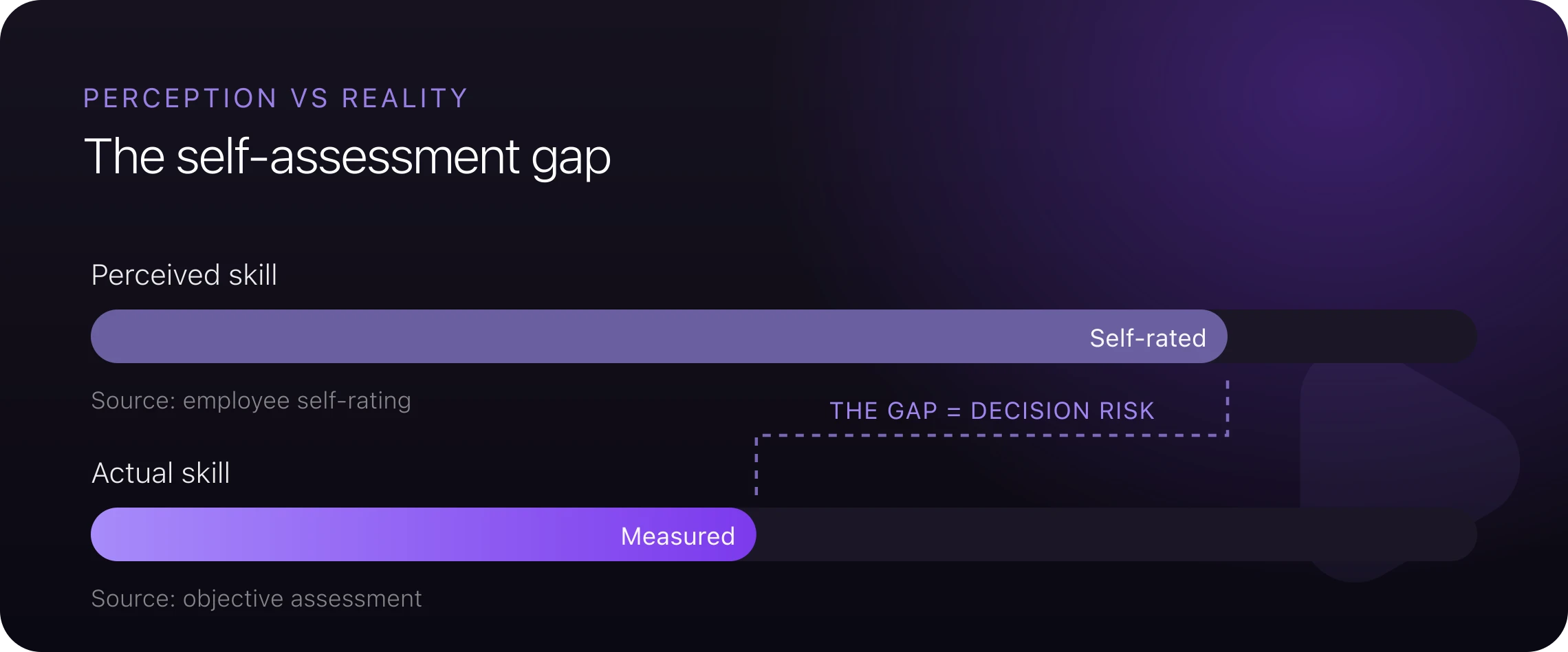
A wider gap means worse hiring and promotion calls — decisions made on perception instead of evidence.
The larger the gap between perception and reality, the greater the risk of poor workforce decisions.
Introducing adaptive skill assessment
Kampster approaches capability measurement differently. Rather than treating assessment as a static test, Kampster uses adaptive assessment methodologies powered by AI. The system continuously adjusts the assessment experience based on the individual's responses, so each answer influences the next: Question → Answer → AI evaluation → next best question.
This allows the system to identify competence levels more quickly and more accurately than traditional testing approaches. Instead of measuring how many questions a person answers correctly, the system focuses on understanding where capability actually begins and ends.
Measuring more than knowledge
Knowledge alone is not enough. Organizations do not succeed because employees know things — they succeed because employees can apply what they know. For this reason, Kampster's Advanced Skill Assessment evaluates multiple dimensions of capability: Knowledge → Understanding → Application → Decision-making → Problem-solving.
This enables a more comprehensive understanding of workforce capability. An employee may understand a concept theoretically but struggle to apply it. Another may possess strong practical skills despite limited theoretical knowledge. Both profiles require different development strategies.
From assessment to skill intelligence
Traditional assessments generate scores. Skill Intelligence generates insights. The goal is not simply to identify performance — it is to understand capability.
Kampster transforms assessment data into actionable intelligence, following the path Assessment → Capability analysis → Skill intelligence → Organizational insights. Organizations can identify workforce strengths, capability gaps, development priorities, future skill requirements, and readiness levels — enabling better workforce planning and more informed talent decisions.
Identifying skill gaps
One of the most valuable outcomes of capability assessment is the ability to identify skill gaps. Many organizations invest in training without fully understanding where development is actually needed, so learning investments often become generic rather than targeted.
Skill gap analysis — Current capability → Gap analysis → Target capability — allows organizations to focus resources where they will have the greatest impact. The result is more efficient workforce development and stronger business outcomes.
Personalized development
Assessment is only the beginning. Once capability gaps are identified, organizations need a pathway for development, and Kampster automatically connects assessment outcomes with personalized learning experiences.
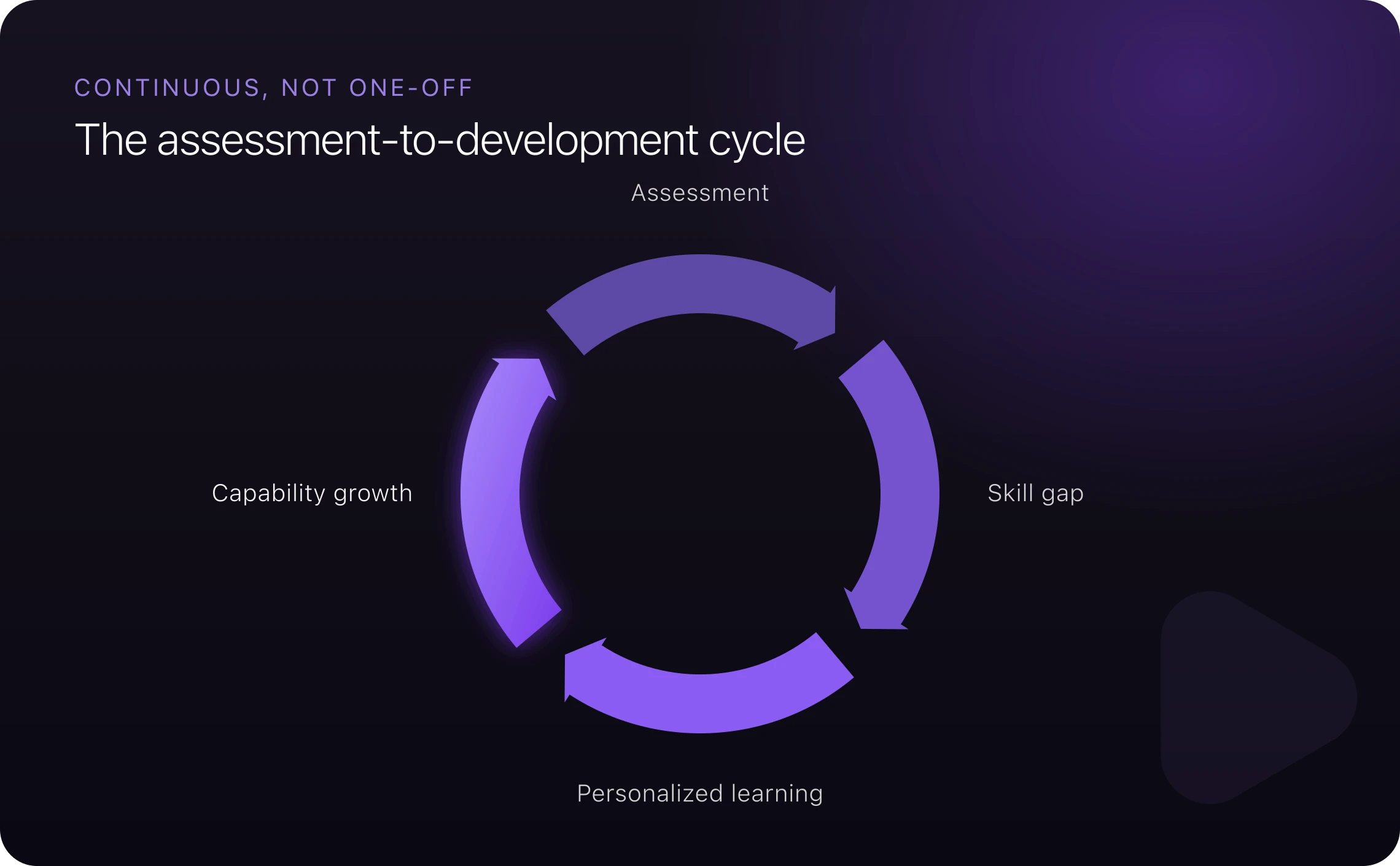
Reassessment restarts the loop, not a fresh test.
This creates a continuous improvement cycle rather than a one-time evaluation process.
Workforce readiness in the AI era
Artificial Intelligence is transforming every industry. As organizations adopt AI technologies, they face a critical challenge: do employees possess the capabilities required to work effectively alongside AI? The answer often remains unclear.
Kampster's Advanced Skill Assessment provides visibility into workforce readiness by identifying existing capabilities, emerging capability gaps, future development priorities, and organizational preparedness for change. This transforms capability development from a reactive activity into a strategic advantage.
The Kampster perspective
The future of talent management will not be defined by resumes, certificates, or course completion rates. It will be defined by capability visibility. Organizations that understand their capabilities will hire more effectively, promote more accurately, develop talent more efficiently, adapt more quickly, and compete more successfully.
By combining adaptive assessment, capability analysis, skill intelligence, and personalized development, organizations gain a deeper understanding of what their people can actually do — and what they need to develop next.
Conclusion
The greatest workforce challenge facing organizations today is not a lack of talent. It is a lack of visibility into talent. Traditional assessments were designed to measure knowledge; modern organizations need systems capable of measuring capability.
Kampster's Advanced Skill Assessment was built to address this challenge. Because in the age of AI, competitive advantage will belong not to organizations with the most information, but to those with the clearest understanding of human capability.