Context Is the Curriculum: Why the Future of Learning Is Not About Content, But About Relevance
When AI makes knowledge instantly accessible, the value of learning shifts from content to context — the right information for a specific person, moment, and purpose.


Why relevance — not content — is becoming the real curriculum for the organizations that train the workforce.
Executive summary
For decades, the organizations that train people — corporate L&D teams and education systems alike — have been designed around content. Training was organized by subjects, learning paths by topics, and success was measured by the amount of information delivered. Artificial intelligence is changing this paradigm. When knowledge becomes instantly accessible, the value of learning no longer lies in content itself. The value lies in context.
The most effective learning experiences are not those that provide the most information. They are those that provide the most relevant information for a specific person, at a specific moment, for a specific purpose. This paper explores why context is becoming one of the most important factors in learning, and how AI-powered systems can move beyond content delivery toward context-driven capability development.
The problem with traditional learning
Imagine two people learning the same language. Traditional education assumes they need the same curriculum, the same lessons, the same vocabulary, the same exercises, the same progression. From the perspective of the educational system, both learners appear identical. From the perspective of reality, they could not be more different.
The problem is that traditional learning systems optimize for content standardization rather than personal relevance. As a result, learners often struggle to remain engaged because the material feels disconnected from their actual lives.
A real-life learning scenario
Consider a young couple expecting their first child. The woman comes from one country, the man from another, and they speak different native languages. As they prepare to become parents, the man decides to learn his partner's language. At first glance, this appears to be a typical language-learning challenge. In reality, it is something entirely different.
He is not learning the language because he plans to work in that country. He is not learning it for tourism, nor preparing for an academic examination, nor trying to achieve fluency for professional purposes. He is learning because he wants to build a stronger relationship with the person he loves. He wants to communicate with her family, understand conversations about their future child, and participate more fully in decisions, emotions, traditions, and everyday moments.
His goal is not language. His goal is connection. The language is simply the tool.
Why context changes everything
Traditional language learning systems would likely begin with greetings, travel vocabulary, restaurant conversations, hotel reservations, directions, and airport situations. These topics may be useful, but they are not relevant. The learner's actual context is completely different.
What he truly needs is vocabulary related to:
- pregnancy
- family
- emotions
- childcare
- health
- everyday conversations
- future planning
The difference is profound. The content may belong to the same language, but the learning experience is entirely different.
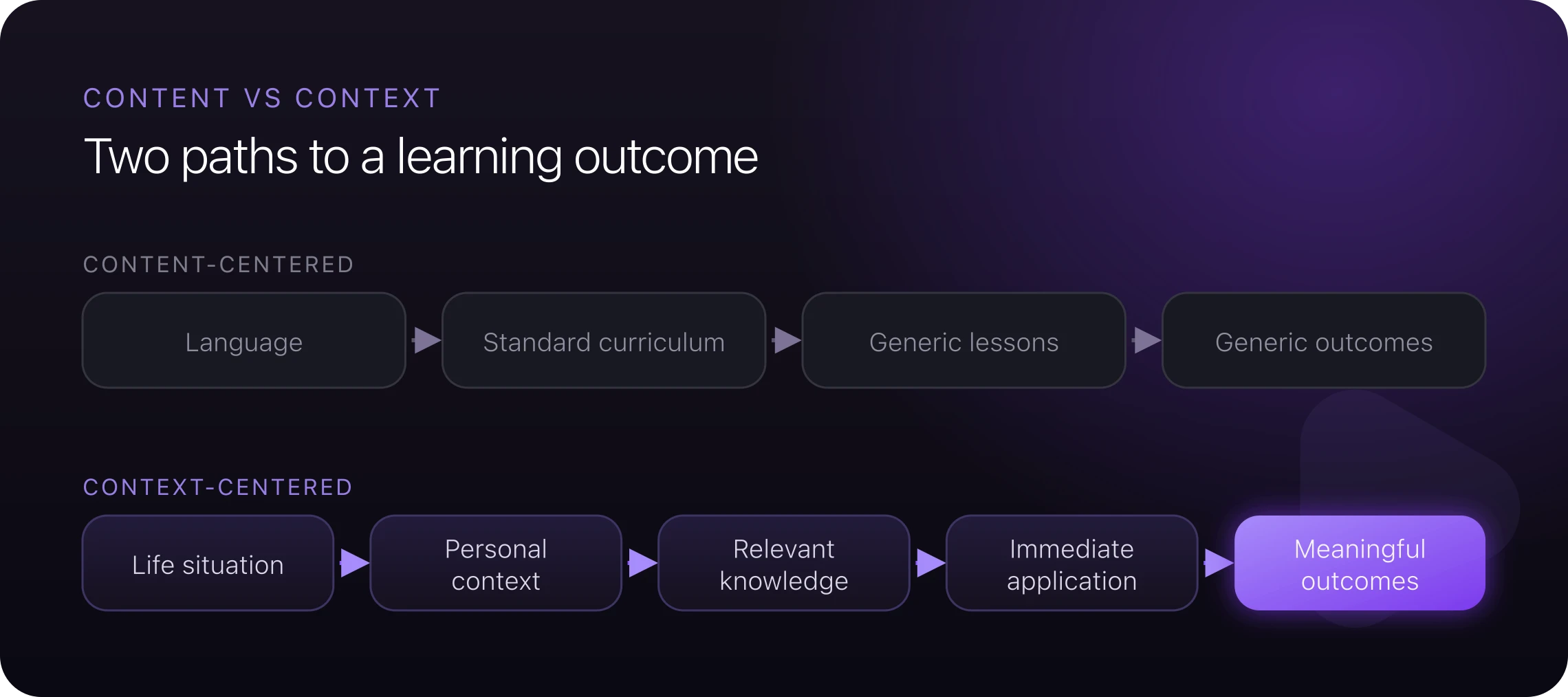
The second model creates stronger motivation, greater relevance, and faster learning.
The hidden driver of motivation
Many educational systems focus heavily on motivation. They introduce badges, points, streaks, rewards, and gamification. These mechanisms can be helpful, but they often treat motivation as something external.
Context creates motivation naturally. The young father does not need a badge to study. He does not need a leaderboard or a reward system. The reason he is learning is already emotionally meaningful — the learning experience is directly connected to something he deeply cares about.
This is one of the most important lessons for the future of education. People rarely struggle to learn things that clearly improve their lives. They struggle to learn things that feel disconnected from their reality.
The AI advantage
Before AI, contextual learning was difficult to scale. Teachers could personalize learning for a limited number of students, and organizations could create a few different learning tracks, but mass personalization was largely impossible.
Artificial intelligence changes this equation. AI systems can now understand who the learner is, what they already know, what goals they have, what challenges they face, what projects they are working on, and what stage of life they are currently experiencing. This allows learning to adapt dynamically to context.
Instead of asking "What course should we create?", organizations can begin asking "What problem is this person trying to solve?" This represents a fundamental shift in educational design.
Why context improves learning outcomes
Context improves learning in multiple ways.
Increased relevance
People pay greater attention to information that directly affects their lives.
Higher retention
Information connected to meaningful experiences is easier to remember.
Stronger motivation
When learners understand why something matters, engagement increases naturally.
Faster application
Knowledge can be used immediately in real situations.
Better long-term outcomes
Learning becomes integrated into everyday behavior rather than remaining isolated inside educational environments.
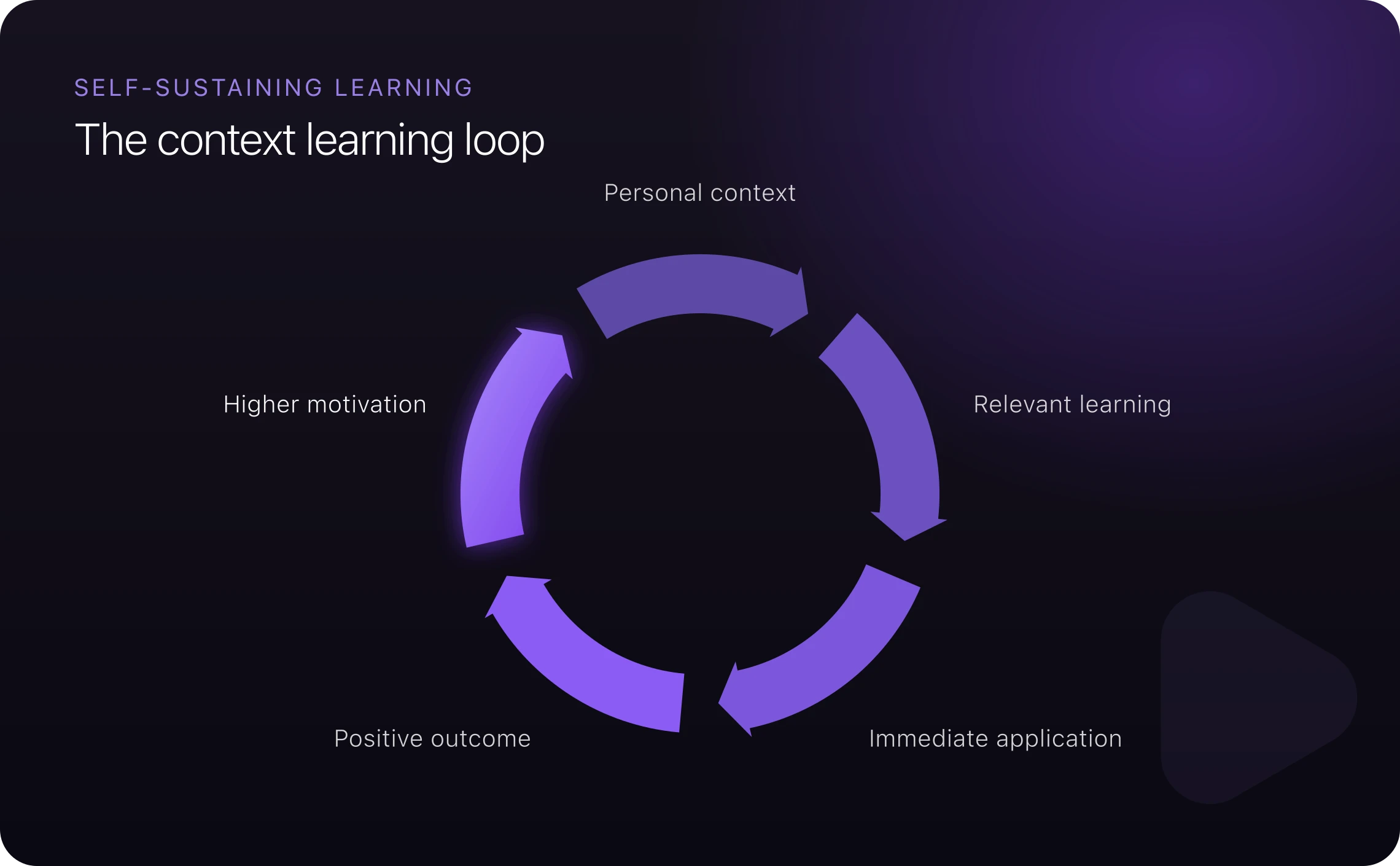
Relevance compounds — each positive outcome raises motivation and feeds the next cycle.
The more relevant learning becomes, the more self-sustaining the process becomes.
From content to capability
The example of the future father learning his partner's language reveals a broader truth. People rarely pursue knowledge for its own sake. They pursue knowledge because they want to achieve something.
Traditional learning systems focus on content. Future learning systems will focus on capability. The question is no longer "What should this person learn?" It is "What is this person trying to accomplish?" The answer determines everything that follows.
Implications for education
Schools, universities, and training providers increasingly operate in a world where information is abundant. Their competitive advantage will no longer come from access to content. It will come from their ability to deliver learning experiences that are relevant to the learner's context. The future belongs to systems that understand not only what learners need to know, but why they need to know it.
Implications for organizations
The same principle applies in the workplace. Employees do not learn best when they receive generic training. They learn best when learning is connected directly to their role, their goals, their projects, their challenges, and their responsibilities. Context transforms training from an obligation into a tool for performance improvement.
Conclusion
The future of learning will not be defined by the amount of content available. Artificial intelligence has already made information abundant. The next frontier is relevance.
The story of a future father learning his partner's language demonstrates a simple but powerful principle: people do not learn because content exists. They learn because something in their life makes that knowledge meaningful.
Context gives learning purpose. Purpose creates motivation. Motivation creates action. And action creates capability. In the age of AI, content is everywhere — context is what makes learning matter.