Why the Future of Learning Depends Less on Motivation and More on Habit
Motivation helps people start learning; habits help them continue. Inside Kampster's Micro-Habit Learning Framework and the behavioral science behind it.


A Kampster white paper on the Micro-Habit Learning Framework — why organizations’ learning results depend more on habit design than motivation.
Executive summary
For decades, the organizations that train people — corporate L&D teams, education systems, and online course providers — have operated under a common assumption: if people are motivated enough, they will learn. The reality tells a different story.
Every year, millions of learners enroll in courses, buy books, download learning applications, and commit to personal development goals. Yet a large percentage never complete what they started. The problem is rarely access to knowledge — it is sustaining learning behavior over time.
Research from behavioral science, psychology, and cognitive science increasingly suggests that long-term learning success depends less on motivation and more on habit formation. Motivation helps people start. Habits help people continue.
This insight forms the foundation of Kampster's Micro-Habit Learning Framework. Instead of asking "How do we make people spend more time learning today?", Kampster asks "How do we help people build learning behaviors that persist for months and years?" The answer lies in transforming learning from an occasional activity into a daily habit through small, consistent, personalized actions.
The learning motivation gap
Traditional learning systems depend heavily on motivation. A learner feels inspired, takes an initial action, and then — as motivation inevitably fades — learning stops. The micro-habit model breaks this pattern.
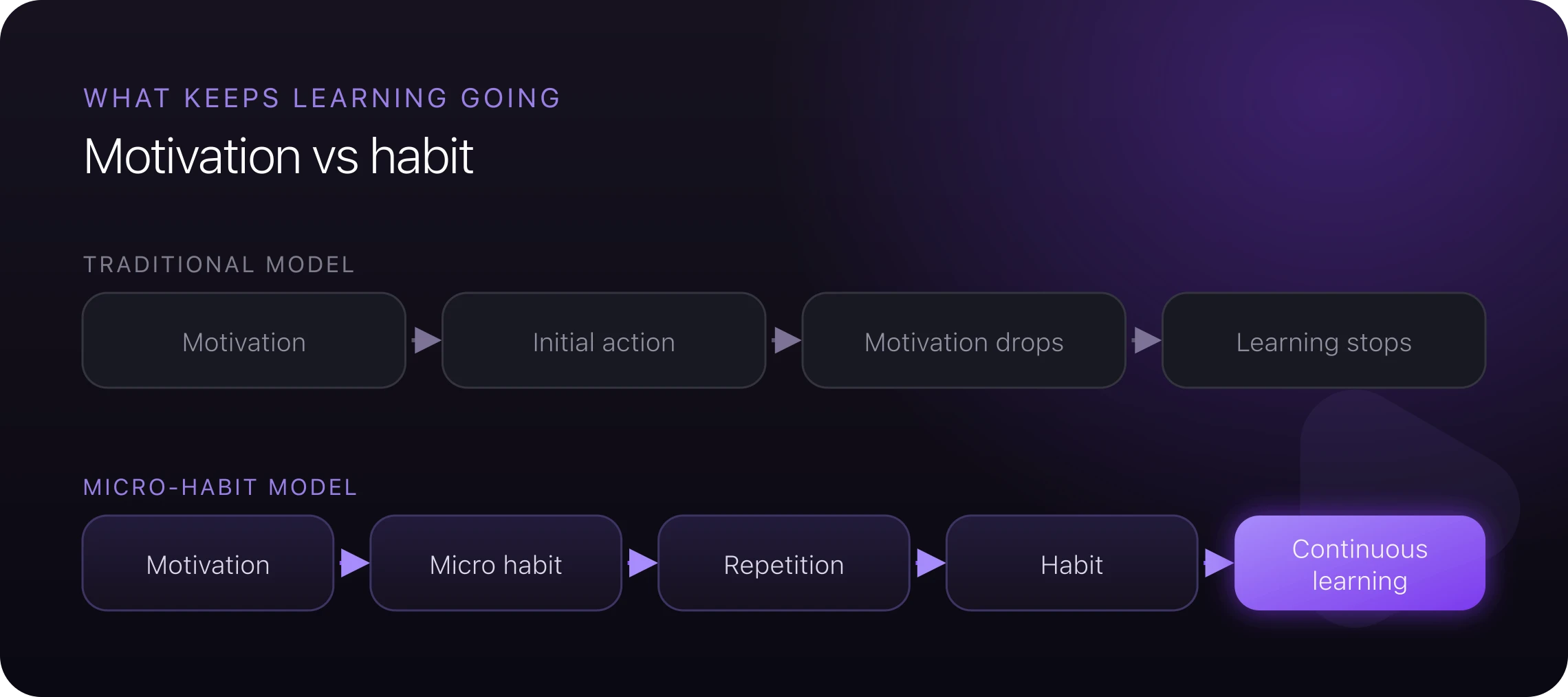
Motivation helps people start. Habits help people continue — long after the initial spark fades.
The key difference is simple: traditional systems rely on motivation, while Kampster relies on habit formation.
The learning motivation problem
Modern learners have unprecedented access to information. They can reach online courses, educational videos, AI tutors, digital libraries, knowledge platforms, and professional certifications. Yet learning outcomes often remain disappointing.
The issue is not information scarcity. It is behavioral consistency. Many learning systems are designed around moments of high motivation: a learner feels inspired, enrolls in a course, completes the first modules, and then gradually disengages.
Motivation fluctuates. People become busy, experience stress, and watch their priorities change. When learning depends entirely on motivation, participation becomes inconsistent. The challenge facing modern education is therefore not simply how to teach people — it is how to help people continue learning after motivation fades.
What science says about habits
Behavioral research suggests that habits are among the strongest predictors of long-term behavior. According to habit researcher Wendy Wood, habits form through repeated behaviors performed in consistent contexts until they become increasingly automatic. Over time, habits reduce the need for conscious decision-making and help sustain behavior even when motivation is low.
This finding has profound implications for learning. If studying remains a decision that must be consciously made every day, it competes with every other demand on a person's attention. If learning becomes habitual, the cognitive effort required to start decreases dramatically.
Traditional learning vs micro-habit learning
| Traditional learning | Micro-habit learning |
|---|---|
| 1-hour course | 3-minute learning action |
| Weekly learning | Daily learning |
| High effort | Low effort |
| Motivation dependent | Habit dependent |
| Often abandoned | Easier to sustain |
| Focus on completion | Focus on consistency |
The objective is not intensity. The objective is repetition. The habit formation curve rewards the same behavior over time: consistency rises steadily with repeated practice until the behavior becomes automatic. The strongest learning behavior is not studying hard once — it is studying consistently for a long time.
The Kampster hypothesis
Kampster was built around a simple hypothesis: learning should be designed as a habit-building process rather than a content-consumption process.
Traditional educational systems often focus on course completion, content delivery, and knowledge assessment. The Kampster framework focuses instead on behavioral consistency, learning routines, gradual skill development, and long-term knowledge retention. The goal is not to maximize the duration of a single learning session — it is to maximize the number of meaningful learning interactions over time.
What are micro-habits?
Micro-habits are intentionally small learning actions that require minimal effort but can be repeated consistently. Examples include:
- answering one question
- completing a one-minute quiz
- reviewing one concept
- spending three minutes with an AI tutor
- reflecting on a single learning insight
- revisiting a previously learned topic
The objective is not intensity — it is consistency. Each individual action may appear insignificant, yet the cumulative effect can be transformational. Each completed micro-learning action increases the probability of future learning, and over time learning becomes self-reinforcing: Learn → Habit → Repeat → Progress.
Why micro-habits work
Small behaviors are easier to repeat
Large learning commitments create friction. Small commitments reduce it. When the barrier to action is low, consistency becomes more achievable.
Habits reduce dependence on motivation
Most learners do not fail because they lack goals. They fail because they cannot consistently act on those goals. Micro-habits create a bridge between intention and action.
Repetition strengthens learning
Learning science demonstrates that repeated exposure to information over time improves retention more effectively than concentrated learning sessions. Micro-habits naturally support spaced learning because they encourage regular engagement rather than occasional intensive study.
Learning behaviors become self-reinforcing
Successful learners do not simply possess more knowledge. They often possess stronger learning habits.
Why people stop learning
Most learners abandon learning for a predictable set of reasons. In order of impact, the most common are motivation loss, lack of time, overwhelming content, no clear structure, and no feedback. Most learning systems attempt to solve these problems with more content. Kampster addresses them through behavioral design.
The Kampster micro-habit cycle
Traditional learning follows a single direction: Motivation → Learning. Kampster reverses and closes the loop: Learning → Habit → Motivation.
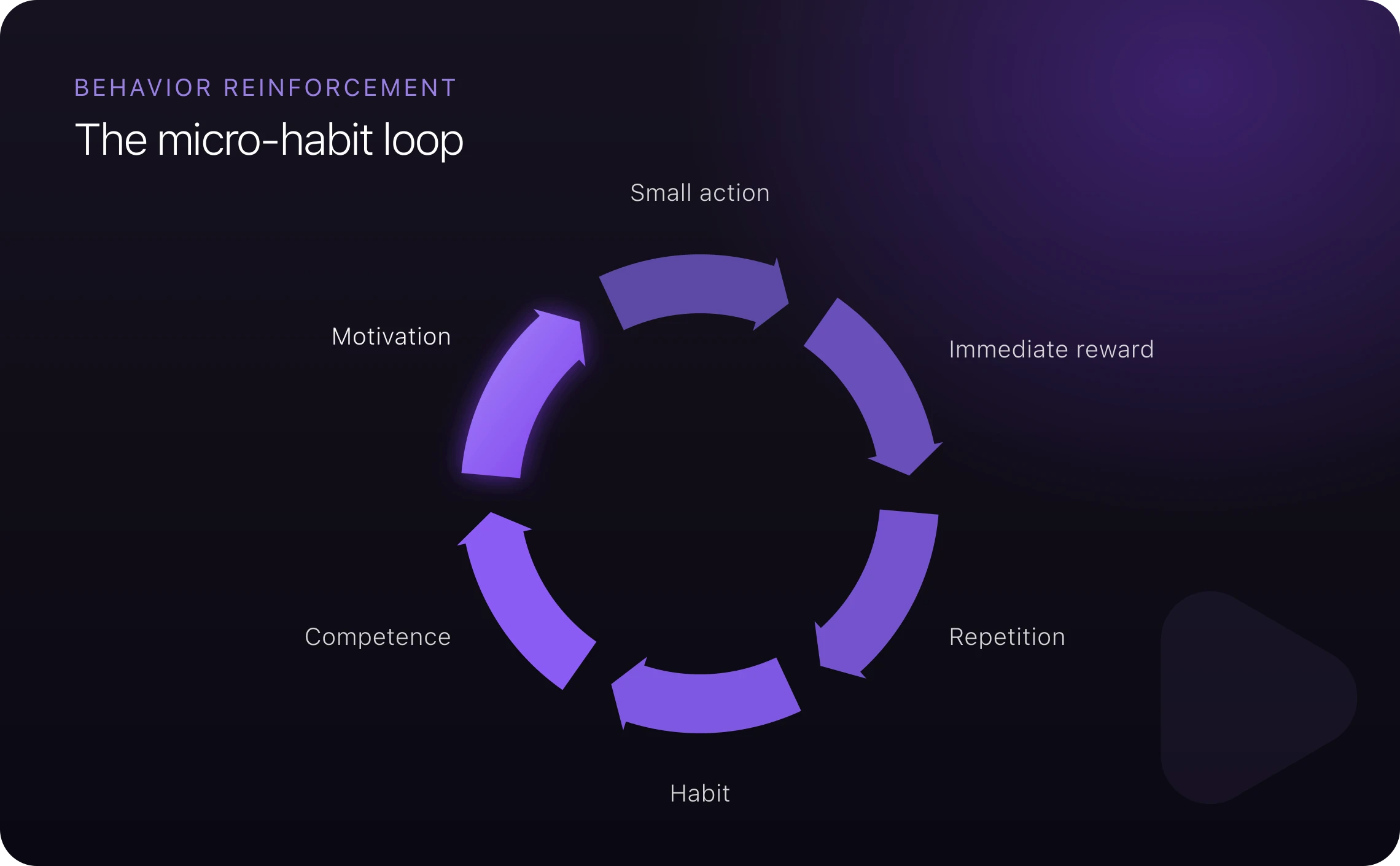
A self-reinforcing cycle — reward drives repetition, repetition builds competence, competence renews motivation.
This is a fundamentally different approach to sustaining learning.
The learning science behind micro-habits
The Kampster framework is built on decades of scientific research, drawing together three foundational pillars: habit formation (Wood, 2016), spaced repetition (Ebbinghaus, 1885), and desirable difficulties (Bjork, 2011). In practice it combines habit formation, spaced repetition, retrieval practice, behavioral psychology, and cognitive science.
Beyond motivation: toward AI-supported learning habits
Artificial intelligence creates a unique opportunity to personalize habit formation. AI can identify learning patterns, consistency gaps, preferred learning times, strengths, weaknesses, and behavioral trends. This allows learning systems to adapt not only to what learners know, but also to how they learn.
The future of AI in education is not simply generating content. The future of AI is supporting sustainable learning behavior.
From behavior to capability
Knowledge alone does not create capability — repeated behavior does. Capability is built from the bottom up: Behavior → Habit → Knowledge → Skill → Capability. The ultimate vision of Kampster is not a platform for courses but a system that supports continuous personal development through small, sustainable learning actions, growing from daily micro-habits toward long-term skills and life goals.
Implications for organizations
Organizations invest billions annually in training and development. Yet many struggle with the same challenge: employees complete training programs but fail to sustain learning afterward.
Micro-habit learning offers an alternative model. Instead of concentrating learning into occasional training events, organizations can support continuous capability development through small, repeated learning actions integrated into everyday workflows.
Implications for education
Schools, universities, and lifelong learning providers face similar challenges. The question is no longer "How do we provide access to knowledge?" It is "How do we help learners develop the behaviors necessary for continuous learning?"
Micro-habits provide one possible answer. By making learning smaller, more accessible, and more repeatable, educational systems can increase consistency and improve long-term outcomes.
Conclusion
The future of learning will not be determined by who has the most content. It will be determined by who best understands human behavior.
Motivation remains important — it helps people begin. But sustainable learning depends on something deeper: habits. The Kampster Micro-Habit Learning Framework is built on a simple belief: small actions, repeated consistently, create meaningful transformation.
By helping learners develop sustainable learning habits rather than relying solely on temporary motivation, educational systems can move beyond content delivery and begin supporting lifelong capability development. In an age of unlimited information, the most valuable learning platforms will not be those that teach the most. They will be those that help people keep learning.