What Happens When Everyone Has an AI Tutor?
When everyone can access an AI tutor, knowledge stops being the advantage. The future of learning belongs to those who turn knowledge into capability.


When every employee has an AI tutor, access stops being the advantage — turning knowledge into capability does. What that means for organizations.
Executive summary
For most of human history, access to knowledge was limited. Books were scarce, experts were difficult to reach, and education was constrained by geography, institutions, and resources. Artificial intelligence has fundamentally changed that reality. Today, anyone with an internet connection can access an AI tutor capable of explaining concepts, answering questions, generating examples, and providing guidance on almost any topic imaginable.
This is one of the most significant educational breakthroughs in history. Yet it raises an important question: what happens when everyone has an AI tutor?
The answer may be surprising. Learning will not become the competitive advantage. Capability will. The organizations, institutions, and individuals that succeed in the next decade will not be those with the best access to knowledge — they will be those who are most effective at transforming knowledge into measurable skills, capabilities, and outcomes.
This paper explores why the future of learning extends beyond AI tutors, and why the next frontier is capability development.
The democratization of knowledge
For decades, access to expertise represented a competitive advantage. Organizations invested heavily in training because knowledge was difficult to obtain, and employees attended courses because information was difficult to access elsewhere.
Today, AI has dramatically reduced that barrier. Within seconds, individuals can receive explanations, examples, summaries, recommendations, and guidance from powerful AI systems. The cost of accessing knowledge is approaching zero.
The evolution is stark: Books → Internet → Search engines → AI tutors. The result is unprecedented access to information. But access alone does not create capability.
The new learning paradox
As AI tutors become universal, a paradox begins to emerge. Knowledge becomes easier to access, yet capability remains difficult to develop. Employees can instantly obtain answers, yet many still struggle to apply them. Students can generate explanations, yet they often fail to transfer learning into real-world situations. Organizations can deploy AI tools, yet adoption frequently remains low.
The reason is simple: knowing is not the same as being capable.
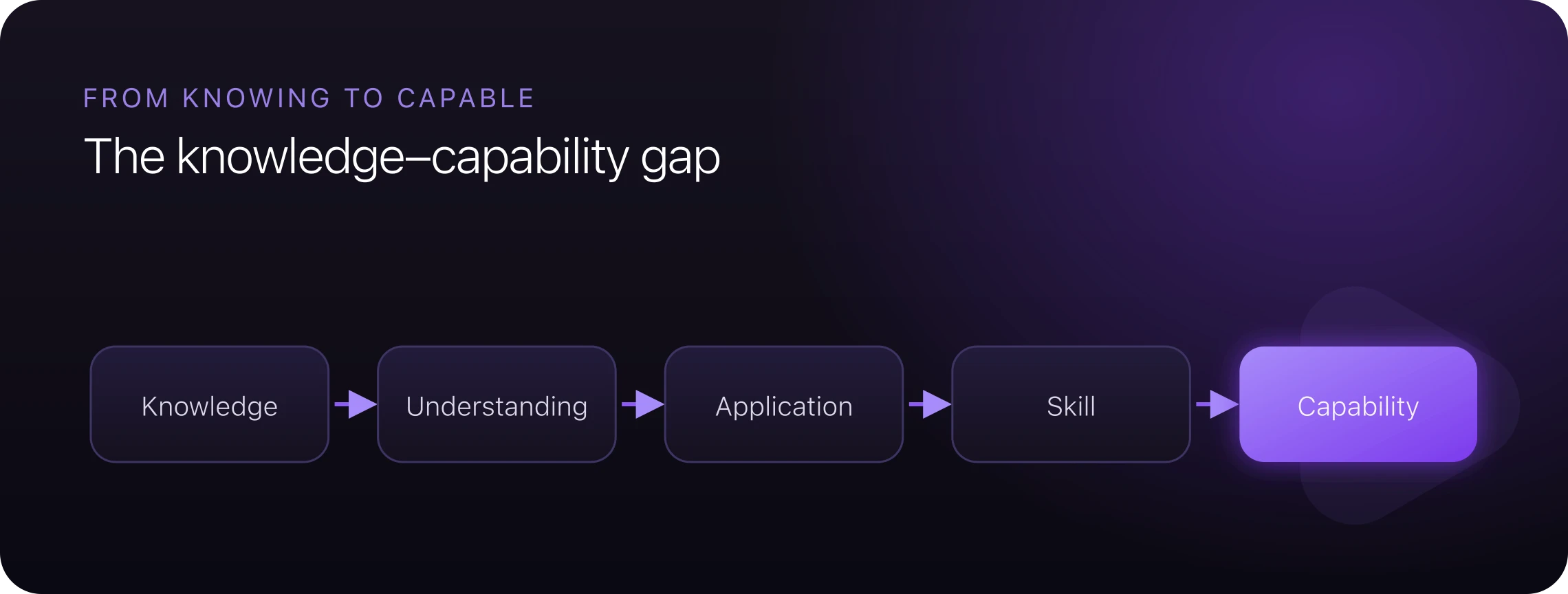
Most AI tutors stop at the first stage. Value is created further down the chain — where knowledge becomes measurable capability.
Most AI tutors operate primarily at the knowledge layer. The challenge organizations face exists further down the chain.
The coming commoditization of AI tutors
Today, AI tutors feel revolutionary. Within a few years, they will become expected. Every major technology company is building AI assistants, every learning platform is integrating AI, and every productivity suite includes conversational support. The market is rapidly moving toward a future where AI tutors become standard infrastructure.
The trajectory is clear. Today, few AI tutors exist, so each one is a competitive advantage. In the near future, AI tutors will be everywhere — and a commodity. When everyone has access to an AI tutor, the tutor itself no longer becomes the differentiator. The differentiator shifts elsewhere.
The wrong question
Most educational technology companies ask: how can we build a better AI tutor? The more important question is: how can we help people become more capable?
This distinction changes everything. An AI tutor answers questions; a capability system develops people. An AI tutor explains concepts; a capability system changes behavior. An AI tutor provides information; a capability system creates outcomes.
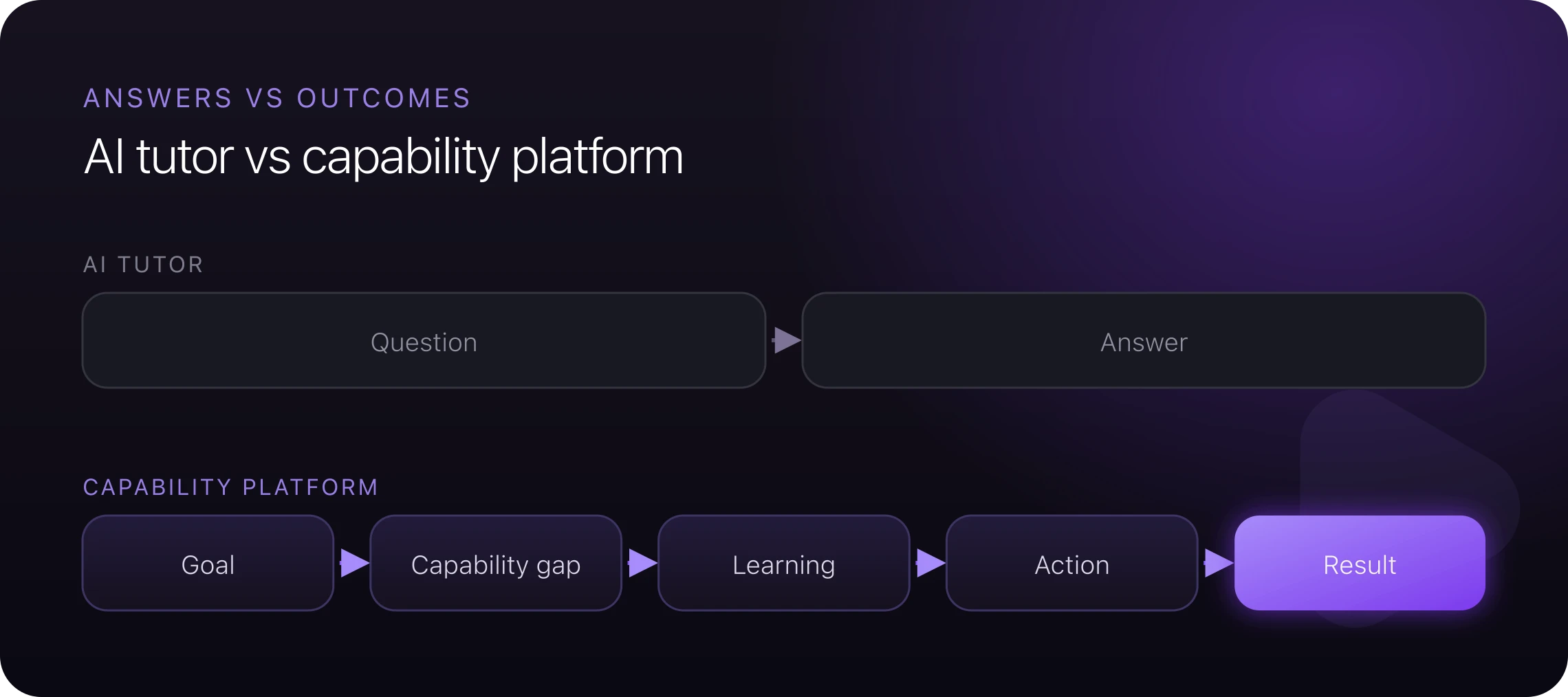
A tutor answers questions. A capability system develops people — and creates outcomes.
The second model reflects how real development occurs.
Why context becomes more important than content
As AI generates unlimited content, content itself loses value. Context becomes the new differentiator.
Consider two individuals learning English. One is preparing for an international business role. The other wants to communicate with a partner from another country before the birth of their child. The language is identical, but the context is completely different — and so are the examples that matter, the priorities, the learning journey, and the desired outcome.
This illustrates a broader truth. Future learning systems will not be defined by what people learn. They will be defined by why they need to learn it.
The chain is direct: Content → Context → Relevance → Motivation → Capability. The future belongs to systems that understand context.
Why learning is no longer the goal
Organizations do not invest in learning because they want employees to consume content. They invest because they want employees to perform better, adapt faster, solve problems, use new technologies, and improve results.
Learning is not the destination. Capability is. This becomes especially important in the age of AI: the ability to access information is becoming universal, while the ability to apply information remains rare.
The emergence of capability systems
The next generation of learning technology will move beyond tutoring. These systems will help individuals:
- identify capability gaps
- verify skills
- build habits
- receive personalized guidance
- track progress
- achieve specific goals
Rather than asking "What would you like to learn?", they will ask "What would you like to achieve?" This is a fundamentally different philosophy.
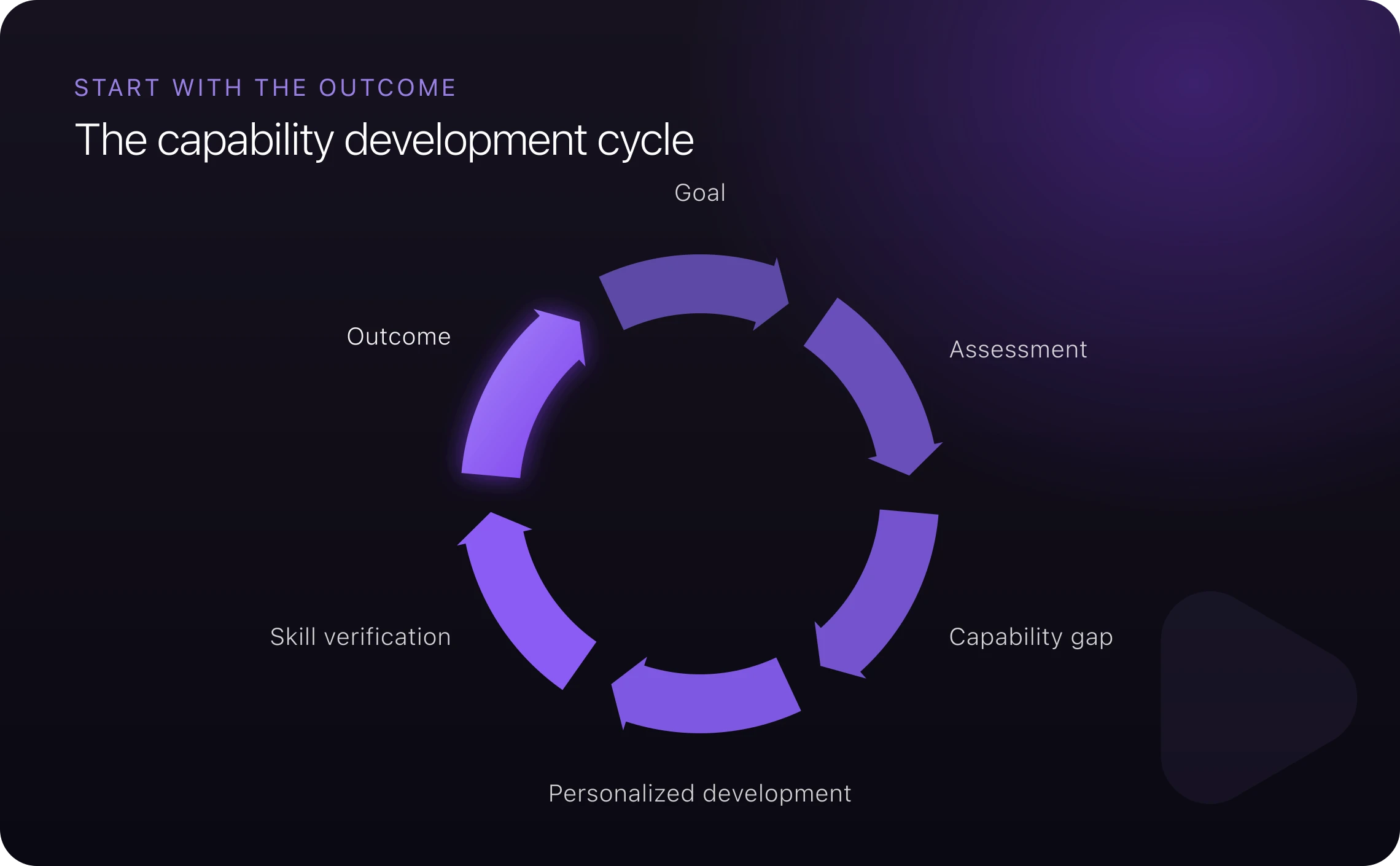
Every cycle starts from a goal and ends in a verified outcome — then the next goal begins.
Learning becomes part of a larger development process.
The Kampster perspective
At Kampster, we believe the future of learning lies beyond AI tutoring. AI tutors represent an important step forward, but they solve only one part of the problem. The larger challenge is helping individuals transform knowledge into capability.
This requires more than answers. It requires context, assessment, skill intelligence, personalized learning, capability verification, habit formation, and continuous development. This is why Kampster's vision extends beyond AI tutoring toward AI-powered capability development.
From AI tutor to AI capability coach
The next evolution of educational AI is already beginning: AI chatbot → AI tutor → learning companion → capability coach → life development partner. The most valuable systems of the future will not simply answer questions. They will help people become more capable over time.
Conclusion
The question facing education is no longer "How do we provide access to knowledge?" Artificial intelligence has already solved that problem. The question now becomes: how do we help people transform knowledge into capability?
As AI tutors become universal, competitive advantage will shift away from information access and toward capability development. The organizations that succeed will not be those with the smartest chatbot. They will be those that most effectively help people learn, apply, adapt, and grow.
Because in a world where everyone has an AI tutor, knowledge becomes abundant. Capability remains rare. And rarity is where value is created.