The Human Side of AI Transformation
Most AI projects fail before they start — not because the technology fails, but because people aren't ready. Why human readiness decides AI transformation.


Why most AI projects fail before they start.
Executive Summary
Artificial Intelligence has become the defining business priority of the decade. Organizations across every industry are investing billions into AI tools, automation platforms, copilots, intelligent assistants, predictive systems, and generative AI technologies. Boardrooms are discussing AI strategy. Technology teams are implementing AI solutions. Consultants are designing AI roadmaps.
Yet despite unprecedented investment, a growing number of organizations are discovering a difficult reality: technology is not the biggest obstacle to AI transformation. People are.
The majority of AI initiatives do not fail because the technology does not work. They fail because organizations underestimate the human side of transformation. Employees do not understand the technology. Managers struggle to adapt workflows. Teams resist change. Skills are missing. Confidence is low. Adoption stalls. The result is a growing gap between AI investment and AI impact.
This paper explores why workforce capability has become the most important factor in successful AI transformation, and why organizations must shift their focus from technology readiness to human readiness.
The Great AI Misconception
When organizations begin AI transformation initiatives, the conversation typically focuses on technology. Questions often include which AI platform to choose, which tools to implement, which vendor to work with, and what infrastructure is needed.
These are important questions. But they are rarely the most important questions. The more critical questions are often ignored: Are our people ready? Do employees understand how to use AI? Which skills are missing? What behaviors need to change? How will work actually be transformed?
The traditional AI transformation model assumes Technology → Implementation → Expected impact — as if technology automatically creates value. In reality, something important is missing.
The Missing Layer
Technology alone does not transform organizations. People do. Every AI initiative ultimately depends on human behavior. Employees must understand new tools, trust new systems, develop new skills, change existing workflows, adopt new habits, and make better decisions. Without these changes, technology remains underutilized.
The real model runs Technology → People → Adoption → Capability → Business impact. The missing layer is human capability — and it is often the least visible part of the transformation process.
Why AI Projects Struggle
Organizations frequently assume that providing employees with access to AI tools will automatically generate value. Experience suggests otherwise. Many organizations encounter the same challenges:
- Low adoption: employees continue using old methods despite access to new tools.
- Limited understanding: teams know AI exists but do not understand how to apply it effectively.
- Fear and resistance: employees worry about job security, performance expectations, and changing responsibilities.
- Skill gaps: workers lack the practical competencies required to integrate AI into daily work.
- Leadership misalignment: managers promote AI initiatives without fully understanding how work needs to evolve.
The problem is rarely technical. The problem is behavioral.
The Readiness Gap
One of the most significant risks facing organizations today is the gap between AI availability and AI readiness.
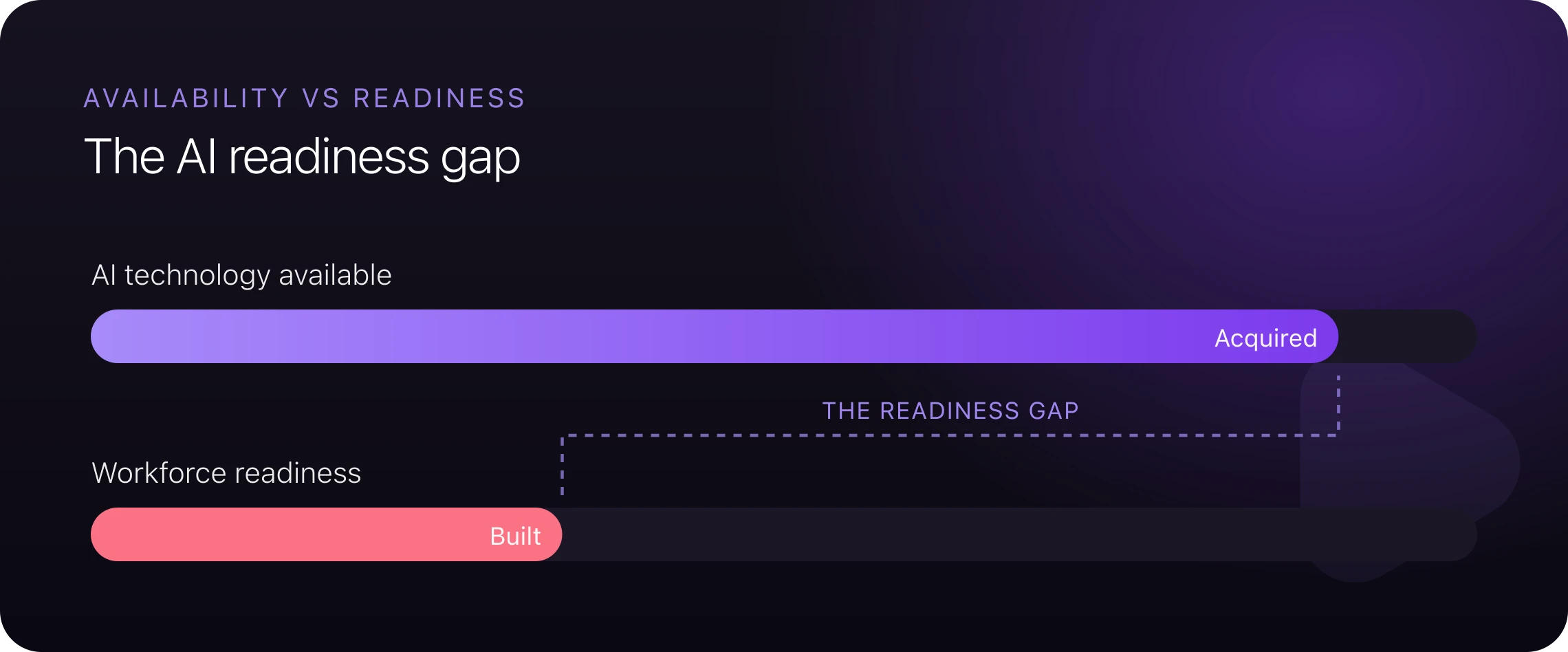
Most organizations already own the tools. Far fewer have built the capability to use them — and the gap is where AI adoption stalls.
Many organizations have already acquired the technology. Far fewer have developed the workforce capabilities required to use it effectively. This creates what can be described as an AI Readiness Gap.
The Four Stages of AI Adoption
Successful AI transformation is not a technology project. It is a capability journey.
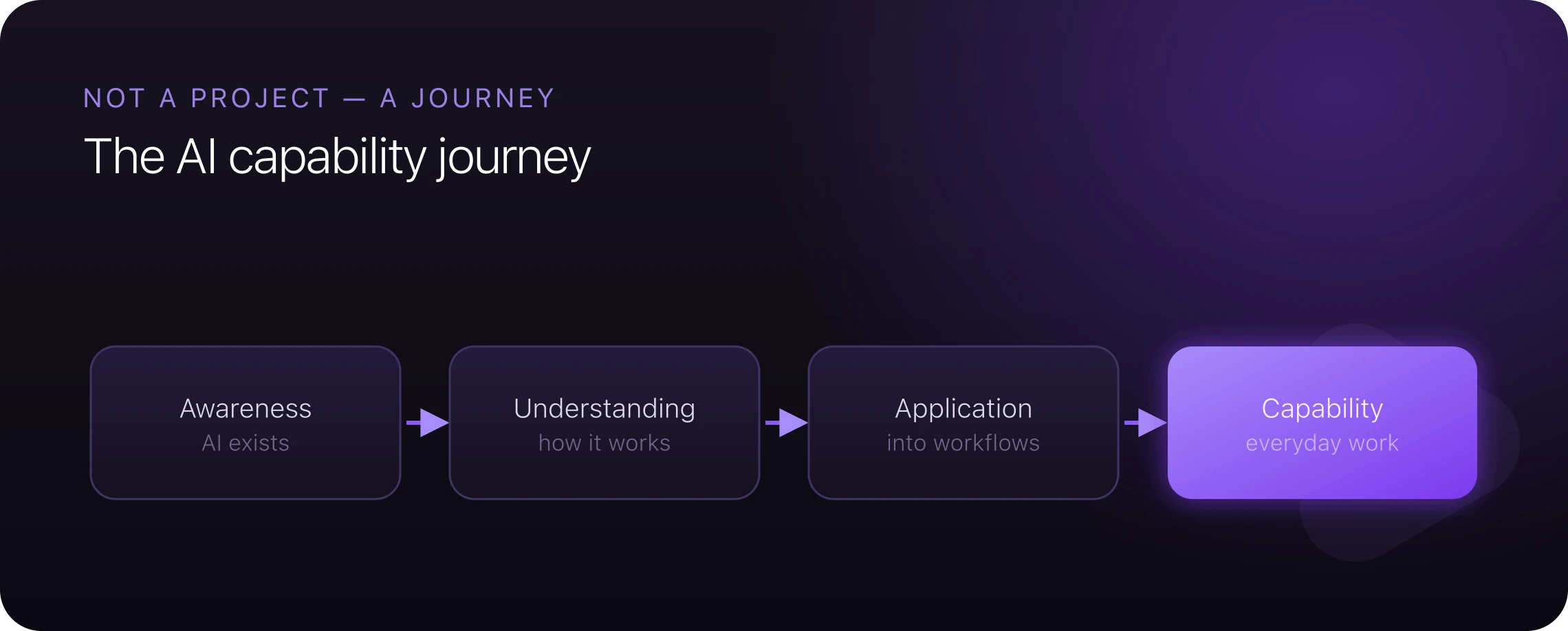
Many organizations stop at awareness. Very few reach capability — yet only capability changes how work is done.
Many organizations stop at awareness. Very few successfully reach capability.
Why Skills Matter More Than Tools
A common mistake in AI transformation is focusing on tool deployment rather than capability development. Organizations often measure licenses distributed, software activated, and platforms installed. These metrics reveal little about actual value creation. The more important question is: can people use AI effectively?
Tools create potential; capability creates outcomes. An AI tool, on its own, only produces potential — it is capability that turns potential into impact.
The Rise of AI Readiness
Just as organizations once measured digital readiness, they must now measure AI readiness. AI readiness extends beyond technical knowledge. It includes understanding, confidence, critical thinking, decision-making, practical application, and adaptability.
Organizations increasingly need visibility into questions such as which teams are AI-ready, which departments require support, what skills are missing, and where the biggest capability risks are. Without these insights, transformation efforts become difficult to prioritize.
From Learning to Capability
Traditional training approaches often struggle because they focus on knowledge transfer. AI transformation requires something different. Employees do not simply need information. They need capability.
The progression runs Knowledge → Understanding → Practice → Capability → Performance. This is where many transformation initiatives break down: knowledge is delivered, but capability never develops.
The Human Side of Change
Technology changes systems. Capability changes behavior. Behavior changes organizations. This is why successful AI transformation ultimately becomes a human challenge.
Employees need guidance, confidence, context, support, and continuous development. Organizations that ignore these factors often discover that technology adoption slows dramatically after the initial launch. The challenge is not implementation. The challenge is sustained adoption.
The Kampster Perspective
At Kampster, we believe the future of AI transformation depends on workforce capability. Organizations do not fail because AI is unavailable. They fail because people are unprepared.
This is why successful AI transformation requires more than technology deployment. It requires AI readiness assessment, skill intelligence, capability mapping, personalized development, contextual learning, and continuous capability growth. The goal is not simply to introduce AI. The goal is to help people work successfully with AI.
The Future of AI Transformation
The first wave of AI adoption focused on technology. The next wave will focus on people. Organizations that succeed will recognize that AI transformation is not primarily a software initiative. It is a workforce transformation initiative.
The evolution runs Technology transformation → Process transformation → Workforce transformation → Capability transformation. The most successful organizations will not necessarily be those with the best AI tools. They will be those with the most capable people.
Conclusion
The greatest challenge of AI transformation is not technology. It is capability. Organizations around the world are investing heavily in AI infrastructure, platforms, and solutions. Yet technology alone cannot create transformation. Only people can.
The organizations that succeed will be those that understand a simple truth: AI readiness is ultimately human readiness. Because in the age of AI, competitive advantage will not belong to the organizations with the most powerful tools. It will belong to the organizations that best prepare their people to use them.